
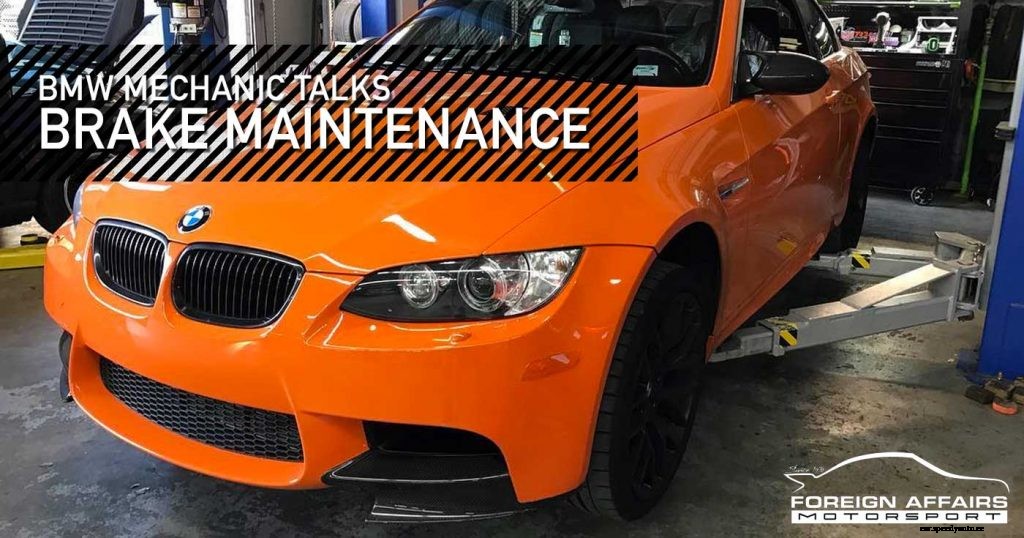
At Foreign Affairs Motorsport, we understand that your vehicle means more to you than simply a means of transport. Your vehicle assists you on your life journey and provides a safe space for your family when traveling between locations. With this in mind, what happens when your vehicle needs to have its engine serviced and undergo break maintenance? Our BMW mechanics share valuable insight on BMW brake maintenance in order to keep your vehicle operating at its optimum.
The lifespan of brake pads can be difficult to pinpoint as there are several factors that play a role on wear-and-tear. Although quality cars, such as BMW, are designed with performance in mind, there are factors that can greatly influence the lifespan of the brakes.
It is important to understand that not all brake pads are made the same. Some are made out of steel (or another metal) and others are made from carbon-ceramic material (these are more often used in high-end cars). The compound that makes up the brake pad will be suited for the driving requirements. For example, softer pads are designed to be used in urban environments where the driving speeds are lower.
Slowing down and minding your cargo are two key driving habits that can improve the longevity of your brakes. Speeding has a dramatically negative effect on burning brake pads by aggressively hitting the brakes to slow down. In the same way that fast driving applies pressure on the brakes, so does heavier cargo which demands more brake power for slowing and stopping.
You may be the best driver in the world, but if you drive in an environment that requires regular braking then your brakes will take more strain. Examples of such areas that place more pressure on the brakes of a car are cities with a lot of traffic, or hills with steep gradients.
One of the most common mistakes that drivers make is allowing their brake fluid level to get too low, or for the fluid to get dirty. This eventually affects the brakes negatively. As a guideline, brake fluid should be flushed every 25,000 miles.
As a guideline, brake pads should be replaced after approximately 50,000 miles of normal driving. However, the above factors could change this requirement to replacing brake pads after as few as 25,000 miles. Here are a few obvious signs that you should get your brakes inspected:
If you experience any of the above signs that your brakes need maintenance, do not delay in getting your BMW to your nearest BMW technician for an inspection.
Regular maintenance and check-ups are a certain way to catch any BMW brake issues early, before they become a problem. At Foreign Affairs Motorsport, we pride ourselves in offering expert maintenance and service for your performance car and their brakes – whether regular maintenance, new brake pads or general repairs, we offer our trust and professional service.
