
🛠️ About to spend $25–$900 on a scanner? Our $7 Buyer's Shortcut breaks down 18 scanners across 3 budget tiers, names the ones to avoid (FIXD subscription trap, fake bidirectional claims, ELM327 clones), and settles 3 of the biggest head-to-heads. No affiliate fluff. Get the Shortcut ($7) →
Disclosure: Some links in this article are affiliate links. This does not affect our review process or product rankings.
Don't waste money on the wrong tool. See which scanner features you actually need for your specific car.
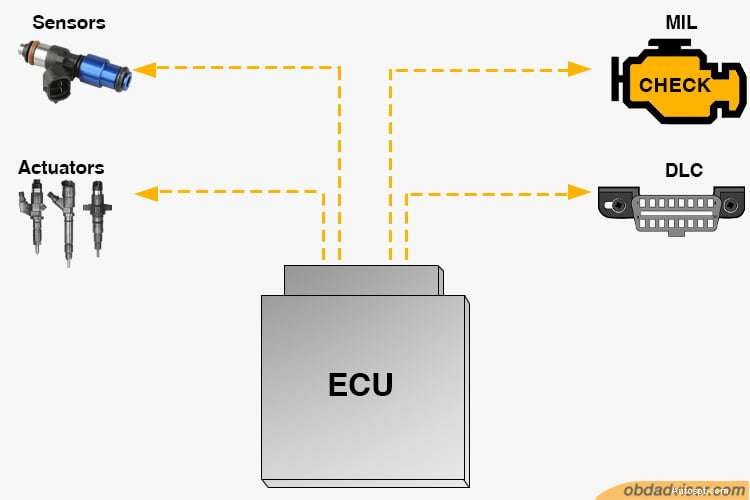
OBD2 is the standardized diagnostic system in every car and truck sold in the U.S. since 1996. It monitors your engine and emissions in real time, turns on the check engine light when something goes wrong, and lets you plug in a scan tool to find out exactly what the problem is. This guide explains how OBD2 works, what it can and can’t tell you about your car, and how to use it to save money on repairs.
OBD2 stands for On-Board Diagnostics, second generation. Your car has a small computer called the Powertrain Control Module (PCM) that controls the engine and transmission. When the transmission has its own separate controller — which is common on newer models — the engine computer is called the ECM (Engine Control Module) instead.
The PCM receives data from dozens of sensors — oxygen sensors, mass airflow sensors, coolant temperature sensors, knock sensors, and more — and uses that data to control fuel injection, ignition timing, and emissions equipment in real time.
When a sensor reading falls outside its expected range, the PCM does three things: (1) stores a Diagnostic Trouble Code (DTC) that identifies the problem area, (2) records a freeze frame — a snapshot of all sensor readings at the moment the fault was detected, and (3) turns on the check engine light (also called the Malfunction Indicator Lamp, or MIL) on your dashboard.
To find out why the light is on, you plug an OBD2 scan tool into the 16-pin OBD2 port under your dashboard. The scan tool reads the stored code, and you use that code to diagnose the problem. That’s the entire concept: sensors detect problems, the PCM logs codes, the scan tool reads codes, you fix the car.
⚙ Expert Insight — Richard McCuistian, ASE Master Technician:
“But only if you know how to interpret the cause-and-effect relationship between the code and what triggered it. For example, a P0171 code doesn’t always mean the O2 sensor should be replaced — a vacuum leak, unmetered air, the wrong PCV valve, or even a missing oil filler cap gasket can throw that same code. I’ve seen plenty of money wasted on parts that weren’t needed.”
Engine electronics first appeared in the U.S. on 1968 Volkswagen Type 3 models with Bosch fuel injection. Through the late 1970s, other manufacturers adopted computerized engine controls — think Chrysler’s Electronic Lean Burn system with the computer hanging on the side of the air cleaner. But these early systems had no way of diagnosing themselves.
Around 1980, engine controllers were programmed with the ability to flag trouble codes. On Chrysler, Dodge, and Plymouth platforms, you could cycle the key on three times and get a diagnostic trouble code — but there were usually fewer than 20 codes in the entire library. GM introduced the Assembly Line Diagnostic Link (ALDL) and began offering live data streams in the early 1980s, while Ford and Chrysler remained code-only until the late 1980s.
Foreign cars had their own methods. On some, you’d pop a rubber plug out of the side of the engine controller (usually under the seat), turn a screw to close a circuit, and an LED in a different hole would flash out codes using long and short pulses — but these codes weren’t terribly reliable.
⚙ Expert Insight — Richard McCuistian:
“In the old days, before live data was available, I would measure all the sensor voltages on older vehicle engine control systems with a voltmeter. Measuring voltages on good vehicles gave me a benchmark for what healthy readings should look like — that way, simply checking sensor voltages on a problem car would often lead to a fix, particularly if the sensor had an in-range failure that wouldn’t set a code.”
European and Japanese automakers were even later to live data. They treated diagnostic data as intellectual property, accessible only to dealer tools. Systems like Bosch K-Jetronic, Denso EFI, and Mitsubishi MUT used closed protocols. Independent garages couldn’t legally or technically access live data streams.
The Clean Air Act, signed by President Johnson in December 1963 and amended in 1970, 1977, and 1990, required the EPA to enforce strict emissions reductions. The 1990 amendments led directly to the OBD2 mandate. Some vehicles received OBD2 as early as 1994 — the Ford Thunderbird is one example — but OBD2 became mandatory for passenger vehicles and light trucks starting with the 1996 model year (some 1-ton trucks didn’t get it until 1997).
The thinking was that emissions systems needed a way to monitor themselves continuously, not just during inspections. Computers with faster processors, more memory, additional sensors, and more sophisticated algorithms became the industry standard with OBD2.
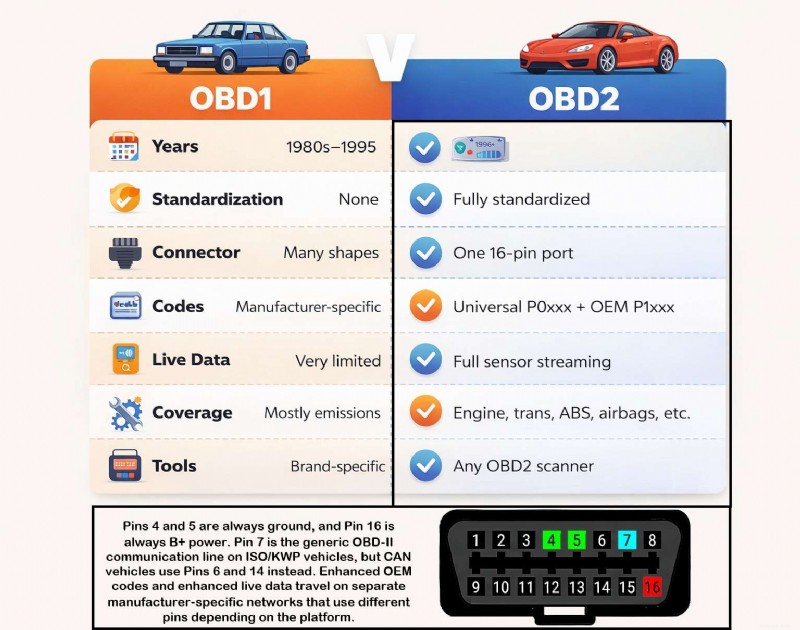
OBD1 vs. OBD2 — graphic by Richard McCuistian
This is where most DIYers get tripped up. OBD2 is powerful, but it has clear limits.
Fault location — which system or circuit has a problem (engine, transmission, emissions, evaporative system).
Live sensor data — RPM, vehicle speed, coolant temperature, fuel trims, O2 sensor voltages, intake air temperature, throttle position, and dozens more.
Readiness monitor status — whether your emissions self-tests have completed (critical for passing a smog check).
Freeze frame data — a snapshot of sensor readings at the moment a fault occurred.
Diagnostic trouble codes — stored, pending, and permanent fault codes.
Mode 6 data — test threshold parameters for each monitored system. When the failure number falls outside the programmed parameters, a code is set. Some Mode 6 setups use hexadecimal, but better tools will translate that into readable values for you.
Which specific part failed. A code like P0420 tells you the catalytic converter system is underperforming — but the root cause could be a bad cat, a failing O2 sensor, an exhaust leak, or an engine misfire. You still need to test.
Anything about non-emissions systems using the generic OBD2 protocol. ABS, airbag, TPMS, body control, power windows, door locks — these require enhanced scan tools with manufacturer-specific coverage.
Mechanical problems that don’t trigger sensor readings. A worn suspension bushing, a slipping clutch, or a leaking head gasket in its early stages may not set a code.
Bottom line: OBD2 tells you where to start looking, not what to replace. The code is a starting point for diagnosis, not a repair order.
Almost certainly yes, if it’s a 1996 or newer gasoline vehicle sold in the United States. Here’s the full breakdown:
Not sure if your specific vehicle is compatible with a particular scan tool? Use our Scanner Compatibility Checker to verify before you buy.
The OBD2 port (officially called the Diagnostic Link Connector, or DLC) is a 16-pin, D-shaped connector located under the dashboard on the driver’s side. Federal law requires it to be within 2 feet of the steering wheel and accessible from the driver’s seat without tools.
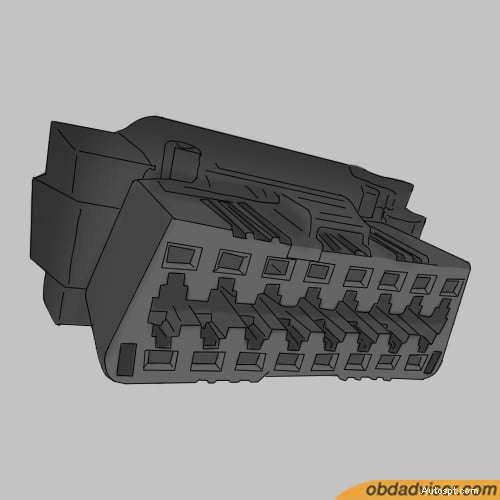
The OBD2 port is the same shape on every vehicle — a 16-pin trapezoid connector.
On most vehicles, you’ll find it directly below the steering column. Some manufacturers tuck it behind a small plastic cover panel, to the left of the steering column, or near the center console. It’s always within reach of the driver.
Can’t find yours? Use our OBD2 Port Locator — it shows the exact location for 67+ vehicle makes.
If your check engine light is on, here’s how to read the code. (For a more detailed walkthrough with photos, see our full How to Use an OBD2 Scanner guide.)
Step 1: Get a scan tool. A basic code reader costs $20–50 and does the job. Bluetooth adapters like BlueDriver or FIXD ($70–100) connect to your phone and give you code definitions and fix suggestions. Not sure which to buy? Take the OBD2 Scanner Quiz for a personalized recommendation, or check our 10 Best OBD2 Scanners for 2026 roundup.
Step 2: Find the OBD2 port. Under the dashboard, driver’s side, within 2 feet of the steering wheel.
Step 3: Plug in and turn the key to ON. Don’t start the engine — just turn the ignition to the “on” position (or press the start button without pressing the brake on push-button cars). The scan tool powers up through the OBD2 port.
Step 4: Read codes. Select “Read Codes” or “Scan” on the tool. It will display one or more DTCs (e.g., P0171). Write them down.
Step 5: Look up the code. Check the code definition on your scan tool, in our OBD2 code database, or search “[code] + [your vehicle make/model]” for vehicle-specific causes.
Step 6: Diagnose before replacing parts. The code tells you the system, not the part. Use freeze frame data, live sensor readings, and basic testing (visual inspection, multimeter, smoke test) to confirm the root cause before spending money.
Every OBD2 code follows a 5-character format. Here’s how to decode P0171 as an example:
So P0171 = Powertrain, generic code, fuel/air metering system, too lean on Bank 1. That tells you the engine is getting too much air or not enough fuel on one bank — and your job is to figure out whether it’s a vacuum leak, a dirty MAF sensor, a weak fuel pump, or a faulty injector.
Stored codes — confirmed faults. The check engine light is on. The PCM detected the fault on at least two drive cycles.
Pending codes — a problem was detected once but hasn’t been confirmed. The check engine light is NOT on yet. One more failed drive cycle and it becomes stored.
Permanent codes — these cannot be erased with a scan tool or by disconnecting the battery. The PCM clears them automatically only after the repair is verified through normal driving. This prevents people from clearing codes just to pass a smog check.
There are three tiers of scan tools, and which one you need depends on what you want to do. (For detailed comparisons, see our OBD2 Scanner Types guide.)
Read and clear generic DTCs. That’s it. Fine if you just want to know why the check engine light is on and plan to take it to a shop. No live data, no freeze frame, no enhanced codes.
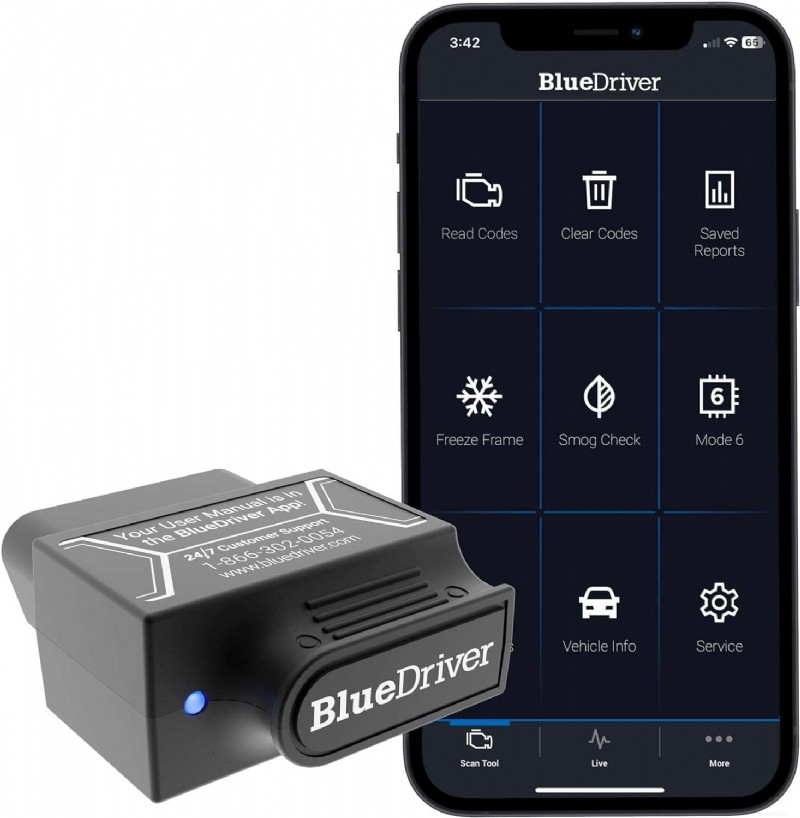
Bluetooth adapters pair with your phone — the most popular format for DIYers.
Read/clear codes plus live data, freeze frame, readiness monitors, and often basic enhanced diagnostics for specific makes. This is where most DIYers should start. Bluetooth adapters (BlueDriver, OBDLink MX+, FIXD) and mid-range handhelds (Foxwell NT301, ANCEL AD310) live here. See our 10 Best OBD2 Scanners for 2026 for specific recommendations.
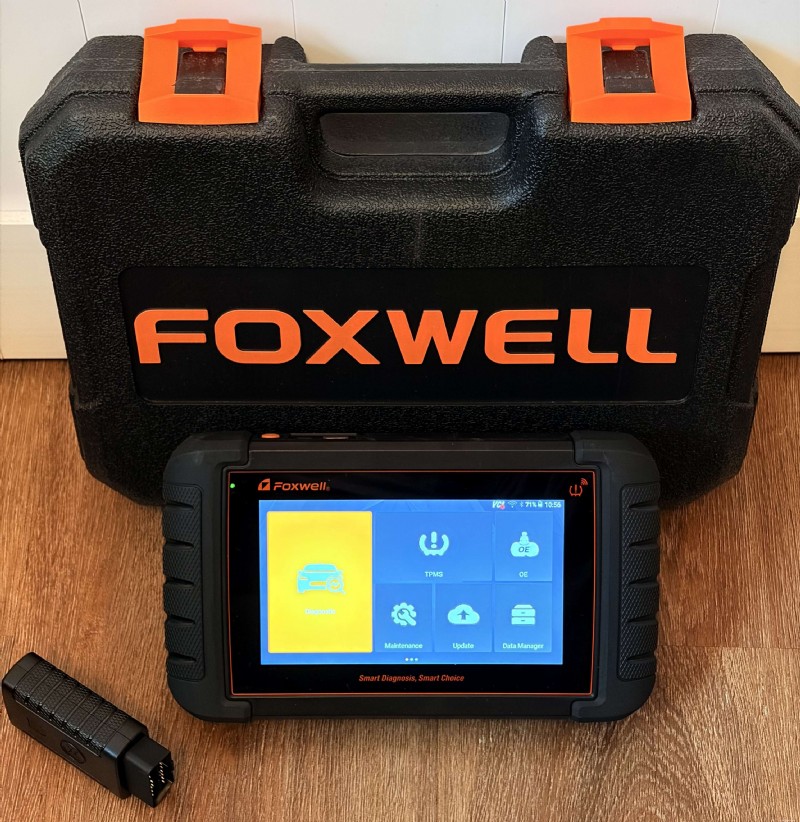
Professional handhelds like the Foxwell NT809TS offer full system coverage beyond basic OBD2.
Full system coverage (ABS, airbag, TPMS, body, chassis), bidirectional controls, active tests, module programming, and manufacturer-specific enhanced diagnostics. Tools like Autel MaxiSys, Launch X431, and Snap-on Zeus. See our Best Professional Diagnostic Tools roundup.
Not sure which tier you need? Take the OBD2 Scanner Quiz — 4 questions, personalized recommendation.
Some 2025–2026 model-year vehicles are shipping with OBDonUDS (OBD on Unified Diagnostic Services) — a newer communication protocol built on top of CAN. It doesn’t change what the OBD2 port looks like or where it is, but it changes how scan tools talk to the vehicle’s computer. Older scan tools may need firmware updates to communicate with OBDonUDS vehicles. Full implementation across all manufacturers is expected by the 2027 model year.
OBD2 was built for combustion engines. EVs don’t have exhaust, catalytic converters, or O2 sensors — so the traditional OBD2 data doesn’t fully apply. California’s Advanced Clean Cars II program is addressing this: starting with the 2026 model year, 40% of new zero-emission vehicles must provide standardized diagnostic data for battery packs, power electronics, charging systems, and thermal management. By 2027, it’s 100%. Same connector, same port location — just new data definitions.
For 2025 and older vehicles, your current scan tool is fine. For 2026–2027+ vehicles, check with your scan tool manufacturer for firmware updates. Most major brands (Autel, Launch, Foxwell, BlueDriver, OBDLink) release annual updates that add new vehicle coverage.
1. Replacing parts based on the code alone. P0442 (small EVAP leak) doesn’t mean you need a new gas cap. It could be a cracked EVAP hose, a bad purge valve, or a faulty vent solenoid. Test first.
2. Clearing codes and calling it fixed. If you clear a code and the check engine light comes back in a few days, the problem isn’t gone — you just turned off the warning. Permanent codes (Mode $0A) can’t even be cleared this way.
3. Ignoring pending codes. A pending code is an early warning. If you catch it now, you might prevent a more expensive failure later.
4. Thinking OBD2 covers everything in the car. Standard OBD2 only covers emissions-related systems. If your ABS light is on, a generic code reader won’t help. You need an enhanced scan tool with manufacturer-specific coverage.
5. Buying the cheapest possible scan tool. A $10 ELM327 clone from Amazon often has connection issues, slow communication, and limited vehicle coverage. Spending $60–100 on a quality Bluetooth adapter (BlueDriver, OBDLink MX+) will save you frustration and misdiagnoses.
Most state emissions inspections now use OBD2 instead of tailpipe probes. The inspector plugs into your DLC, checks for stored codes, and verifies that all readiness monitors have completed. If you have a stored emissions code or too many monitors “not ready,” you fail.
Don’t clear codes right before the test. This resets your readiness monitors to “not ready,” which is an automatic fail in most states. Inspectors know you cleared codes.
Drive the car for a full drive cycle before the test. If you recently had repairs done or the battery was disconnected, you need to drive normally for 50–100 miles to complete the readiness monitors.
Fix the root cause, not the symptom. Permanent codes (Mode $0A) can’t be cleared manually. The only way to clear them is to fix the problem and let the PCM verify the repair.
Check how many “not ready” monitors your state allows. Most states allow 1–2 monitors to be “not ready” on 1996–2000 vehicles, and only 1 on 2001+ vehicles. Your state’s DMV website will have specifics.
Need to reset your check engine light after a repair? That guide walks you through doing it properly without resetting your readiness monitors.
On-Board Diagnostics, second generation. It’s the standardized system that lets scan tools communicate with your car’s computer to read fault codes and sensor data.
1996 for all gasoline vehicles sold in the United States. Some manufacturers included OBD2 as early as 1994–1995 on select models — the Ford Thunderbird was one of the first.
Not with a standard OBD2 tool. Pre-1996 vehicles use OBD-I, which has different connectors and protocols for each manufacturer. You need a brand-specific OBD-I adapter or a scan tool with OBD-I support.
It depends on the adapter. The OBD2 port provides constant battery power (even with the ignition off), so a cheaply made adapter can slowly drain your battery. Quality adapters like the OBDLink MX+ and BlueDriver have low-power sleep modes that prevent this. If you’re parking for more than a few days, unplug to be safe.
Yes, but clearing the light doesn’t fix the problem. If the underlying fault still exists, the light will come back within 1–2 drive cycles. Permanent codes cannot be cleared manually at all. For the right way to handle it, see How to Reset the Check Engine Light.
EVs have the OBD2 connector, but the standardized data available through it is limited since OBD2 was designed for combustion engine emissions. Starting with 2026–2027 model-year EVs, California’s Advanced Clean Cars II program is requiring standardized diagnostic data for batteries, charging, and power electronics.
A code reader reads and clears codes — that’s it. A scan tool adds live data, freeze frame, readiness monitors, and often enhanced diagnostics. For a full breakdown, see OBD2 Scanner Types Explained.
Probably, but some 2026–2027 vehicles are switching to OBDonUDS communication. Check with your scan tool manufacturer for firmware updates. Most major brands release annual updates that add new vehicle support.
OBD2 gave every car owner the ability to understand what’s happening under the hood. A $60 scan tool and 5 minutes of reading can save you hundreds in unnecessary shop visits — or help you walk into the shop knowing exactly what’s wrong so you don’t get upsold.
Ready to get started? Take the Scanner Quiz for a personalized recommendation, or browse our 10 Best OBD2 Scanners for 2026 to find the right tool for your car and budget.
→ 10 Best OBD2 Scanners for 2026
→ OBD2 Scanner Quiz — Find the Right Tool in 60 Seconds
→ Scanner Compatibility Checker
→ OBD2 Port Locator
→ Best OBD2 Bluetooth Adapters
→ OBD-III: What We Know So Far
🛠️ Before You Spend $25–$900 on a Scanner
No affiliate fluff. No "top 10" lists copied from Amazon. Just the honest breakdown of what to buy — and what to walk past.
28 pages · Technically reviewed by ASE-certified master technicians · Updated March 2026 · 30-day money back
