
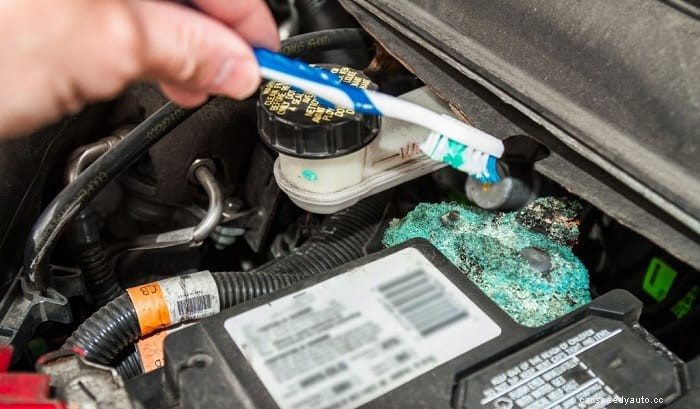
Dealing with battery acid spills and old batteries can be hazardous. So the process of how to clean up battery acid spills must be undergone with protection and caution. If battery acid accidentally gets in contact with your skin and starts to burn, rinse the affected area using lukewarm water for at least 30 minutes.
The process would depend on your battery’s type. You can check the battery’s label to see what type it is. But basically, the process involves:
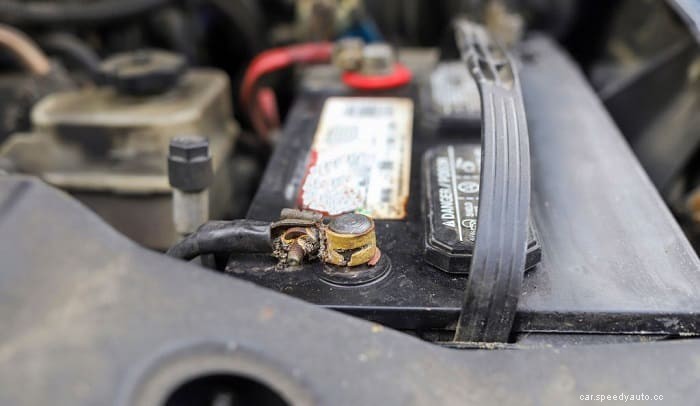
Most vehicles make use of lead-acid batteries, while chargeable cars manufactured in the 90s make use of NiCd batteries. Moreover, lead-acid batteries have voltages in multiples of 2.4V, while NiCd batteries’ voltages are in multiples of 1.2V.
These batteries have the most potent and hazardous acid that can burn through fabric, carpets, and metal. So practice extra caution when cleaning them.
What You Need
Battery acid can be irritative to the skin and eyes when gotten contact with and harmful to the lungs when inhaled. So to safely clean battery acid, you must protect yourself by wearing rubber, nitrile, or latex gloves; safety goggles; and a face mask.
It’s also advisable to work in an area that’s well ventilated to allow the hazardous chemicals to air out.
You need to store the battery safely in two thick garbage bags. Once you put the battery inside, tie the bags up immediately.
Pour some baking soda on the battery acid. Cover them entirely with the baking soda until there is no longer any fizzing.
Combine baking soda and water to make a paste mixture. Then scrub away the battery acid using a toothbrush dipped in the paste mixture.
If the battery is damaged, pour some baking soda that’s ample enough to neutralize the battery acid in the garbage bag. You should also put away the solution into the same garbage bag where you placed the battery.
Find out how to properly dispose of the battery according to your local area or states’ regulations on hazardous waste. Some would require recycling instead of disposing of it. And you can even get a discounted or free battery replacement in exchange for your old battery.
Lithium batteries are used in some vehicles, particularly electric or hybrid vehicles. They are also in chargeable portable electronics. Their voltages are usually multiples of 3 to 3.7V.
Secure the battery in two thick plastic bags. If you are dealing with a car battery, use thick garbage bags. Immediately tie the plastic bags up once the battery is inside.
Moreover, lithium batteries tend to explode. So you must also secure it in a container after you put it in the plastic bags to contain an explosion in case it happens. If the battery was damaged, you must contact the battery manufacturer regarding proper handling.
Take a towel and dampen it with water. Then use it to wipe the battery acid spills.
Disposing of lithium batteries must be done with extra care. If their terminal ends contact with each other or if they’re damaged, they could spark and start a fire. Do not simply dispose of them in the trash bin.
What you can do is to send them to any battery recycler or retailers who take back old batteries. Or you may also contact the authority on solid waste or hazardous waste in your area.
Alkaline batteries are small batteries used in powering electrical devices. Their voltages usually are in multiples of 1.5V.
Before cleaning battery acid spills, put on some protective gear. And to prevent yourself from being exposed to too many harmful chemicals, do your battery acid spill clean up in a well-ventilated place.
Keep the battery secure in two thick plastic bags. Tie up the bags immediately after placing the battery inside.
Create a neutralizing and cleaning solution by combining vinegar and lemon juice. Then take a cotton swab, dip it into the solution, and apply the solution onto the battery acid to neutralize it. You may also dip a toothbrush into the solution and scrub the spills that have dried.
Do not apply water, as it can result in more corrosion. Instead, wipe away the acid with a paper towel. Then let the area dry for many hours.
The battery must be disposed of properly in accordance with your local area or state’s regulations. In some places, you may simply throw alkaline batteries in the trash bin, but in other places, batteries should not be disposed of but recycled instead.
There are reclamation companies wherein you may send alkaline batteries for recycling or check with the solid waste authority in your area.
Whether it’s a car battery or a smaller battery for electronic devices you’re dealing with, you need to clean with caution and also remember to dispose of it carefully.
Hopefully, this tutorial on how to clean up battery acid spills was helpful for you and that you enjoyed it. We appreciate it if you share your thoughts in the comments and share this article.
