

Many drivers have the misconception that a winter tire’s sole benefit over an all-season tire is better traction in the snow.
Think again. Tests conducted by Canada’s Traffic Injury Research Foundation showed that winter tires provide superior traction, braking, and cornering in all cold-weather driving conditions compared to an all-season tire. We’re talking better traction whether the road surface is snow-covered, icy, wet, or even dry. The foundation is an internationally recognized road safety research institute.
The research revealed that braking distances were as much as 30% shorter for vehicles with winter tires than all-season tires. Winter tires also deliver better traction on ice- and snow-covered road surfaces at minus 22 degrees Fahrenheit (minus 30 degrees Celsius) versus an all-season tire at 39 degrees (4 degrees Celsius). That’s a difference of 61 degrees. The results appeared in the 2021 Canadian Consumer Winter Tire Study released in November by the Tire and Rubber Association of Canada.
An all-season tire is not a bad tire. This variety is basically a compromise tire created with a little bit of this and a little bit of that.
“It has a tread pattern with certain winter elements in terms of the design and summer elements as well. [All-season tires] use a formulation of compounds designed to operate optimally up to summer-type temperatures and operate optimally” down to 44 degrees, according to Ian Coke, chief technical officer for Pirelli Tires North America.
RELATED STORIES: Car Tires Guide: Everything You Need to Know
When the temperature drops below 44 degrees Fahrenheit, tire compounds generally used for all-season and summer tires will start to harden. The tire will progressively lose more traction as the temperature continues to drop. Forty-four degrees is an industry-wide standard determined after years of winter testing.
“I’m not saying freezing, but they will start to harden, become rigid. When the compounds become rigid, when the tread block becomes rigid, what you will find is you lose traction, you will also lose wet grip and braking,” Coke said. “That is why winter compounds themselves are a softer compound.”
The three main differences between all-season/summer tires and winter tires are rubber compound, tread pattern, and structure.
The Tire and Rubber Association of Canada’s winter report said “the superior grip of today’s high-tech winter tires is the result of more flexible rubber compounds that provide superior traction even at extremely cold temperatures.
“These specialized rubber compounds coupled with sophisticated tread designs allow for greater control and braking capability on cold, dry, snow-covered, icy, or slushy roads. Shorter stopping distances in emergency situations represent the primary safety feature of the advanced technology in today’s winter tires,” the report said.
A winter tire’s tread pattern is quite different from an all-season tire’s. For example, “a winter tire has lots of sipes, small grooves cut into the tread blocks that allow the blocks to move but also stay rigid when the tire is rounding a corner. That basically increases traction and braking,” Coke said. The tread pattern keeps the blocks free of snow by throwing the snow behind the vehicle as the tire rolls forward.
Also, manufacturers design some winter tires to perform better in snow and others to perform better on ice, the association said. Take your time to select the right tire for your region.
RELATED STORIES: AWD vs. 4WD: Which is Better?
Canada knows something about cold weather. That country’s Traffic Industry Research Foundation said winter tires play a measurable role in increasing road safety and protecting drivers, passengers, and pedestrians.
The “2021 Winter Tire Report” said 80% of winter tire owners in Canada believe the winter tires on their vehicle saved them from losing control of their vehicle or colliding with another vehicle. The study also found that 75% of Canadian motorists use winter tires.

What’s called a “Three-Peak Mountain Snowflake Symbol” is located on the sidewall, identifying the tire as a winter tire. A tire carrying this symbol meets the industry’s snow-traction-performance requirements on medium-packed snow.
A word of caution: A few all-season tires carry the snowflake symbol. “I would reinforce the fact that the three-piece snowflake is about pure traction. It does not evaluate braking,” as well as turning, ice traction, and overall performance at lower temperatures, Coke said.
RELATED STORIES: 10 Tips on How to Winterize Your Car
Winter and summer tires only have one thing in common: They are round. Each tire is composed of a specific compound made to handle extreme heat or extreme cold. They can’t do both. Engineers didn’t design winter tires for use in warm weather, so remove them when the snow season ends. High temperatures and hot pavement will quickly wear down the tread because of the soft properties of the tire compound.
“They are certainly not designed to operate in Florida in mid-August,” Coke said. “When compounds run very, very hot, they actually could give you great grip, but you are consuming them at a dramatic rate.”
The useful life of tires depends mostly on your driving habits. Refer to the tire’s warranty for an idea of what to expect. You should rotate winter tires every 5,000 miles. “You should be looking to get two seasons out of a winter tire and should get at least two seasons out of a summer tire, if not more. So overall, you are probably not spending more. You are just splitting it between winter and the rest of the year,” Coke said.
The proper tire pressure for a vehicle is listed on a sticker attached to the inside of the driver’s door, the inside of the glovebox door, or the owner’s manual. Keep in mind that each 10-degree (Fahrenheit) drop in outside temperature during the winter can mean a 1- to 2-pound loss in air pressure inside the tire. If the tire has a slow leak, the tire pressure could be underinflated by 5 to 7 pounds or more. Proper tire pressure is critical to driver safety in every season.
“If you don’t have the correct pressure in each tire, you are presenting a different tire footprint to the surface of the road,” Coke said. “You are not going to get the braking and steering performance” the tires and vehicle were engineered to handle. “This can mean instability that could mean longer braking distances. You are not running in optimal condition.” The same issues will result if the tires are overinflated. Check tire pressure at least once a month.
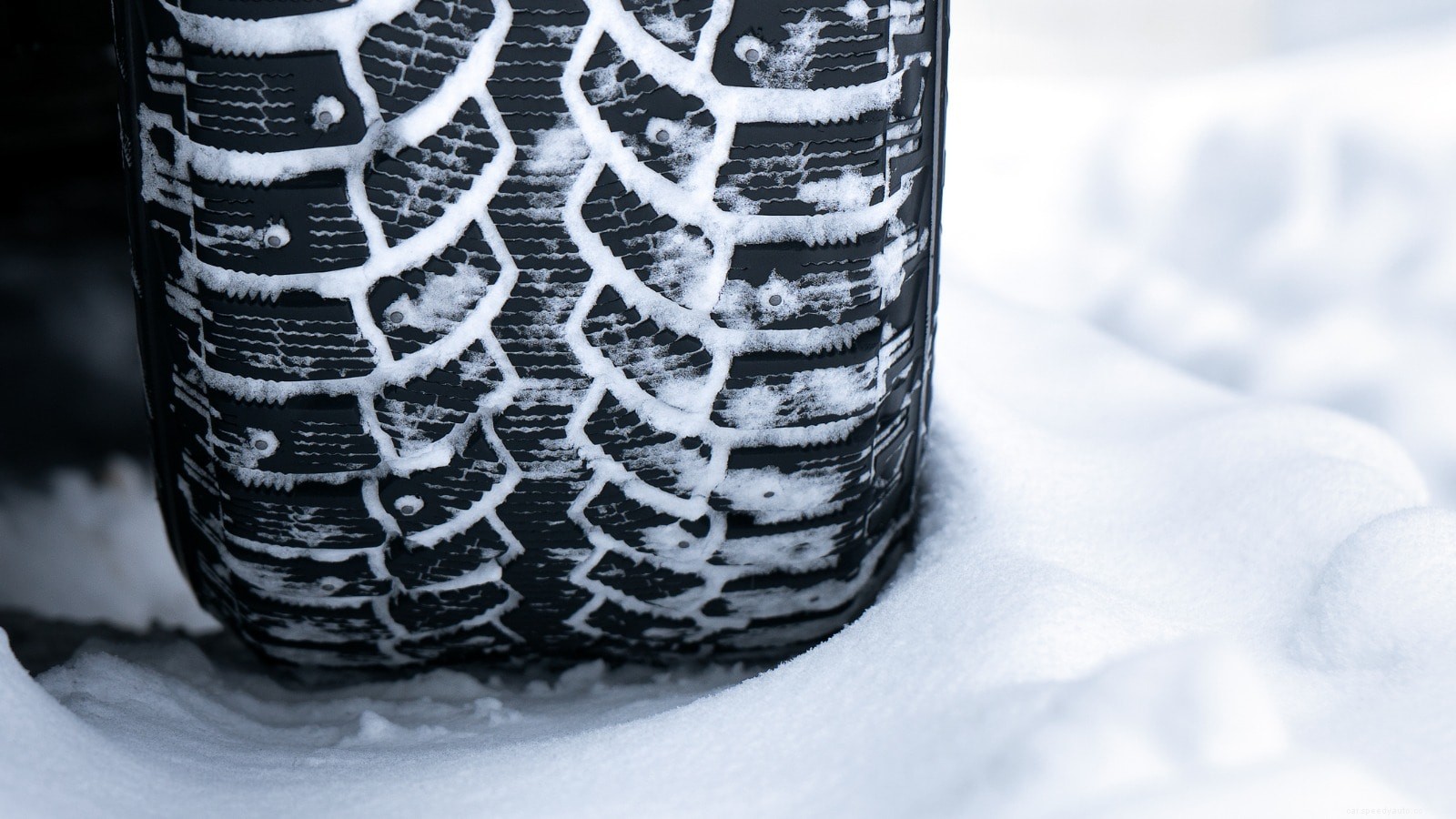
If many of the roads you travel are ice-covered during a good portion of the winter, consider a studded tire. The winter tire tread is literally embedded with numerous metal studs that provide better traction because they dig into the ice. Typically, a tire contains 80 to 100 studs. However, they provide no added traction benefit to driving on snow-covered roads.
The downside of studded tires is that the studs dig into the dry pavement, damaging roads. The studs are noisy.
Five states, including Michigan and Texas, prohibit the use of studded tires. Other states allow studded tires only during select months of the year. Six states, including Colorado, Wyoming, and Vermont, allow tires with studs in them any time of the year.
Check your state’s regulations before buying a set.
Sometime this winter, it is going to happen. Be sure to properly inflate each tire to reduce the probability of a blowout when a tire hits a mini crater.
“There are a lot of variables. You are more likely to have a rim impact with lower pressure,” possibly resulting in a bent wheel, Coke said. “The tire sidewall will not be able to absorb the full deflection” from the pothole because of tire underinflation.
“The tire gets forced back into the rim,” he said, “and you are possibly going to have a tire failure.” This blowout could lead to an accident on a slippery surface.
Generally, a set of winter tires cost about the same price as a good set of all-season tires. For example, expect to pay $800-$1,000 for a set of four winter tires from a major manufacturer if you own a 2022 Hyundai Santa Fe Limited.
Stay away from unfamiliar brand names that woo potential buyers with a low price.
Experts say that tire’s snow, ice, slush, and dry performance likely will be far below recognizable brands. Don’t waste your money. Before buying winter tires, check several websites for prices and performance like Tire Rack and Discount Tire.
Editor’s Note: This article has been updated for accuracy since it was originally published.
