
Did you ever consider those wonderful days when your car won't start? If you left your lights, radio, or some other electrical gizmo on after you parked the car, you know what the trouble is: Your battery is dead. Of course, there are other possible reasons that your car won't start.
Your car may not start for a number of reasons. The following list outlines the most common circumstances and tells you what action you can take to try to remedy each situation:
To safely jump-start a car, follow these steps:
1. Take out your jumper cables.
It's a good idea to buy a set of jumper cables and keep them in the trunk compartment. If you don't have jumper cables, you'll have to find a Good Samaritan who not only is willing to assist you but has jumper cables as well.
2. Place both cars in Park or Neutral, with their ignitions shut off and their emergency brakes on.
3. Remove the caps from both batteries (unless they're sealed).
Batteries produce explosive hydrogen gas, and a spark could set it off. If the caps are open, you can avoid such an explosion. (Sealed batteries have safety valves.)
4. Connect the cables.
The positive cable has red clips at either end, and the negative cable has black clips. It's important to attach them in the proper order:
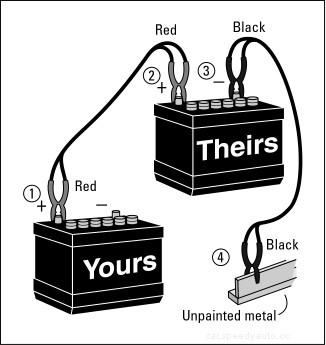
1. First, attach one of the red clips to the positive terminal of your battery (it has "POS" or "+" on it, or it's bigger than the negative terminal).
2. Attach the other red clip to the positive terminal of the GS's car.
3. Attach one of the black clips to the negative terminal on the GS's battery.
4. Attach the last black clip to an unpainted metal surface on your car that isn't near the carburetor (if your car has one) or battery.
Figure 1 shows how both the positive and negative cables should be connected.
 |
|
Figure 1: Make sure to connect jumper cables in the proper order. |
5. Try to start your vehicle.
If it won't start, make sure that the cables are properly connected and have the GS run his or her engine for five minutes. Then try to start your car again. If it still won't start, your battery may be beyond help.
6. Disconnect the cables, thank the Good Samaritan, and resume your life.
Don't shut off your engine; drive around for a while to recharge your battery.
If your alternator light stays on or the gauge on the dashboard continues to point to "Discharge" after your car's been running, make sure that your fan belt is tight enough to run your alternator properly. If your battery keeps going dead, have a professional check both the battery and your alternator.
In any case, never drive around with a light or gauge that reads "Trouble"; have it checked out immediately — that's why those gauges are in there!
