
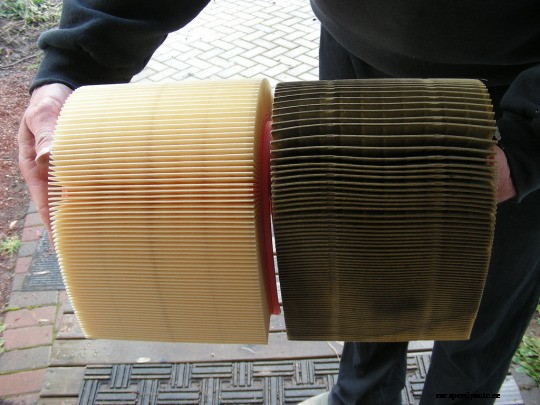
Your car or truck burns around 12,000 gallons of air for every gallon of gasoline it burns, according to the Filter Manufacturers Council. Do that math—if your vehicle gets 20 MPG, that’s 240,000 gallons of air for every mile you drive. Why do we care? Unfortunately, that air is carrying a fair amount of plain old dirt, swept up off the road by traffic and the breeze. And a lot of that is silicon dioxide: common beach sand. Silicon dioxide is what’s used to make sandpaper. And it has no business inside your engine, because it will inevitably wear out expensive components like valves, pistons and bearings which is why its important to follow the guide below to know when you need to change your air filter. The air filter’s job is to let in the air with as little restriction as possible, while keeping out as much dirt as feasible.
As the filter accumulates dirt, the restriction to flow grows cumulatively, making your engine work harder to ingest air. The engine’s fuel injection system will, of course, correct the amount of fuel mixed with the air to keep the proper proportion of fuel to air. The result of that is a reduction in maximum horsepower, although the reduction will be miniscule. More importantly, the engine has to expend some energy to suck air through an increasingly more restrictive filter, and that eventually will affect fuel economy.
You may be thinking your best bet is to remove the filter, and clean or change your air filter regularly, right? Not so fast. It’s more complicated than that.
Exactly how often do you need to change your air filter? That’s a simple answer—it’s in your owner’s manual.
Mike Allen – guest writer for Openbay. He’s an ASE-certified mechanic, longtime former editor of Popular Mechanics, and world-record-holding race-car driver. For more on Mike, check out his bio here, and find him on his own site, Saturday Mechanic
