
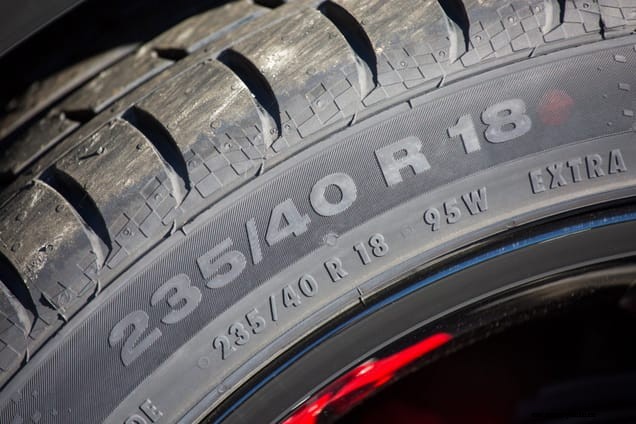
It’s not uncommon for many people to not know much about their tires beyond what type of tires came on the vehicle or what the technician at the tire shop recommended. But, the series of letters and numbers on the side of your tires actually tell you everything you need to know about the type, tire size, and more.
Not all vehicles require the same tire size. Plus, different types of vehicles, road conditions, handling, and vehicle response preferences all require a different type of tire. So, being aware of how to read your tires is a valuable skill to have and can help make the process easier when it comes time to buy tires. Understanding the numbers will ensure you get the proper tire size, rating, etc for your vehicle and conditions.
In this guide, we’ll go through everything you need to know about reading your tires.
Usually, when people think of tire numbers and reading tire sizes, their diameter and width are the first two things that come to mind. Both of these are identified within the series of letters and numbers on the sidewall of the tire. But, there are quite a few other things indicated there as well.
Let’s break down what all of these letters and numbers on the side of tires mean so that you know exactly what you are looking at:
For this guide, as examples, we’ll use two sets of tire numbers –
P225/60R16 95S and LT235/75R15 96H
The sequence on every tire always starts with a letter. This letter indicates the specific type of tire that it is. In looking at our first example, the letter ‘P’ means that it is a passenger car tire, specifically for cars, minivans, SUVs, and some light-duty pickup trucks. These tires are made to certain U.S. standards and load indexes for passenger vehicles and come in P-metric sizing.
With our other example, the ‘LT’ indicates that it is a light truck tire. These tires come in LT-metric sizing with higher load indexes and are designed to be used on vehicles that can pull trailers or carry heavy cargo.
Occasionally, you may see a tire that does not have any letters in front of the numbers. This means it is a Euro-metric tire that is made to European tire specifications. These often have different load indexes than a similarly sized P-metric tire.
Other types include ‘“T” for “temporary”, which will be on small spare tires, and “ST” for “special trailer”, which is for a trailer tire.
The next thing you’ll see in the sequence is three numbers before the slash. This is the section width, which is the width of the tire tread. This is measured in millimeters from sidewall edge to sidewall edge across the tire. So, in our first example, P225/60R16 95S, the section width is 225mm. In the second example, LT235/75R15 96H, the section width is 235mm. So, the wider the tire, the larger that three-digit number is.
Next, the next two numbers after the slash is the aspect ratio. This is expressed as a percentage and is the sidewall height compared to the section width. So, from our examples above, the aspect ratios are 60% and 75%. This means the sidewall heights are 135mm (60% of 225mm) and 176.25mm (75% of 235mm). The larger the aspect ratio is, the larger the sidewall height is.
Tires that offer improved vehicle handling and steering response will have a shorter sidewall, with an aspect ratio around 55 or less.
Usually, right after the aspect ratio, you’ll see the letter “R”, which stands for Radial. This refers to the internal construction of the tire. Radial tires are the industry standard in today’s modern tires. Radial tires are made of internal ply cords that run radially across the tread, perpendicular to the rotation axis. Compared to previous types of tire construction, these tires offer good road grip, ride comfort, and durability, and lower rolling resistance for improved gas mileage.
After the tire construction letter will be the wheel (rim) diameter in inches. So, using the examples above (P225/60R16 95S and LT235/75R15 96H), the wheel diameters would be 16 inches and 15 inches.
Following the wheel diameter, you’ll see a space and then a two or three-digit number. This number is the tire’s load index. This is the digit that equals the maximum weight that the tire can individually support when properly inflated, as referenced in the load capacity index. This index starts at 1 and ends at 150, with the numbers in the load index referring to weight capacities of 99 to 7385 lbs.
For our two examples, the load indexes are 95 and 96. So, the carrying capacity of the tires (per tire, not all four) is 1521 lbs and 1565. When having tires installed, it is very important to only use tires with a load index that meets or exceeds the manufacturer’s recommended specification for your vehicle.
The last part of the sequence, a letter found after the load index, indicates the speed rating. This is the maximum speed in mph that the tire can safely be driven on for an extended period. The letter corresponds to a specific speed capability determined in standardized laboratory testing. So, for our two examples, P225/60R16 95S and LT235/75R15 96H, the speed rating “S” equals a maximum speed rating of 112 mph, while an “H” equals a maximum rating of 130 mph.
This DOES NOT mean that you should drive at these speeds. These are simply the top speeds that the tires can handle safely.
Tires with a high speed rating, like high-performance tires, will usually provide better handling performance. When you are getting new tires, it is important to make sure that they meet or exceed your vehicle manufacturer’s recommended speed rating for maximum vehicle capability.
On the tire’s sidewall, one of the other things you’ll find is the maximum air pressure specification. This is the maximum psi that the tire can be inflated to safely. Keep in mind, this is just a safety indication and is not the tire pressure that you should maintain while driving around daily. The recommended air pressure is actually not found on the sidewall of the tire. The manufacturer-recommended tire pressure guidelines for your vehicle will be found on your driver’s side door jamb and in your owner’s manual.
Keeping your tires properly inflated plays a big role in their specifications and performance. It will also help you extend the life of your tires. So, make sure to stick to your vehicle manufacturer’s recommended tire pressure guidelines.
All tires will also have a Department of Transportation (DOT) number/code displayed on the sidewall. This shows that the tire has passed all minimum DOT standards to be sold in the U.S. The code will indicate the manufacturer, the specific plant it was manufactured at, and the size. There may also be an optional part of the code that specifies the category of the tire, construction, and tread pattern. The end of the code will indicate the week and year that the tire was produced.
The tire’s sidewall will usually also display the Uniform Tire Quality Grading (UTQG) information. This rating system was developed by the U.S. Department of Transportation (DOT) to give consumers more information that can help when purchasing tires. These ratings include the tire’s relative treadwear, traction, and temperature capabilities. Each tire manufacturer is required to conduct these independent tests and grade their tires based on the DOT ratings.
The treadwear grade is based on standardized tests that help predict the expected life of the tire tread. For example, a tire with a treadwear grade of 100 will last half as long as a tire with a treadwear grade of 200.
The traction grade indicates the traction performance of a tire in wet conditions in a controlled test. If the tire has an “AA” rating, this means it provides exceptional traction in these conditions.
The traction grades can be: AA, A, B, or C.
The temperature grade indicates the tire’s ability to withstand and dissipate excessive heat while in motion. So, a higher temperature grade means that the tires are able to safely operate at higher speeds.
Temperature grades:
A = Speeds over 115 mph
B = Speeds between 100 and 115 mph
C = Speeds between 85 and 100 mph
When buying new tires, it’s very important to stay within the size limitations of your vehicle. If your tires are the wrong size, they can rub against the body or suspension of your vehicle, cause pulling in the steering wheel, reduce the vehicle’s clearance, or result in a noisier or stiffer ride.
For replacement tires, you generally want to keep within 3 percent of the diameter (height) of your existing tires. This is assuming that your current tires meet your vehicle manufacturer’s recommended specifications.
If you’re thinking about changing to a different tire size, your best bet is to check with a tire expert. You need to confirm if the tires and wheels you’re interested in will properly fit your vehicle’s bodywork, suspension, and gearing. You also want to find out how any differences in the speed rating, load index, etc will affect your vehicle performance and ride quality.
As mentioned above, the tires for a passenger vehicle are going to be different than those for a light truck. Within those tire types, there is also another level of types that are based on road conditions or your driving habits.
If you are looking to change to a new tire type for your vehicle, understanding what each of them is best for can help you pinpoint what might be the best fit for your needs and conditions. Plus, now that you know exactly how to read your existing tires, you’ll know what to look for to ensure the specifications for your vehicle are met.
The different tire types include:
Now, you should have a good understanding of how to read your tires and determine your tire size. All of the important information about your tire can be found on the sidewall. But, if you have questions, the professionals at each of our Driver’s Edge locations are here to help. Our tire experts can answer any questions you may have and help you determine the proper tire size and type for your vehicle and driving needs.
Whether you need to purchase new tires or need in-depth vehicle repair, you can count on our expert ASE-certified technicians. For over 10 years, Dallas and Ft. Worth area drivers have trusted our team for preventative vehicle maintenance, reliable auto repair, and unbeatable customer service, all at the best and most affordable prices around.
Schedule your appointment with Driver’s Edge today!
