
Brand-new tires can certainly put a dent in your household budget, but good tires are a necessity for both the handling and safety of your car, truck, or SUV on the road. You can make your tires last and avoid the repair costs that worn tires can lead to by taking care of some simple preventative tasks that help keep your tires in good shape.
Here are ways you can get more (and safer) life from your tires:
The expert technicians at your local tire service shop know how to ensure that your tires are getting even wear and last their full life expectancy. Routine maintenance services will help do just that. You should be making the following services part of your regular maintenance schedule:
Including the services above in your vehicle’s regular preventative maintenance routine will significantly help prevent the need for tire repairs and extend the life of your tires.
Another one of the top things you can do to protect your tires is to keep them properly inflated. Most newer cars are equipped with a Tire Pressure Monitoring System (TPMS) that will alert you when a tire is low on air. But, with older vehicles, you will have to manually check the air pressure with a tire pressure gauge. It is recommended to check your tires’ air pressure, including the spare, at least monthly. If you notice that one of your tires has low air pressure, either put more air in it yourself or take it to the closest shop to have it inflated ASAP.
Making sure your tires are always at the proper inflation/air pressure will also help you maintain optimal gas mileage. When a tire is underinflated it is harder for it to roll. This also means your engine has to work harder to move it along.
You should also periodically check the tires’ valve stems for any air leaks. The valve stem is the part of the tire that has the cap that you unscrew to put air in it. Even just a small particle of dirt on the valve can cause an air leak. Also, over time, valve stems can become fragile and crack, causing an air leak.
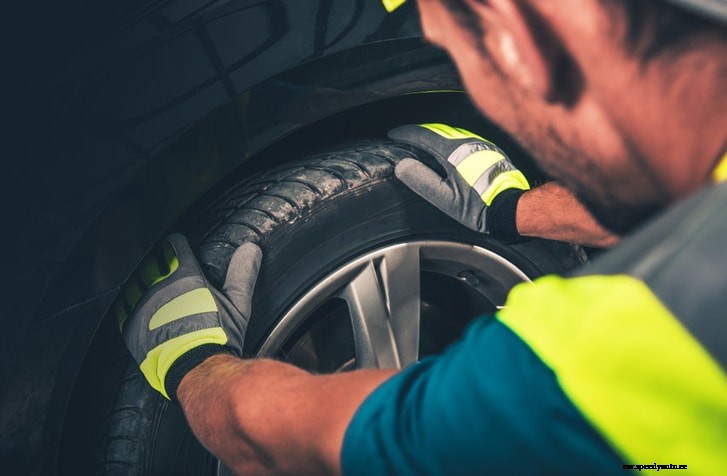
In between your routine tire services, you should also be checking the tread and sidewalls of your tires. If there are any foreign objects stuck in the tire, the tires are dry rotting and cracking, or the tread is extremely worn, chances are you’ll need tire repair or replacement very soon.
You can check your tire tread yourself by doing the “penny test”: Just grab a penny and, with Lincoln’s head facing down toward the tire, insert it into a groove of the tire tread. The more covered Lincoln’s head is, the more tread you have and the safer it is to drive on the tire. So, if you can see Lincoln’s whole head, there is too little tread and the tire should be replaced.
This may sound obvious, but pay attention to what you are driving over. If you see debris or a pothole in the road ahead, try to switch lanes or take an alternate route to avoid it. These things can all cause punctures and flat tires. Also, if possible, avoid driving on unpaved roads (unless you’ve got offroad tires). This will help prevent your tire from wearing down faster and eliminate the chance of a tire being popped by rocks or other debris.
You also want to avoid driving near construction areas as much as possible. The streets near construction sites are often full of nails, screws, or other sharp objects that could end up in your tire, quickly causing a flat.
Take a look at the label on the inside panel of your driver’s door to find the maximum weight your vehicle should carry. When loading up your vehicle, you want to avoid going over the max weight listed. Overloading your vehicle can end up ruining your tires.
If you do have to carry a heavy load, increase your tire pressure slightly to help your vehicle support the weight. On the sidewall of your tire, you’ll find how much weight your tires can carry if they’re inflated to the maximum pressure (which you’ll also find on the side of the tire).
Worn-out brakes can also cause uneven tire wear, which could lead to a flat tire. So, make sure to have your brakes inspected periodically. Especially if they are not performing as they should and you’re concerned about them.
It is also important to avoid hard and fast stopping (and going) as much as possible to prevent excess wear on your tires.
Of course, some instances of flat tires are unavoidable. But, by following the prevention methods we mentioned above, you’ll help extend the life of your tires and minimize the need for tire repair as much as possible.
When you need preventative tire services performed or if you do run into a situation where you need repair work done, you can trust the expert technicians at Driver’s Edge!
At each of our convenient locations throughout the Dallas and Fort Worth areas, our professionals can help you protect and maintain the life of your tires and perform tire repairs when needed. If you need new tires, we can also help you find the best tires for your vehicle and driving needs. We also frequently offer tire deals to help make new tires even more affordable.
You can also count on our ASE-certified master technicians to meet any other auto maintenance or repair needs your vehicle may have. Local area drivers trust the experts at Driver’s Edge for top-quality auto service at great prices, all backed by exceptional customer service.
Schedule your appointment at your closest Driver’s Edge location today!
