
A starter is an electromechanical device that provides engine start, creating the crankshaft’s primary torque with the necessary rounds so that the compression ratio is formed to ignite the combustible mixture.
And when the starter does not work or works intermittently, the engine start is very problematic and sometimes impossible. But before you start looking for reasons why the starter does not work, you need to remember that this unit works in tandem with other vehicle systems in a standard starting and charging circuit (battery-start control mechanism-starter). Therefore, there can be both mechanical and electrical failures with their distinctive features.
Table of Contents
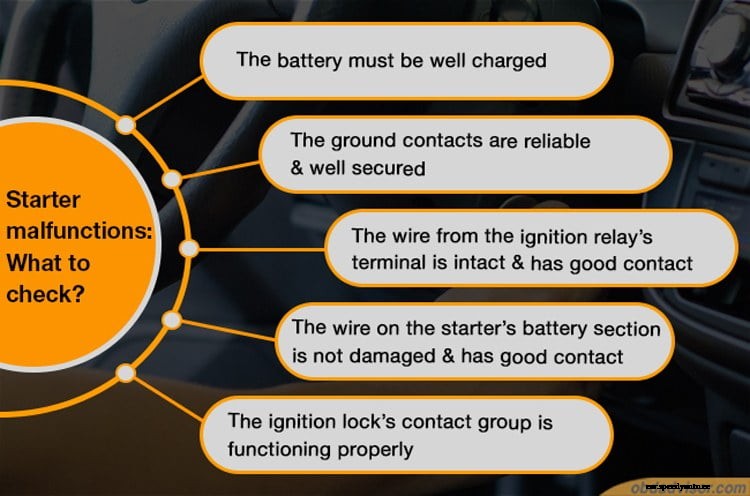
When the starter does not turn the engine or turns it slowly, with insufficient power to start, then, first of all, it is worth checking the electrical circuit, starting from the battery:
You should note these points when the key is turned in the ignition lock, but the ignition relay does not work, the armature does not rotate if there is a break in the starter relay coil and heavy contacts sparking.
The starter’s problems on the electrical part may also arise due to the slow turning of the flywheel.
And when there is no apparent reason, it is worthwhile to dismantle the part for inspection because the commutator may have burnt or its plates have shorted out. Although, the main possible reason is most probably worn out or stuck brushes.
Since typical starter faults are:
If the electrical part is OK and the circuit is intact, it is worthwhile to dismantle the spare part for disassembly and detailed inspection to detect defects. But before you do this, you need to study the structure and working principle of the starter.
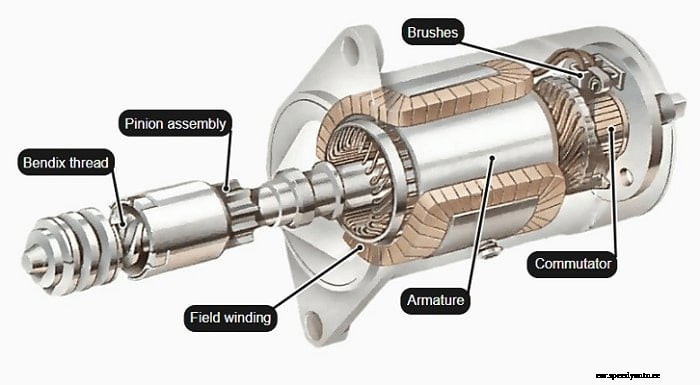
When you turn the key and start the engine, the following processes occur:
Based on the scheme considered, it is possible to make assumptions about possible malfunctions at the appropriate stages.

If the starter is running, but the engine does not start because the crank does not turn, there might be some mechanical malfunctions.
Parts you should check: Overrunning clutch arm, clutch ring, return spring, flywheel crown.
One of the reasons why the starter does not turn the crank
With the spinning starter, the engine start may not happen because the clutch slips, the release arm fails, or it has slipped out of its axis, the clutch lead ring is worn, or the return spring fails. When a rattle gnashes at startup, these symptoms may indicate wear of the flywheel crown teeth. In this case, it is worth checking the adjustment of the pinion stroke and the return spring’s condition.
If you heard an unusual noise when the starter is running, it is worth examining it from the pothole and underhood space, as one of the following starter malfunctions may have occurred:
But besides the startup phase, the problems may also occur after it. It’s a typical situation where the starter does not shut down but continues to spin. These may be the reasons:
In this case, quickly disconnect the starter terminal or the relay terminal and look for the cause of the starter malfunction.
If the issues mentioned above are not faced, but the starter still behaves unusually when the engine starts, it is worth looking at the symptoms that promise a rapid malfunction:
According to BestArny.com, a starter’s working life is around 70,000 – 200,000 km, and for it to serve your car for as long as possible, some preventive work is necessary regularly.
We recommend studying a specific model’s technical characteristics to check the starter and its subsequent repair as correctly as possible. The main ones are rated voltage and power, current consumption and torque, and the shaft speed.
Bonus: 10 Best Jump Starters Review [Updated Jan. 2021]
