
Are you at that point where you need to change the firing order of your car’s V8 engine? It could be for various reasons, such as a boost in power, better balance, improved torque, or efficient heat management.
If your answer to the above question is yes, then you may be thinking of swapping your engine’s firing order to that of the LS. We’ve got you covered with helpful information that will make you know if you can and should do the switch.
What about making it a 4/7 swap instead? We’ll also guide you on that.
Table of Contents
Here, you’ll understand what firing order is all about. You’ll also see descriptions for the V4, V6, and V8 firing orders.
Firing order refers to the order of ignition for the cylinders in an internal combustion engine. In other words, it’s the order of power distribution of the cylinders in an engine that contains multiple cylinders. Automobile makers ensure that the sequence doesn’t follow the regular number series (1, 2, 3, 4 …) because of the following reasons:
Firing order is made possible by the sparking of spark plugs in the correct sequence in gasoline engines or the process of fuel injection in diesel engines. Engines have different firing orders depending on if it’s an inline or radial engine.
V4 engines are 4-cylinder piston types with V configuration and one crankshaft. This engine uses the 1-4-2-3 firing order.
V6 engines are 6-cylinder piston types that have a V configuration and a single crankshaft. A V6 engine in which the cylinders banks have an angle of 60 degrees between each other can utilize a firing order of R1-L1-R2-L2-R3-L3. For the ones having cylinder banks with an angle of 90 degrees between themselves, it’s possible to find an R1-L3-R3-L2-R2-L1 or R1-L2-R2-L3-L1-R3 firing order.
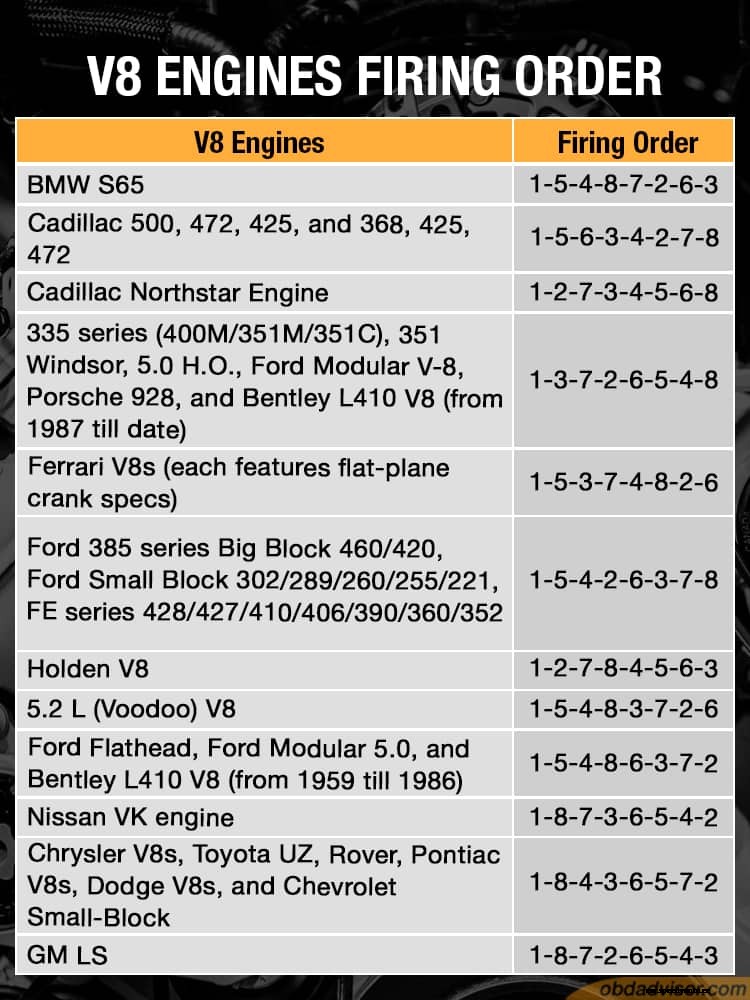
V8 engines are 8-cylinder piston types with a single crankshaft featuring a V configuration. A V8 engine can utilize many types of firing orders and even use dissimilar ones between engines from the same automobile maker.
Firstly, the acronym “LS” stands for luxury sport. The LS engine was invented as an improvement on V8 engine designs. It’s very popular among people who are into motorsports, such as drag racers, drifters, and others. One of the reasons for this is the LS swap which we will take a deeper look into in subsequent sections.
LS engines were introduced into the industry in January 1995 by Chevrolet. Although the company wasn’t the original inventor of the traditional V8 engine, Chevrolet applied the knowledge used in producing the small-block Chevy to develop the LS engine.
The LS engine is different from the traditional V8 engine in the sense that the former is smaller, lighter, and easier to swap into cars than the conventional V8 engine. When it comes to firing order, the LS has it better than the traditional V8 engine in terms of alternating firing between banks.
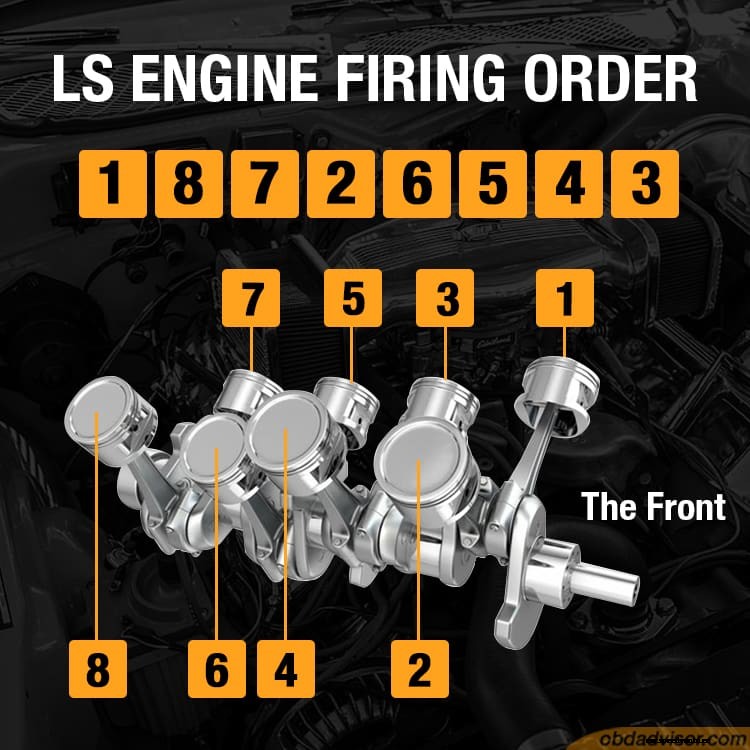
So what’s the firing order of the LS engine? It’s 1-8-7-2-6-5-4-3. You can achieve this in other engines through various ways, such as swapping.
For example: Using a Cam Motion LS camshaft which features a 224/258 degrees duration as well as a 0.629/0.630-inch lift for a big block Malibu. The LS cam is run in order to adjust the timing. The mechanic will aim to fine-tune the harmonics of the big block and enhance cooling as part of the objectives of the swap.
All LS engines have the same firing order, except for the modified ones, such as the types featuring the 4/7 swap.
The answer to this question mainly depends on your preferences in terms of torsion and cooling enhancements. Car owners could decide to swap their engine firing order to that of the LS engine due to the following reasons:
Your engine’s firing order can be swapped if it’s a 90-degree V8 type (diesel or gas). The talk of swapping isn’t common in the racing and high-performance industry. You can’t do swaps for I4s, V6, straight-6, and straight-8s.
Better still, it’s advisable to find out about this from a well-experienced auto mechanic. You can also Google this question and browse relevant articles. Get an expert to help you ascertain if the engine’s specs and conditions are OK or necessary for a swap.
You can make the swap by ordering a custom camshaft and then performing a DIY replacement. Another way to do this is for your mechanic to rearrange the lobes on the camshaft to change each target cylinder’s positions. The goal is to switch cylinders 7 and 4 as well as cylinders 3 and 2.
The cost of swapping may depend on the mechanic’s discretion, engine type, car type, and your location. You can get a custom camshaft for anything from $399. Some online stores offer camshaft recommendations for a fee—as low as $30 or as high as $40, depending on the service.
Our answer here is the same as what was stated for the LS firing order (4/7-2/3). It would mainly depend on your preferences in terms of torsion and cooling enhancements.
The 4/7 swap involves switching the firing order of cylinder 7 with that of cylinder 4. It’s different from the 4/7-2/3 swap in the sense that it involves two switches—where 7 and 4 are switched as well as 3 and 2. However, the 4/7-2/3 method has more advantages (better alternation of firing between banks).
Your engine might get the following benefits from the 4/7 swap:
As we stated in the above list of benefits, you’ll only be getting a small boost in power. But there are other benefits listed. The only other one that’s sure is better heat management. Points 2 and 4 aren’t 100% probabilities. Weigh the cost of performing the switch against the possible merits and make a decision.
Similar to the LS firing order swap, you can do the swap by ordering a custom camshaft and then performing a replacement. Another way to do this is for your mechanic to reorganize the camshaft lobes to change the positioning of the target cylinders. The aim is to switch cylinder 7 with cylinder 4.
Now you know the basics of LS engine firing order and swapping it. Car owners should ensure that they meet their auto mechanics to get advice in order to make an informed decision.
Good luck on your quest!
Q: Does Firing Order Change Sound?
A: No, firing order doesn’t change the sound the engine makes.
Q: What Is the Firing Order of an SBC?
A: The firing order of an SBC (small-block Chevy) is 1-8-4-3-6-5-7-2. It’s different from that of the LS (1-8-7-2-6-5-4-3) regarding the third, fourth, seventh, and eighth cylinders to fire.
Q: Can Firing Order Be Changed?
A: Yes, it can be changed, as seen in the swap types described earlier.
