
It’s a simple fact that most humans like driving fast (okay, we can’t be positive it’s a fact, but if you’re reading this, we can assume you like driving fast). But, it’s not as simple as hopping in the driver’s seat, flooring the accelerator, and ripping around the curves at record-setting speeds. It takes some skill and finesse, and we have some tips for you. But before we begin, let’s get the disclaimer out of the way first, shall we? We can’t condone unsafe driving or doing anything with a vehicle that could put yourself or other motorists at risk. Therefore, we’re going to assume that if you’re reading this article it’s because you’ll be putting our tips to use on a closed track, preferably with professionals close by to render assistance if needed. Got it? Then with no further ado, here are 6 tips for driving fast.
Putting everything you need to know to successfully drive at high speeds down on paper is impossible. So this is by no means a comprehensive list, but these 6 tips will certainly put you a step (or a t least a car length) ahead of most amateur drivers.
This may seem obvious, but not all cars are built to drive fast around a road track. Amateurs may think that all they need to turn heads at a racetrack is a car with a big engine. But it takes much more than that. Here are some features to consider when choosing your vehicle. Also we will list a few of our favorite cars that excel in each category.
Weight To Power Ratio
If we’re talking about drag racing or pulling ahead in the straight-aways on a road course, it’s all about the ratio between how much your car weighs and the amount of horsepower under the hood. This is a great racing factor because it can give the “little guy” a fighting chance. In a nutshell, the more horsepower you can put in the lightest car possible, the faster you’re going to go (not considering things like traction, suspension, etc.). Here’s an example:
A classic Lamborghini Jalpa (produced 1981-1988) weighs in at 3,329 pounds and produces 250 horsepower. Dividing weight by HP gives us a weight-to-power ratio of 13.3.
A 2015 Honda Civic Type-R weighs in at 3,296 (a mere 50 pounds less than the Lambo). However, the civic boasts 310 HP, giving it a weight-to-power ratio of just 10.6. In short, the civic would wax the Lambo on the straight-aways. Plus, it costs less than half of what the Jalpas are going for these days.
Simply put, the lower your weight-to-power ratio, the faster your vehicle will go. If you’re looking for a great, affordable vehicle with a respectable weight-to-power ratio, consider the Ford Mustang GT. The 2017 model boasted an impressive ratio of 8.5 and has a price tag of well under $40K in most cases.
Cornering Force
Driving fast on a road course is about more than just flying down the straight-aways. You also need to be able to take corners at high speeds and accelerate out of them. That’s where “cornering force” comes in. Not-so-simply put, cornering force is the lateral force produced by a vehicle’s tire on the road surface while cornering, usually measured in G-forces. If a vehicle is capable of producing impressive G-force numbers without spinning out, you’ve got a rocket in the corners! Consider this: a Formula-1 race car is capable of cornering at 4-6 Gs and fighter pilots have been known to pass out within that same range!
We’ll assume you’re not looking to take a Formula-1 racer out on the track. So our recommendation for an affordable vehicle that does great in cornering is the Subaru Impreza P1. The engine channels 281 HP to all four wheels. The result is like driving a slingshot with a steering wheel in the corners!
Braking Force
It might sound crazy, but part of driving fast is slowing down. The longer it takes you to brake before a turn, the slower you’re going to go, overall. When you have a vehicle with a lot of power, you also need a braking system that’s equally robust. “Braking force” is much like the concept of cornering force—it’s a measurement of the force generated on the vehicle’s tires when a car brakes. The higher the braking force, the quicker a vehicle can slow down at high speeds. A Formula-1 race car can generate braking forces of up to 5.5 Gs. To put that in perspective, an F1 car can decelerate from 60mph to 0mph in about 48 feet. That’s less than half the distance of a luxury BMW.
So, the third major component in choosing your vehicle is finding a car with stellar braking capabilities. At a price of nearly $100K, the Dodge SRT Viper certainly comes in at the top of what we’d consider the “everyman” price range for a car. But there’s no denying it’s a great car when it comes to high-speed braking. The 4- and 2-piston brake calipers (front and rear, respectively) do a fantastic job of keeping the Viper’s 654 HP in check. Take caution, though—with no driver-assist system, the Viper is a car that requires some serious practice to master on the track.
For more detailed info on how your car’s brakes work, check out this article.
One of the biggest mistakes new drivers make on the racetrack is sitting incorrectly in their vehicle. The good news is that it’s one of the first things any driving instructor will teach you. The better news is that we’re here to give you an abridged version of that training.
The first element you need to lock in is the position of your legs. Start by pushing your brake and clutch pedals all the way to the end of their travel range. Your leg should be just slightly bent at this point. Move your seat forward or back to find the sweet spot.
Next, you need to find the correct position for your hands on the wheel. To do this, rest your wrists on the top of the wheel. Your arms should be slightly bent and comfortable. Use the reclining feature on your seat to find the correct position.
Now, you’ll need to adjust the height at which you’re sitting. Lower your seat as low as you can while still being able to effectively see out of the windshield. This helps reduce the vehicle’s center of gravity. And believe it or not, you’ll be able to “feel” the road better with your body.
Finally, if your vehicle’s seats are equipped with bolsters (wings that help “hug” your body), adjust them so you’re held snugly in the center of the seat and you won’t be sliding around while taking tight corners.
We’ve all been in the car when a certain song comes on the radio and for some reason, it just makes us want to drive fast. However, blaring your tunes while driving at high speeds is not a good idea. The bottom line is that listening to loud music drastically reduces your ability to stay focused. And that’s not something you want to happen on a racetrack. In fact, research conducted by Memorial University in Canada suggests that the louder the music, the longer it takes you to react while driving.
The research found that when music is played at 95 decibels (most factory vehicles top out at 100 decibels), reaction time increases by 20%. That’s a serious issue when you’re trying to apply the brakes at 120+ mph.
Furthermore, all seasoned racecar drivers will tell you that you need to “listen” to what your car is telling you. When you’re blaring your music, you can’t effectively hear the car’s engine. So it’s harder to determine things like shift points and overall speed.
Chances are, you were taught in your high school driver’s education class that the correct position for your hands on the steering wheel was at “10 and 2” (if you look at the wheel as a clock). However, when it comes to racing at high speeds, your driver’s ed teacher is wrong.
Now, if you’re just taking the kiddos to school or heading to the market, keeping your hands at 10 and 2 or, more likely, driving with one hand at the 12 o’clock position is just fine. But when you’re ripping around a track, you actually want your hands to be at 9 and 3. This position allows you to “feel” the front tires on the road and will ensure that you’re as accurate as possible when it comes to steering.
Speaking of steering, it’s important that you keep your hands in that 9 and 3 position as much as possible, even when turning. Traditionally, we’ve been taught to turn the wheel using a hand-over-hand method. But taking one hand off the wheel will limit that “feel” we’ve discussed. So, when you’re taking a turn, keep both hands on the wheel. Even if it means you have to cross your arms. However, there are some situations where you’ll have no choice but to remove one hand—like when you need to shift gears or take a hairpin curve. Just remember to get that free hand back to the 9 or 3 position as quickly as possible.
Successful racecar drivers have trained themselves to look as far ahead as possible while driving. You should do the same. It will enable you to see hazards and turns in time to react properly. If you’re looking at a corner as you enter it, you’re already too late.
There’s a common saying in racing that says, “look where you want to go” .You should constantly be visualizing the line you want your vehicle to take as you drive. And ideally, that line should be as straight as possible.
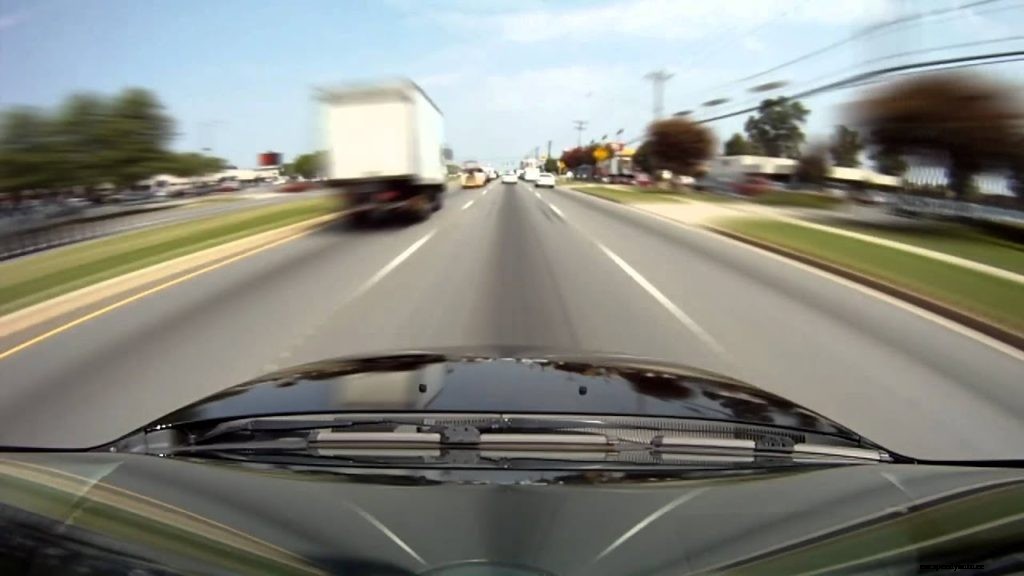
You may remember something from high school geometry class called “vanishing point”
. It’s the concept by which two parallel lines seem to get closer together and eventually converge the further away they get from you (think railroad tracks). You’ll apply the same concept while visualizing your “line” through a corner, keeping the throttle steady so your vehicle stays balanced through the turn and applying more gas as you come out of the turn. The further away that vanishing point is, the more you can hammer on the accelerator.
With today’s gas prices, there’s a good chance you’ve unconsciously embraced the practice of “coasting” in your daily driver. If you’ve ever gotten off the throttle while going downhill so you can watch your instant MPG readout on your dash spike 99+, you know what I’m talking about. With the slight exception of endurance racing, fuel efficiency is not something you’ll be concerned with when ripping around a track.
In short, don’t let your car coast.
You need to be doing one of two things when you take a corner or turn: accelerating or decelerating. And here’s the tricky part: you always need to be applying throttle during both. This is one of the hardest things for new racers to master. But it’s vital to keeping your car on the track.
When you remove throttle pressure on a corner, the rear of your vehicle becomes unbalanced. This accounts for the majority of spinouts on racetracks when new racers are behind the wheel. To maintain consistent throttle pressure, drivers must master the art of downshifting and “two-foot” braking. Using your left foot to brake while keeping the RPMs up with your right foot will ensure that the rear end of your vehicle stays under a consistent load, even though you’re slowing down. You’ll find that your car hugs the road better and you’ll be able to come out of those corners much more aggressively.
Driving fast is an exhilarating feeling and an exciting sport. But, like any sport, it takes a lot of practice to master. The great thing is that there are tracks all over the world open to amateurs and many have instructors on hand to help you master the art of driving fast. By utilizing the tips we’ve outlined above you’ll already be ahead of your competition before you ever get behind the wheel. So, get that new Viper you bought out to the track, be safe, and have fun!
