
When deciding to buy a new car, one of the things to consider are the safety features built-in, from adjustable headrest, anti lock brakes, traction control and seatbelts. Another safety feature in most cars that helps minimize the physical effect of a crash is the airbag.
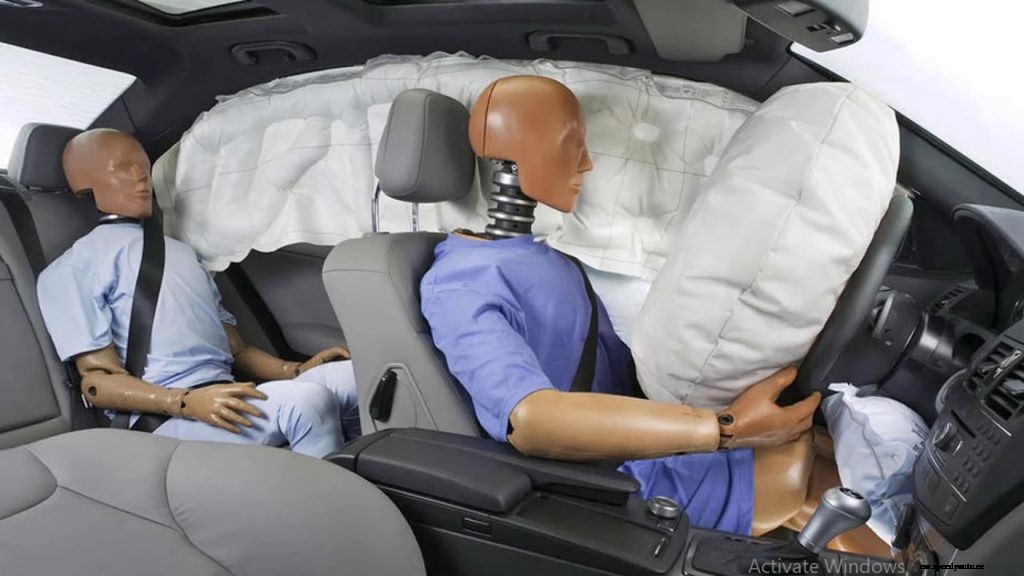
The purpose of an airbag is to cushion the head and neck from injury during the forward motion that occurs in a collision. It prevents the head from smashing into the dashboard, but with all the news regarding airbag recalls, it begs the question ‘how do airbags work?’, ‘what happens if they don’t function properly?’, ‘how safe are airbags?’, and ‘how did the idea come about?’
Turns out the airbag is one simple, yet clever safety feature. They have to inflate way faster than it takes a car to crash at over 200mph (300km/h). We’re curious, let’s look closer at how they work.
There’s energy involved in pretty much everything we do – and driving a car is one of them. Like most things, energy obeys certain precise laws of physics. The laws of motion are what make it possible for a vehicle to move and halt. We need to look at mass and velocity to get a better grasp as to how important this is – don’t worry, you can still understand how airbags work even if you don’t get this part.
Any object in motion has a mass; this basically means how much matter the object contains. This also contributes to how much it weighs. An object in motion also has velocity; this is related to speed, but it more of speed focused in a specific direction.
An object that possesses both velocity and mass is said to have kinetic energy. The amount of kinetic energy the body possesses varies with the mass and velocity of the object i.e. The greater the velocity and mass, the greater the kinetic energy it possesses.
As long as the object keeps moving, then this isn’t a problem until the object stops. This could be because you wanted the object to stop or because the object has been forced to stop by colliding into another object. Either way, the kinetic energy in the object needs to be transferred somewhere because it can’t simply disappear.
This explains why your brakes wear faster when you drive too fast and make sudden stops too often. The kinetic energy is handled by the brake pads. In the case of a collision, the energy is what causes damage to the car. Most modern cars are built to absorb most of this kinetic energy during a crash, but while this mitigates the damage, it doesn’t account for the occupants of the car, which are all objects with mass and velocity. Before airbags were a safety feature, it was just the seat belts that prevented the passengers from being propelled out of the car.
It’s undeniable that seat belts also play their part in saving lives during a car crash, they didn’t offer any protection to the head and neck. The seat belt holds you in the seat and restrict your torso from lunging forward, but not the head. The head and neck are pushed forward during this motion and snapped back very quickly, often damaging the joints and muscles of the neck.
The speed at which the vehicle is traveling matters a lot because, at a faster speed, the forward motion of the head and neck can ram it into the dashboard of the vehicle. The job of the airbag is to provide a soft cushion for the head and neck to land on instead of colliding with the car dash and also reduce head injury caused by the jolting effect that occurs when the head is suddenly propelled forward and backward.
The way this is possible is because of the unique operation of airbags. But, how does a compressed bag that fits inside your vehicle dashboard achieve these safety feats?
An airbag works by inflating faster than the head can hit the steering, as is the case in an accident. The initial idea for airbags was to use some sort of pressurized gas that inflates the airbag as soon as a collision occurs but this wasn’t fast enough (imagine trying to inflate a balloon to full size in a couple of milliseconds), so explosions were used instead – you read that right.
When sensors in the vehicle pick up an abrupt loss of velocity of the vehicle, it triggers the airbag circuit which sends an electric current to a heating element. When the heating element is red hot, it ignites a chemical explosive that gives off an enormous quantity of harmless gas to fill the nylon airbag.
The airbag is designed with tiny holes that help it deflate as soon as the head makes contact with it. Without this design, then the problem of sudden forward motion would not be solved as the head would simply bounce back towards the headrest.
So, how fast does the airbag inflate? The short answer, fast enough to cushion the head. But, it is even crazier than you think. Imagine what has to happen to cushion the head of the driver or passenger of a car traveling at 45mph.
Save for the last one, all of these have to happen in real time – before the head hits the bag. While it’s true that the seat belt also helps reduce the velocity in the case of a crash, and this gives the airbag some time to inflate, it doesn’t take anything away from the genius of this design. This is also why you need to use your seatbelt – even in a car equipped with an airbag, since both work hand in hand. Or better still, just watch where you’re going and read the road conditions better.
Airbags are classified as supplemental inflatable restraint (SIR) or supplemental restraint system (SRS). This means that the airbags are intended to work with seat belts to help protect you, and are not to be solely relied on. When airbags and seatbelts are used correctly, head-on vehicle collision fatalities have been found to drop by about 24%.
A quick search online returns multiple results with different people being credited for coming up with the idea. But, who first thought of implementing an airbag? It seems the idea first occurred to John W. Hetrick of Newport, Pennsylvania, after he crashed his car into a gully, almost launching his daughter through the windscreen while trying to avoid a rock. On August 5, 1952, he filed a patent for a Safety cushion assembly for automotive vehicles which was granted on August 18, 1953, as US Patent number 2,649,311.
Several months prior to Hetrick’s patent, a German by the name Walter Linderer filed a patent for an airbag that was granted after Hetrick’s. From the information available, it seems both inventors came up with the idea independently. Other inventors and engineers have tried to refine the idea since then, for instance, Allen K. Breed (1927-2000) came up with various ways of setting off the explosion as soon as the crash occurs.
Though very rare, airbags sometimes fail to trigger when they should and other times, as in the case of Takata’s airbags, the explosion creates too much force that ruptures and sends pieces of sharp metals flying towards the driver or passenger’s head.
Take the case of a 35-year-old Texas man killed in a 2002 Honda Accord. He bled to death in a head-on collision with another car because shrapnel from the airbag explosion fractured his windpipe, severed his jugular vein and carotid artery. How fast was he driving? Just over 30mph. According to the police report, one woman in Orlando looked like she was shot in the face.
While it’s true that modern airbags have been redesigned to ignite with less force than before, as well as improved driver education on their use, it is still not recommended to place rear-facing child seats in the front seat of vehicles where there’s an airbag. The violent explosion comes with a small risk of hearing loss and eye injury to children.
Now you know how airbags work, why they are installed, and how to use them efficiently. I think it’s fantastic that they do not deploy every time you make a sudden brake or stop at a signal light – it would have been pretty annoying, to say the least. They’re just one instance of how technology is implemented to make driving safe for all of us.
