
There’s a whole team of players working together to keep your vehicle moving in a straight line as you drive your car down the road. The front and rear suspensions are working in unison with the body and the frame, assisting the steering to give you the smoothest driving experience possible. In order for all these things to collaborate, they need to be in aligned with each other. This is where the front end alignment comes in.
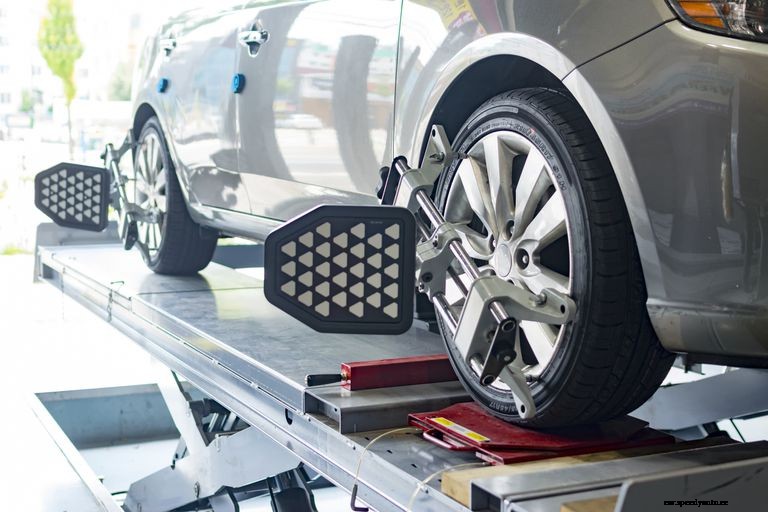
Front end alignments are actually four wheel alignments. It’s very important that the front wheels line up with the rear wheels. When checking your alignment, the technician is concerned with three things, toe, camber, and caster. Here’s how they work.
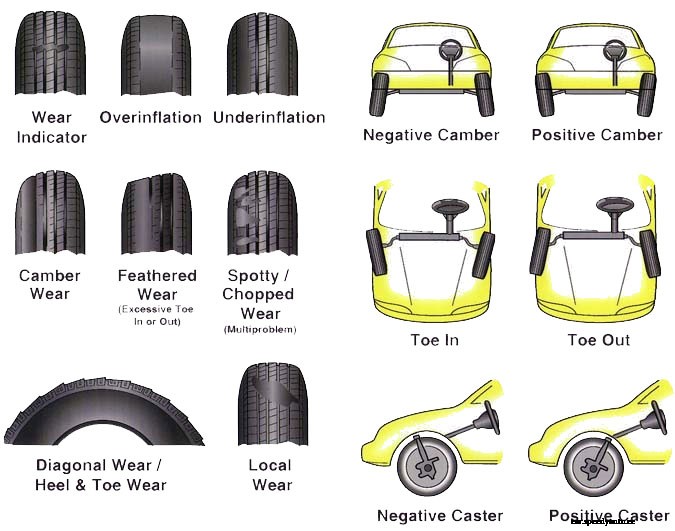
Imagine that you’re looking at your front tires from up above, with no hood lid or fenders blocking the view. Now picture your left tire is turned to the right and your right tire is turned to the left. In this case the front wheels are toed in. The front wheels are pointing towards each other.
Now picture your left wheel is turned to the left and your right wheel is turned to the right. In this case the front wheels are toed out. The front wheels are pointing away from each other.
The most common symptom of your toe adjustment being out of specification is an uneven steering wheel. This means that your steering wheel spokes aren’t centered. So while you’re driving straight, your steering wheel is making a slight turn. Out of spec toe can also greatly affect handling. A vehicle with an incorrect toe angle seems to try to follow the imperfections in the road. So if your car seems to want to catch a groove in the road and stay with it, you probably need an alignment. Another symptom of out of spec toe is tire squealing around turns. This is also a symptom of low tire pressures. Always check tire pressures.
An out of specification toe adjustment can be very hard on tires. It causes the tires to wear in a feathered pattern. You can’t always see this wear pattern, but you can feel it. Run your hand across the tire tread from inside to outside, then from outside to inside. If your tires are feathered, the tread will feel much rougher in one direction due to the tread wearing on an angle. Toe is measured in inches, millimeters, or degrees.
Camber is the angle of each individual wheel from top to bottom as viewed from the front of the vehicle. It is best described as how a tire leans. Negative camber is when the top of the tire leans inward towards the vehicle. Positive camber is just the opposite, and causes the top of the tire to lean outward away from the vehicle. Camber is measured in degrees, and in most cases the specification calls for the camber to be about 1 degree positive. This is why, when you look at almost any car or truck, the front tires are leaning slightly outward.
An incorrect camber angle can really raise hell with tires. I’m sure you’ve seen a tire that is worn considerably more on one side than the other. This is due to the camber being out of specification. If you notice one of your front tires leaning more than the other, you need to see a technician immediately. Quite often excessive camber angles are caused by worn and sometimes dangerous suspension components. Excessive wear on only one side of a tire is the most obvious sign that your camber is out of specification.
Caster is a very important front end alignment angle because it determines vehicle stability. It is the angle of your steering axis when viewed from the side of your vehicle. Looking at your front wheel from the side, imagine a line going straight through the center of the tire from top to bottom. That line represents the position of your front suspension. If your caster is within specs, that line will start towards the rear side of center at the top of the tire, go straight through the center, finishing at the front side of center at the bottom of the tire. This is positive caster. When the caster angle is negative, the axis line will start in front of center and finish behind center.
Caster is measured in degrees, and it’s essential that the caster angle at both front wheels is equal. The vehicle will always pull to the side of the negative caster. So if your right side caster angle measures at 1 degree positive, and the left side is 1 degree negative, your vehicle will pull to the left.
If the caster on both front wheels is too far negative, the vehicle will handle poorly. You’ll find that you’ll have a hard time keeping the vehicle moving straight down the road. Too much positive caster will have very little effect on handling. In extreme cases, too much positive caster can prevent the steering wheel from smoothly returning to center after completing a turn. Positive caster does put heavy wear on front suspension components, causing premature wear. Out of spec caster angle will not cause uneven tire wear.
All of these angles except for caster are available as an adjustment on the rear wheels of most front wheel drive vehicles. As mentioned earlier, it’s important that the front wheels line up with the rear wheels. This is what keeps the vehicle tracking in a straight line. Usually when a rear wheel gets knocked out of alignment, the steering wheel spokes won’t be centered. You also might notice that the vehicle seems to turn in one direction more easily than it does in the other direction.
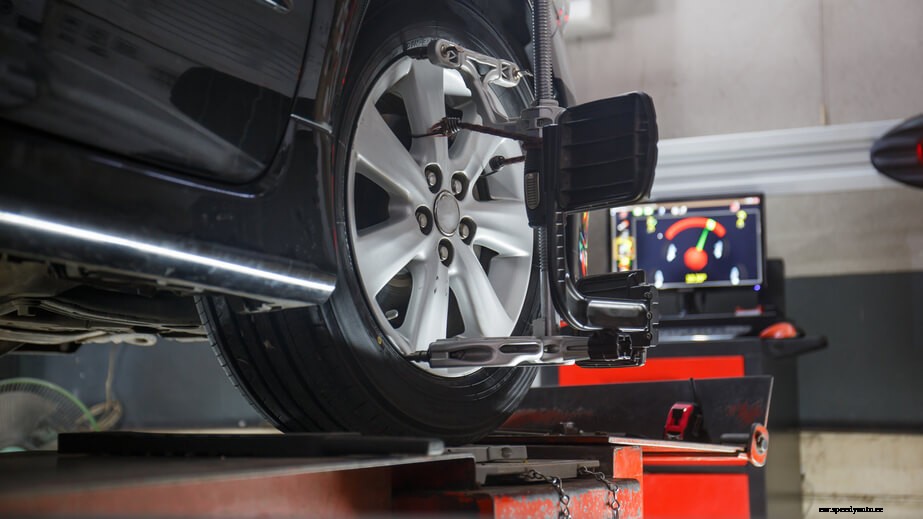
Under normal driving conditions, wheel alignment changes due to the natural wearing of steering and suspension components. Most of the parts that make up your suspension are mounted on rubber. Rubber is necessary because steering and suspension components are joined together, and quite often they move at the point of the union. Since metal to metal moving parts are bound to make a racket, rubber bushings are used to cushion the friction. The problem is that over time rubber tends to wear, and even come apart. This causes the position of steering and suspension components to change, altering the alignment angles.
Your alignment can also be knocked out of whack by hitting a curb or a pothole. In this case you need to get the vehicle checked out for bent or broken suspension components.
It’s most important that you are in tune with your vehicle. If your steering doesn’t feel right, or your suspension is noisy, bring it to the shop. Besides the obvious safety concerns, you could be saving your tires from an early demise.
You should also consider getting a four wheel alignment annually, as a maintenance item. Better safe than sorry.
