
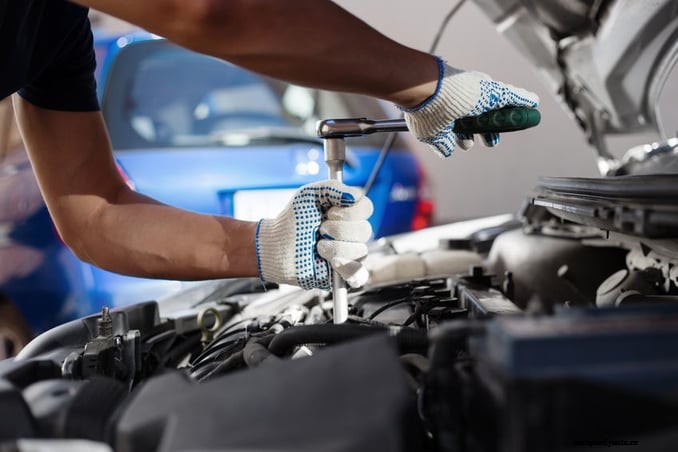
Regularly maintaining and servicing your vehicle to a good standard can keep you safe, extend your vehicle’s life, and save you money in the long run. When it comes to repairing and servicing your car, working with a trustworthy and professional auto mechanic or car repair shop is essential . Read on to find out what you can expect at your next car repair service.
Every vehicle owner should be concerned about maintaining and servicing their vehicle. While some repairs and services are relatively rare, others, such as oil changes, come up regularly. Common car repair and maintenance services apply to all types of vehicles and can include, but are not limited to:
When considering an auto service and repair shop, look out for ASE-certified auto mechanics who have the necessary experience and qualifications to service and repair your car to the highest standard. Lamb’s Tire & Automotive only employs ASE-certified technicians and it can be a convenient one-stop shop for all your car repair needs. Contact us now for further information and to schedule an appointment.
Depending on your budget and vehicle, you may have several options for replacement parts when repairing your car. Replacement parts can come as:
While OEM parts are new from the manufacturer and therefore the safest and highest quality parts, they come at a price and are typically the most expensive option. One distinct advantage of purchasing new OEM parts is that they come with a warranty.
Aftermarket parts are brand-new. However, they can be cheaper than OEM parts as they are manufactured by a third-party company and not the original equipment manufacturer. Aftermarket parts can come with a warranty.
Although used, remanufactured, reconditioned, or rebuilt parts have been restored to good working order. However, they may or may not come with a warranty.
Salvaged parts have been taken from another vehicle, without any alteration or restoration. While savage parts can be a good idea when no alternatives are available, using salvaged parts can come with safety and reliability issues.
When selecting any parts for repairing your vehicle, other than OEM, you should be aware of potential issues such as lack of warranties, or in the case of used parts, potential lack of reliability and safety. In certain instances, used parts can be a cost-effective option. In some cases, such as when repairing old cars, salvage parts may be the only option available. A reputable car repair shop can educate you on your options and explain the pros and cons of using these different types of parts.
Promptly identifying auto problems can potentially save you thousands of dollars. Picture yourself driving along. You suddenly notice a strange smell. However, rather than stopping and checking your car or driving straight to a repair shop, you keep going. Later on, it turns out that the strange smell pointed to a significant issue that needed immediate attention to stop it from further damaging your vehicle. As a result, you are left with a large repair bill that could have been avoided.
Consulting with an experienced auto mechanic or repair shop immediately when you notice something unusual can be crucial. When it comes to car issues, knowing what to look out for is important for your safety, as well as your wallet. Common signs of trouble can often be identified by sight, smell, sound, or handling.
Checking the outside of your vehicle and the ground underneath can help detect problems such as leaks.
Coolant and antifreeze leaks – If you notice a bright yellow-green, light blue, or bright orange fluid, you could have a radiator or coolant leak.
Engine oil leak – If you see a dark or black sticky fluid on the ground, this can be a sign of an oil leak.
Transmission or power steering fluid – If there is a red, oily-looking fluid underneath your car, it can indicate that there’s a transmission or power steering leak.
If you are noticing an odd smell in your car, chances are that something is wrong and you should investigate further. Smells and odors can occur from a number of issues, including:
Electric issues – If you notice a sharp burning smell, you may have an electrical short or burning insulation.
Catalytic converter – If there is a smell of rotten eggs in your car, there could be a problem with the catalytic converter or another emission control component.
Oil leak or old oil – If you notice a strong smell of oil or a bitter, burning odor, you may have an oil leak or might need an oil change imminently.
Overheated or stuck brake – An overheated or stuck brake typically comes with a strong burning chemical or rubber smell.
Coolant leak – A coolant leak can produce a sweet smell that is comparable to maple syrup.
Unusual sounds can point to engine problems and other car issues such as:
Brake wear – If you notice a high-pitched squealing sound, you may need to have your brakes checked immediately.
Defective exhaust pipe or muffler – A defective exhaust pipe can produce a low, rhythmic rumbling sound.
Worn crankshaft or worn connecting rod bearing – You may hear a heavy rhythmic sound or knocking with a worn crankshaft
Loose exhaust pipe or suspension components – Loose exhaust pipes and suspension components can produce a random, loud clanking noise.
A vehicle that is performing out of the ordinary, such as a vibrating steering wheel, or pulling to one side of the road, typically points to problems that need investigating.
Steering wheel vibration – A vibrating steering wheel can point to unbalanced tires.
Vehicle pulling to one side – An underinflated tire, misaligned wheels, or a brake issue could lead to a car pulling to one side while driving.
Brake sinks to the floor when pushed – A brake pedal that feels different can point to a serious brake issue and should be investigated immediately.
Finding a good car repair shop in Austin can be challenging. Your next best steps before committing to a shop or auto mechanic should include doing some research such as:
Since professional car maintenance is vital for your safety, you will want to work with a reputable auto shop that employs qualified technicians, uses quality parts, and generally has a high standard of service.
If you are looking for a professional and reputable one-stop car repair shop in Austin, Lamb’s Tire & Automotive is here for you. We are committed to offering our customers the highest standards in car maintenance and service by:
Stop by at one of your local Lamb’s Tire & Automotive shops in Austin for car repair or service.
