
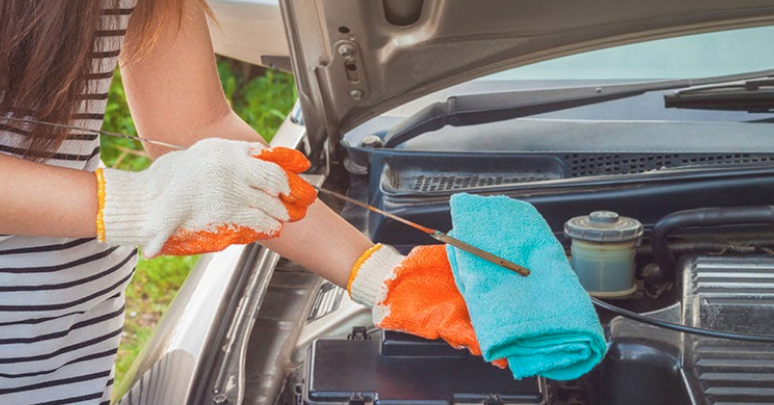
There are a lot of maintenance and repair operations on a car that most vehicle owners should not attempt to do themselves. Checking the oil is not one of them. It might be a good idea to pass on changing the oil if you are not mechanically inclined, and you should probably reconsider replacing your brake pads yourself, but there is no harm in checking your engine’s oil. In fact, it is a quick and simple process, and you should do it regularly.
Why do you need to check the oil?
Motor oil lubricates the moving parts inside your engine. Without sufficient lubrication, your engine would seize and see an early demise. So, it is essential that there is plenty of the right type of oil in your engine at all times.
You might ask, “My car comes equipped with an oil life monitor. Doesn’t that tell me when it is time to change the oil?” Well, yes. But it does not tell you the whole story.
Over time, motor oil breaks down from heat and stress. That is why it is necessary to change it frequently. As a convenient reminder, vehicle manufacturers began including an oil life monitoring system to alert you that it is time for your next oil change service. Depending on the make and model of your car, that could be anywhere from every 5K to 10K miles or more. Sometimes less if you drive in what they consider “special” or “severe” conditions.
But in between those oil changes, your car can lose oil. Sometimes that is due to an oil leak. But even a perfectly good engine can burn or lose oil. If truth be told, some manufacturers suggest that their engines will lose up to a quart of oil every thousand miles or so! While that sounds ridiculous, it is, unfortunately, not uncommon with modern motors. It is expected.
If your engine gets low on oil, the oil warning light could show up on your dashboard display to tell you that the oil pressure has dropped. By that time, engine damage could already be occurring from low oil pressure and an insufficient amount of oil.
Therefore, no matter how conscientious you may be about on time oil changes for your car, there is a fairly high likelihood that you would need to top off your oil in the meantime.
So, how do you check your engine oil?
To make sure there is always plenty of oil in your engine, check the level every couple of weeks or at least monthly. The process is pretty easy. All it involves is opening up the hood and removing a dipstick to discern what your engine oil is trying to tell you. It can be done in as few as five steps.
Before you begin, there are a few items that you will want to prepare. First, if you are not familiar with what’s under the hood, consider reading your vehicle owner’s manual where you will find a detailed description of where the dipstick is located. Next, get a lint-free cloth to wipe off residue from the dipstick. Finally, warm up your engine for a few minutes (a good time to check the oil is right after you return from a short trip to the market or when you stop at a station for gas). Turn the engine off before you open the hood and check the oil.
From there, follow these five steps:
A couple of other things you might notice when you are checking the oil, besides its level, are the smell and color of the oil.
Some auto owners worry about their engine oil appearing dark black in color. Most of the time, this is not a problem, since soot (a normal byproduct of combustion) gets in the oil and stains it black. But soot is not a problem in your oil if it is changed on time. On the other hand, if it is dark and discolored and you have skipped oil changes, the discoloration could be due to some other contamination and thermal breakdown.
Likewise, if your oil is dirty and you see or feel grit or tiny flakes of metal, those are problematic; your oil should be changed. And if you smell gasoline or a sweet syrup odor on the dipstick (or the oil appears milky), you should take your car to a mechanic as soon as possible, as those are signs of more severe engine problems.
