
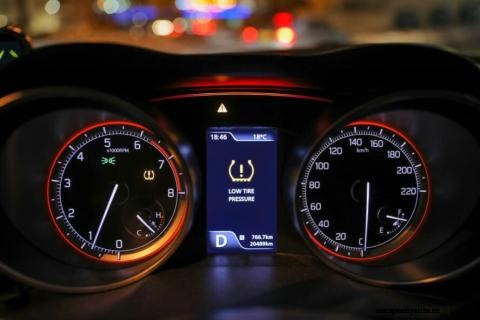
We recommend taking five minutes at the beginning of each month to check your tire pressure to help save you money and headaches down the road. But how do you check your tire pressure? We wrote this blog just for you to learn!
It’s not the tire that supports the weight of your vehicle but rather, the air pressure. So, it’s no surprise that tire pressure influences many important characteristics of vehicle performance, such as driving comfort, directional stability, cornering, and braking grip, plus the general handling behavior. Driving with incorrect tire pressure will have a negative influence on one or more of these important characteristics. So, it’s important to monitor tire pressure with frequency to ensure peak performance.
The tire pressures specified for your vehicle are agreed to between the vehicle manufacturer and the tire producer. The psi is based on your vehicle’s total weight and size, towing weight capability, and recommended tire size. These pressures are set to help keep you safe and comfortable on the road, so it is important to follow them. But how do you know what the recommended tire pressures are? Here’s a hint… The recommended tire pressures for your vehicle//tire combination can be found in your vehicle handbook, inside the fuel filler flap, or on the driver's doorpost. If you are not sure how to find this, you can always give us a call and we are happy to help!
Recommended tire pressures for your vehicle are based on cold inflation pressure. The gas expands when heated and contracts when temperatures decline. This means that you should check your pressures in the morning before the tire has been run, before the ambient temperature rises, and before exposure to direct sunlight. Hence, cold inflation pressure.
Daily temperatures rise and fall between day and night and as we move through the seasons. Tire pressures can fluctuate 1 psi for every 10-degree change in Fahrenheit, increasing in pressure with heat, and decreasing in the cold. The pressure inside warm tires will be higher because driving causes heat buildup. So, you should never reduce the pressure inside warm tires because when they have cooled down, the pressure could fall below the minimum tire pressure.
You can check your tire pressure right at home. As mentioned above, just be sure to check pressures when tires are cold or have not been driven in several hours. You will need an accurate tire pressure gauge which you can find at an auto parts store or get in touch with us and we can help you find one. There are battery-operated digital gauges and the more traditional stick-type gauge, either one will work and can be purchased for about $15, which pays for itself in no time with peace of mind.
If you’re still curious about how tire pressure works, here are some facts for you:
For more information please call SPARKS Complete Car Care.
