
Electric cars predate their gasoline cousins, and we had them even before the invention of the internal combustion engine. Electric cars, trams, trolleybuses, and carriages go back as far as the 19th century. However, range or mileage has always been the bane of all-electric vehicles. So how far do EV’s go in general?
Modern electric cars have a range from 200 miles (322 km) to over 600 miles (965 km) with a fully-charged battery pack. These ranges are per the brands and mileages rated by the EPA. The real-world range or mileage of these electric cars may be considerably less.
Contemporary electric cars are significantly different from gasoline and hybrid vehicles, but all of them have many variables affecting their range, such as load, environmental factors, and driving patterns. This article elaborates on the evolving ranges and how far electric cars can really go.
The first electric car wasn’t invented by one individual or enterprise. Inventors and entrepreneurs in the United States and many parts of Europe developed the earliest prototypes around the same time in the 1830s, such as Thomas Davenport in Vermont and Robert Anderson in Scotland.
Inventor Anyos Istvan Jedlik of Hungary created an electric car model with non-rechargeable primary battery cells in 1828.
Jedlik is also known for his pioneering work in conceptualizing the earliest electric motors and dynamos. A few years later, a Dutch professor Sibrandus Stratingh developed a small-scale electric car prototype with the assistance of Christopher Becker.
We wrote a helpful article on Which Electric Cars Can Go Over 500 Miles. Feel free to check it out!
However, Thomas Davenport and Robert Anderson developed the first practical electric cars.
Like Jedlik, Stratingh, and Becker, both Davenport and Anderson used non-rechargeable primary cells in their models as lead-acid batteries weren’t invented yet. The history of batteries is quintessential because the evolution of electric car range or mileage is inherently interlinked.
Electric cars weren’t viable until 1859 when French physicist Gaston Plante invented the rechargeable lead-acid battery.
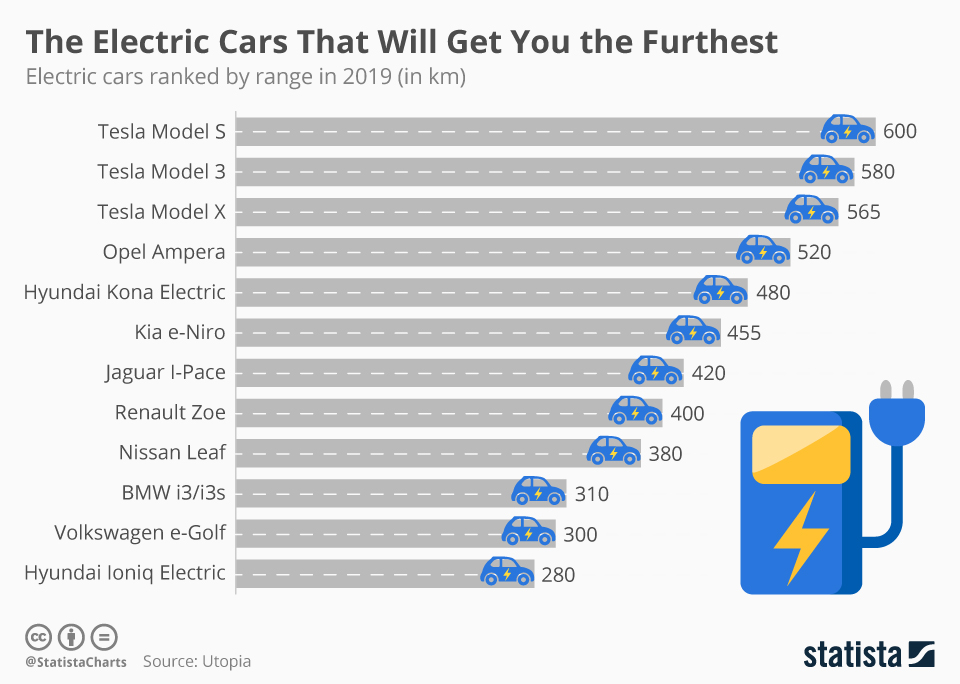 You will find more infographics at Statista
However, the battery didn’t have the requisite capacity to make electric cars practical on the streets until 1881, when Camille Faure made an improved version suitable for automobiles. In 1991, William Morrison introduced the first electric car in the US.
By 1897, New York City had electric taxis plying on the streets. Yet, electric cars did not become viable beyond the cities as much of the country did not have access to the power grid. The subsequent 100 years is primarily a history of trying to improve electric cars’ range or mileage.
Here’s a video of the Electrobat as New York City taxis, circa 1895:
| Brand / Model | Range or Mileage | Years in Production |
| The Electrobat | 25 miles (40 km) | 1894 to 1900s |
| Studebaker Electric | 30 – 40 miles (48 – 64 km) | 1902 to 1912 |
| Ford Comuta | 37 miles (60 km) | 1967 |
| Detroit Electric | 70 – 100 miles (112 – 161 km) | 1907 to 1939 |
| Henney Kilowatt | 40 – 47 miles (64 – 75 km) | 1959 to 1960 |
| General Motors Electrovair | 40 – 80 miles (64 – 128 km) | 1964 to 1970s |
| CitiCar | 40 miles (64 km) | 1974 to 1977 |
| General Motors EV1 | 80 – 160 miles (128 – 257 km) | 1966 to 1999 |
The evolution of electric cars and their range or mileage is invariably linked to the histories of motors and batteries. Incidentally, gasoline cars succeeded in beating the urban popularity of electrics during the early 20th century only because an electric motor solved the starter issue.
The primitive hand-crank method to start the internal combustion engines powered by gasoline wasn’t popular among the city folks, especially women. Unsurprisingly, the earliest electric cars throughout much of the 20th century were particularly popular among the women living in cities.
Likewise, the modern electric car is viable only because of the evolution in battery technology.
If you would like to find out how MPGe compare with MPG and what it means, feel free to check out this helpful article!
All-electric, plug-in hybrid electric, and hybrid electric vehicles have used nickel-metal hydride, lead-acid, and lithium-ion batteries over the decades, with the latter becoming the standard now. Beyond the basic difference among the batteries, the specific cell technology or chemistry determines all the attributes of the pack that goes into an electric vehicle.
Hence, Chevrolet and General Motors or Ford and Nissan offer a significantly different range than a Mercedes or Tesla.
| Brand / Model | Range or Mileage | Notes |
| Toyota Prius | 6 – 25 miles (9.5 – 40 km) | On EV mode |
| Ford C-Max Energi | 20 miles (32 km) | All-electric driving range |
| Honda Clarity | Up to 47 miles (~75 km) | On EV mode |
| Chevrolet Volt | 25 – 50 miles (40 – 80 km) | All-electric driving range |
| Smart Fortwo ED | 68 miles (109 km) | Real-world mileage varies |
| Chevrolet Spark | 82 miles (132 km) | |
| Nissan Leaf | 149 – 226 miles (239-362 km) | Standard & Plus models |
| Tesla Roadster | ~200 miles (322 km) | First-generation |
| BMW i3 | 150 – 200 miles (241-322 km) | The upper limit isn’t EV mode |
| Chevrolet Bolt | 259 miles (417 km) | EPA estimate |
| Tesla Model S | 208 – 265 miles (335-426 km) | Standard & Long Range |
| Hyundai Ioniq 5 | ~300 miles (480 km) | |
| Hyundai Kona Electric | ~300 miles (480 km) | |
| Kia EV6 | ~300 miles (480 km) | |
| Volkswagen ID.4 | 260 miles (418 km) | Base model |
| Skoda Enyaq iV 80 | 280 miles (452 km) | 82 kWh @ 56mph / 90km/h |
| Ford Mustang Mach-E | 230 – 305 miles (370-491 km) | EPA estimate (2022 model) |
| BMW iX | ~300 miles (480 km) | |
| Polestar 2 | 298 – 335 miles (479-539 km) | 245 miles (one estimate) |
| Tesla Model Y | ~330 miles (531 km) | 2022 version |
| Tesla Model 3 | 315 – 358 miles (507-576 km) | Subject to model/year |
| Mercedes EQS | 350 miles (563 km) | EPA estimate |
| Tesla Model X | 360 miles (579 km) | Long-range variant |
| BMW i4 | 245 – 365 miles (394-587 km) | Subject to variant |
| Mercedes EQE | ~400 miles (644 km) | |
| Tesla Model S | 405 miles (652 km) | Long Range Plus |
| Lucid Air | 520 miles (837 km) | Official EPA range |
| Tesla Roadster | 620 miles (998 km) | With 200 kWh battery |
Tesla and Lucid Motors offer the longest ranges with their new Roadster and Air models capable of clocking around 620 miles (998 km) and 520 miles (837 km), respectively. A few Mercedes, BMW, Ford, and Volkswagen electric cars can deliver ~400 miles (644 km).
There’s a significant difference between EPA estimates and real-world ranges.
Also, mileage isn’t a universally-applicable metric that won’t waver in specific circumstances. More than half a dozen factors weigh decisively on the actual mileage you’ll experience with every electric car. All-electric cars underperform in cold conditions, and the extent to which a particular model’s mileage may deteriorate in certain circumstances varies.
For instance, cold weather coupled with strong headwinds and an uphill drive will potentially wreck the EPA-estimated mileage.
Furthermore, people often encounter contradictory experiences, such as a Volkswagen ID.3 EV outperforming a Skoda Enyaq and vice versa. Similarly, you may have interesting accounts about a Tesla, Ford, Mercedes, or BMW. Lucid Motors is yet to be tested for its Air electric cars.
Despite being the oldest automobile technology, the batteries in electric cars and the various possibilities are still at a nascent stage in the modern context. Besides, rechargeable batteries and diverse chemistries of cells, modules, and packs have undergone unprecedented evolution.
Electric cars can go long distances, such as beyond 300 miles with a fully-charged battery, as proven by Tesla, Mercedes, Skoda, Ford, and BMW. How much such ranges will vary in the real world is an entirely subjective matter, so is the extent of battery degradation in time.
Tesla’s new Roadster and Cybertruck are the best electric cars for mileage. The official claims for the two models are 620 miles (998 km) and 500+ miles (804+ km), respectively, thus making them the top 2, even if the real mileage is 10% less than the EPA estimates.
However, the range isn’t synonymous with the mileage.
Electric cars don’t have internal combustion engines running on gasoline, so you cannot calculate the mileage using the conventional method of miles per gallon. Instead, the battery capacity and energy consumption become the base to calculate the cost of recharging a particular model for its maximum range.
Take the example of Skoda Enyaq.
These figures are way below the estimates and claims.
In contrast, the Tesla Model X Long Range delivers ~290 miles (466 km) against the claim of 330 miles (530 km) combined range (city/highway & mild weather). This real-world mileage is after the initial battery degradation of around 5% that happens in the first few months of the car.
This mileage discrepancy is also evident when you compare the ranges of Mercedes and BMW electric cars, among other brands, as published in the United Kingdom and here. Both Mercedes and BMW have higher range claims in the UK, but EPA estimates bring those down.
Mercedes, BMW, and even Ford claim longer ranges in several estimates, but the real-world mileage may or may not match the figures. On the flip side, EPA estimates aren’t carved in stone, as one recent test has revealed, in which Mercedes EQS outperformed Tesla Model S.
The EPA estimates the Mercedes EQS 450+ to have a range of 350 miles (563 km).
However, the Mercedes model covered 422 miles (679 km) during a real-world test at the Los Angeles loop, where most other electric cars embark on a similar 12-hour drive. Thus, the EPA rating is conservative.
The Tesla Model S Long Range Plus has an EPA estimate of 405 miles (651 km). If this figure is conservative, too, Tesla may beat the Mercedes model by several miles. However, that’s yet to be seen.
Until recently, though, Tesla and Lucid remained undisputed superiors in this category.
According to industry trends and experts, electric cars may go 600 miles (965 km)by 2025. Electric cars are routinely clocking up to 300 miles (483 km) now, with a few premium long-range models covering more than 400 miles (644 km) with a fully-charged battery.
The three leading brands, Tesla, Lucid Motors, and Mercedes, are logged in a perpetual war to outdo one another. Mercedes has temporarily beaten Tesla with its EQS, but fortunes may change as Musk and co roll out the new Roadster and Cyberstruck.
Also, Lucid Motors may surprise the market and their first owners with the initial range of Air models and other variants.
Tesla has been working on more affordable batteries to reduce the costs of its standard range cars. Now, Tesla is switching to new battery technology. Like many fans claim and critics counter, Tesla is, in a way, a battery company, with more than a few innovations in development.
Mercedes has already beaten Tesla and Lucid by attaining a 0.20 drag coefficient, thereby making the EQS the most aerodynamic electric car available today. Further efficiency in designs, probably at the cost of traditional aesthetics, will complement evolving battery tech.
Considering the origin, history, and contemporary evolution of electric cars, one can conservatively predict that future models will effectively clock 1,000 miles (1,609 km) before requiring a recharge.
Also, such a tectonic shift may happen before the end of this decade.
The leading brands, such as Tesla, Lucid, Mercedes, and the likes of BMW, Volkswagen, Skoda, Ford, and Chevrolet, have a new paradigm now because people know the real-world viability of electric car batteries and the reliability of their ranges or mileage.
