
The 2020 Toyota Prius goes head to head against the Prius Prime. Each has its unique characteristics. But which one is right for you? Let’s take a closer look to find out which one will be crowned champ. There can only be one highlander, I mean, Prius.
The Toyota Prius is the legendary hybrid that began in the late 1990s. To date, Toyota has sold over 4.3 million Priuses (Pri?) per Business Insider. With almost instant success, Toyota created a car that was cheap, efficient, and unique. Even if car shoppers were only looking for two of those traits, the Prius became a status symbol for the economical.
Since the first generation, the conventional hybrid offered a MPG of over 40. This was a substantial improvement over standard gas cars that only offered 20 MPG during that same time.
After years of success, Toyota introduced a slight twist to the Prius. In 2016, Toyota introduced the Prius Prime. In 2012, Toyota released a previous version of the Prius Prime, known as the Prius Plug-In Hybrid. That particular Prius was in limited production for a short time.
Rather than a conventional hybrid powertrain of the Prius, the Prius Prime is a plug-in hybrid electric vehicle (or PHEV). Not only did the Prius Prime compete against itself (the regular Prius), but also against the Chevy Volt PHEV.
What is the difference between a conventional hybrid and a PHEV? A conventional hybrid uses gas as the primary source of energy and recharges the small battery slowly while driving. The small battery provides a slight boost to the vehicle’s efficiency through the driving experience. The small battery cannot be recharged by plugging in nor can it solely propel the vehicle on electric power alone.
On the other hand, a PHEV has a larger battery that can be plugged in to charge. The PHEV can drive solely on electric power until the battery is depleted, then the gas engine kicks in.
As of today, about 1/3 of total Prius sales are Prius Primes per Motor Trend and InsideEVs. Why did those individuals select Prime rather than the regular version? In a three-round competition, let’s review each vehicle’s specs, pricing, and cost of ownership to find out which is the better Prius.
The regular Prius is available in L Eco, LE, XLE, Limited, LE AWD-e, and XLE AWD-e trims. The Prius Prime is only available in LE, XLE, and Limited. Obviously, there are many more trims to choose from with the regular Prius. Most notably, only the regular Prius offers AWD as an option.
Besides the additional three trims offered with the regular Prius (L Eco, LE AWD-e, and XLE AWD-e), the Prius and Prius Prime LE, XLE, and Limited trims are nearly identical. The main exception is the regular Prius includes three packages: Premium Convenience Package, Advanced Technology Package, and Advanced Technology Package with Options.
Each vehicle includes a 121 HP (90 kW) motor that propels the car at 54 MPG while using gas.
With the Prius Prime (being a plug-in hybrid), an 8.8 kWh battery propels the car at 133 MPGe. Yes, that is correct. In EV mode, the Prius Prime is more than twice as energy-efficient than while using gas. Electric power is much more efficient than gas. In electric mode, the Prius Prime can travel 25 miles on electric before the seamlessly gas kicks in.
So who wins this round? Well, the regular Prius offers AWD as an option. For some, that is a must-have. On the other hand, the Prius Prime has an MPGe of 133 while in EV mode. If you thought the regular Prius MPG of 54 was great, the Prius Prime (and other EVs) put it to shame.
Round 1 Winner: Tie
The regular Prius starts at $24,325 with the L Eco trim. The Prius Prime starts at $27,750 with the LE trim. All things being equal, the regular Prius LE trim starts at $25,535. In other words, the Prius Prime is $2,215 more expensive than the regular Prius. But wait, there’s more math to do.
The Prius Prime is eligible for the federal electric vehicle tax credit and available state, local, utility, and air district EV rebates. Just including the federal tax credit of $4,502, the Prius Prime net starting cost is actually $23,248. Therefore, the net starting cost of the Prius Prime is really $2,187 cheaper than the regular Prius. Add in other incentives and the cost is even lower.
All things being equal, the Prius Prime is a much better option in this round. For the base LE trim, the Prius Prime is cheaper than the regular Prius. Even if charging at home is a challenge, the Prius Prime would technically be a better financial decision. Regardless, an occasional charge at public charging stations would allow drivers to take advantage of the impressive 133 MPGe EV mode.
Round 2 Winner: Prius Prime
Using the Plugstar EV calculator and default assumptions (12,000 miles/year, 50% EV mode, California electric and gas rates, and cash purchase), the results remain clear that the Prius Prime again is on top. Over five years of ownership, the regular Prius costs $30,248 while the Prius Prime costs $26,374. In other words, the Prius Prime is $3,874 cheaper than the regular Prius over five years of ownership.
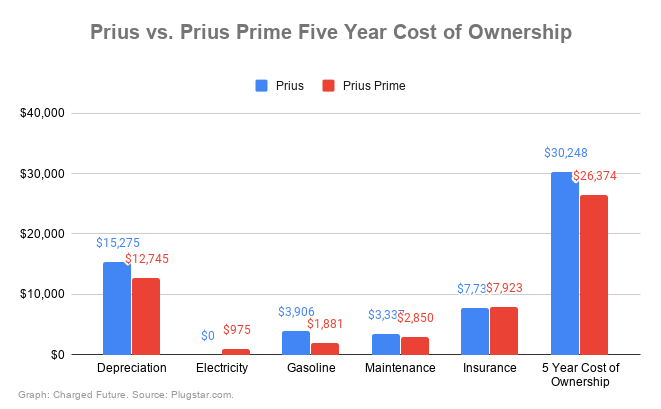
Unsurprisingly, the Prius Prime is the cheaper vehicle to own over five years of ownership. As found in the last round, the Prius Prime is also cheaper at the time of purchase than the regular Prius. Since the Prius Prime is much more efficient given it’s PHEV powertrain, the savings keep going throughout the years of ownership.
Round 3 Winner: Prius Prime
The Prius Prime wins the competition with two wins and one tie. The regular Prius only claimed one tie and no wins. It is important to note that the regular Prius does offer much more trims and packages than the Prius Prime. At the moment, the regular Prius is the best bet for those who want AWD.
