
DS Automobiles is a French luxury automotive brand, which was launched in 2009. Though it was initially part of the PSA Group (Citroën DS), it was launched as a standalone brand in 2014. The French marque was developed by the PSA Group to include a more premium brand in its portfolio. DS Automobiles was inspired by the original DS unveiled at the 1955 Paris Motor Show. The company is also involved with Formula E.
In fact, electrification has been part of the brands strategy from its creation. The company claims, ‘the lowest average CO2 emissions in Europe (100.2 g/km of CO2 according to the WLTP cycle per registered car in the first half of 2021) and more than a third of its cars are electrified. This strategy is accelerating: from 2024, every new DS Automobiles model will be exclusively 100% electric”.
The company currently has the following battery-electric vehicles (BEVs) and plug-in electric vehicles (PHEVs):
For those of you new to zero-emission electric driving, we recommend a read of the following articles:
The DS 7 was first unveiled in 2017, at the Geneva Motor Show. The compact luxury SUV initially had ‘Crossback’ included in its name, however, that has been dropped. The DS 7 is also based on the Efficient Modular Platform EMP2 platform. The new (updated) DS7 PHEV has been available since October 2022. Though an improvement from its predecessors, the updated PHEV is not class-leading.
In general, given the significant improvement in the range of pure electric cars, owning a plug-in hybrid electric vehicle (PHEV) has become less compelling i.e. range anxiety is not such a significant concern for consumers seeking to migrate to electric driving.
Therefore, for plug-in hybrid electric cars to truly offer a strong proposition to consumers, the electric vehicle (EV) has to offer longer emission-free electric range and reduced tailpipe emissions i.e. the vehicle has to be more environmentally-friendly and efficient.
Though the updated DS 7 PHEV has lower tailpipe emissions (26g – 40g CO2/km), compared to the conventional internal combustion engine (ICE) variant (134g CO2/km), the emissions are not class-leading. As an example, the Range Rover Sport plug-in hybrid has tailpipe emissions as low as 20 – 18g (CO2/km), which is certainly class-leading.
Also, in terms of the zero-emission electric range, the DS7 PHEV is not class-leading. It has an average sized onboard EV battery (14.2 kWh), with a claimed WLTP electric range up to 43 miles. Adjusting for real-world driving conditions, one can expect to achieve 35 miles on a fully charged battery. Not as impressive as the list of the Longest Range Plug-In Hybrid Electric Cars 2023.
Bottom-line, to truly leverage the benefits of driving a PHEV on electric mode, adequate electric range is imperative. If the electric vehicle (EV) is driven primarily using the internal combustion engine (ICE), it would be a significant challenge to achieve anywhere near the claimed fuel efficiency of the electric vehicle. The manufacturer claims up to 250 mpg.
Like most PHEVs, the DS 7 PHEV does not incorporate DC charging. However, not surprising, given the size of the onboard EV battery. The EV does incorporate a single-phase 7 kW AC onboard charger, but not as standard for all variants. The entry-level E-Tense 225 has a 3.7 kW AC onboard charger. A pity, given the price tag of the EV!
We discourage using a 3-PIN domestic plug for charging an EV, and encourage the use of a dedicated residential EV charger like myenergi zappi. Using a single-phase EV charger, the onboard EV battery can be fully charged in 1 hour and 45 minutes. Using a domestic socket will take up to 7 hours to achieve 0%-100% charge. We encourage plug-in hybrid owners to adopt a ‘topping up’ approach to charging an electric car. This way, there is always available emission-free electric miles!
We also encourage businesses and families to install an on-site renewable energy system, like, a solar PV system or wind turbines, coupled with battery storage. It further enhances the benefits of electric driving, to include, zero-tailpipe ‘well-to-wheel’ emissions when driven on e-mode. Of course, there are also financial savings when a plug-in hybrid is driven on electric mode. Far cheaper than calling on the petrol engine!
The 1.6-litre petrol (4 cylinders) direct injection turbocharged DS 7 plug-in hybrid is available as both, a front-wheel drive (FWD) and an all-wheel drive (AWD). The E-Tense 225 is front-wheel drive, while both the E-Tense 4X4 300 and the 4X4 360 are all-wheel drive. The EV can achieve 0-62 mph between 5.6 – 8.9 seconds, and has a top speed up to 146 mph. Maximum power is up to 355 hp and torque up to 520 Nm. The EV incorporates regenerative braking.
In terms of technology and features, the EV offers: rear parking sensors, front parking sensors, reversing camera – 180° Vision, cruise control with speed limiter, hill start assist, 12.3 inch digital instrument cluster, 12 inch HD touchscreen, Apple CarPlay and Android Auto. Other features include: emergency braking system, blind spot detection, lane keeping assist, extended traffic sign recognition and driver attention alert.
The interior cabin quality is premium, and does reflect the brands upmarket positioning. There is ample legroom and headroom, however, for taller adults seated at the rear, it may feel like a squeeze. The available boot space is 555 L.
Company-car drivers can take advantage of the lower Benefit-in-Kind (BiK- from 12%) for the PHEV. Bottom-line, electric driving is good for the environment and the wallet. You can lease electric vehicles (EVs) via e-zoomed at very competitive prices!
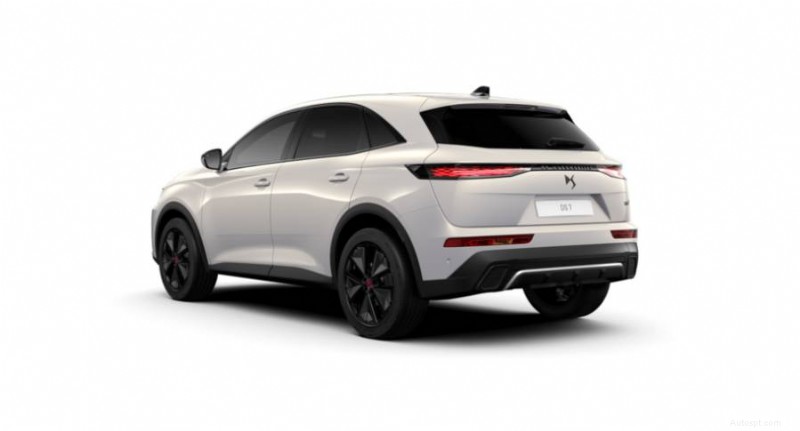
The DS 7 E-Tense PHEV SUV (credit: DS Automobiles)
While e-zoomed uses reasonable efforts to provide accurate and up-to-date information, some of the information provided is gathered from third parties and has not been independently verified by e-zoomed. While the information from the third party sources is believed to be reliable, no warranty, express or implied, is made by e-zoomed regarding the accuracy, adequacy, completeness, legality, reliability or usefulness of any information. This disclaimer applies to both isolated and aggregate uses of this information.
