
Skoda Auto a.s., more commonly referred to as Skoda, is headquartered in the Czech Republic. The founders of Škoda, Václav Laurin and Václav Klement were initially involved with the manufacturing of bicycles and motorcycles. In due course they progressed to trucks and eventually to cars, establishing Skoda in 1925.
From 1948 the company was state owned. In 1991, the company began partial privatisation and become part of the German automotive group, Volkswagen AG in 1994. The company became a wholly owned Volkswagen subsidiary in 2000. The Skoda brand has come a long way since then. Skoda vehicles are now sold in over 100 countries with over 1.25 million annual units sold globally.
Skoda is committed to an electrification strategy. The Citigo-e IV was the first all-electric vehicle from Skoda. Order books for this BEV opened in December 2019. The sales of the Citigo-e IV EV was terminated in 2020. Since then, Skoda has launched a number of EVs. The company currently has the following battery-electric vehicles (BEVs) and plug-in hybrid electric vehicles (PHEVs):
For those of you new to zero-emission electric driving, we recommend a read of the following articles:
The Skoda Octavia family car has been manufactured since 1996. The model is currently on its fourth generation. The Octavia has sold well since its introduction, with more than five million cars sold. The fourth generation Octavia was unveiled in Prague in November 2019. Deliveries commenced in 2020. The Skoda Octavia is also available as a plug-in hybrid electric vehicle (PHEV).
The Skoda Octavia hatchback has been a family-favourite for sometime, in particular, with those keen on affordability. With the introduction of the PHEV variant, the Skoda hatchback value proposition has become even more compelling. Driving a PHEV on the emission-free electric mode is cheap, in comparison to using the petrol or diesel engine. Depending on the cost of charging, driving an electric car will cost between 5 pence and 10 pence per mile.
The Skoda Octavia hatchback plug-in hybrid has a 13 kW onboard EV battery, quite typical for PHEVs in this price segment. The manufacturer claims an EV range up to 41 miles (WLTP certified). Even adjusting for real-world driving, the electric car should be able to achieve up to 35 miles, which is reasonably good in comparison to other plug-in hybrid electric vehicles.
Do keep in mind that the majority of family trips are short distances i.e. school-runs, grocery store, shopping etc. The average distanced travelled in a day in the UK is 30 miles (2/3rd motorists), so an electric range up to 35 miles is more than sufficient to take advantage of the benefits of pure electric driving.
Even, for those that drive to work, driving on electric mode works well, as the electric car can be charged at home and at work (workplace EV charging)! For those weekend getaways, the petrol engine can be utilised for the longer drive.
Taking advantage of the EV range will also require inculcating a habit of charging the EV on a regular basis, which again is as easy as charging a smartphone. We at e-zoomed discourage the use of a domestic 3-PIN plug for charging an electric car. A ‘topping up’ approach to charging will help improve the overall efficiency of the electric vehicle and also improve the long-term maintenance of the onboard EV battery. Skoda offers a 8 years or 100,000 miles warranty.
The PHEV is not DC charging compatible (most PHEVs are not) and has a 3.6 kW onboard charger. The PHEV can be fully charged in 3.5 hours. Using a 3-PIN socket will take up to 5 hours. In any case, we at e-zoomed recommend charging the EV overnight, when the electricity tariff rates are cheaper. Of course, we also encourage using green energy to charge the EV!
Moreover, driving on e-mode improves the efficiency of the vehicle i.e. lower motoring costs! Skoda claims the PHEV has a fuel economy up to 284.1 mpg. Real-world economy will certainly be lower, but substantially better compared to the conventional internal combustion (ICE) variant (52.6 mpg).
Though the Octavia plug-in electric car will not deliver a ‘Ferrari acceleration’, the PHEV offers decent performance, appropriate for this type of family car. The 1.4-litre TSI iV petrol engine (4-cylinders) is paired with an electric motor. The plug-in electric car can achieve 0-62 mph in 7.7 seconds.
The top speed of the EV is 137 mph. The total system performance is up to 245 PS and 250 Nm torque. Certainly suitable for city and motorway driving. Of course, do keep in mind that the EV also benefits from instant torque.
Practicality is a strong point for the Octavia PHEV. The vehicle offers generous interior cabin space for front and rear seat passengers, to include legroom and headroom. The EV is certainly comfortable. The boot space has been reduced due to the placement of the onboard EV battery. Nevertheless there is up to 450 L cargo volume on offer!
For company-car drivers, there is the added benefit of lower Benefit-in-Kind (BiK-8%) tax bills, given the lower tailpipe emission of the PHEV (36g CO2/km), compared to the conventional internal combustion engine (ICE) variant (157g CO2/km). The plug-in electric car does not qualify for the UK government plug-in car grant (PiCG).
Bottom-line, electric driving is good for the environment and the wallet. You can lease electric vehicles (EVs) via e-zoomed at very competitive prices!
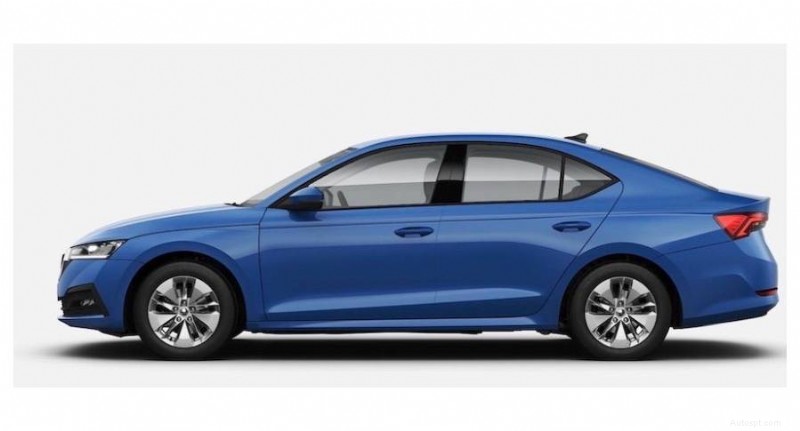
The Skoda Octavia Plug-In Hybrid Hatchback (credit: Skoda)
While e-zoomed uses reasonable efforts to provide accurate and up-to-date information, some of the information provided is gathered from third parties and has not been independently verified by e-zoomed. While the information from the third party sources is believed to be reliable, no warranty, express or implied, is made by e-zoomed regarding the accuracy, adequacy, completeness, legality, reliability or usefulness of any information. This disclaimer applies to both isolated and aggregate uses of this information.
