
As we tracked and discussed previously over the past few years, the upcoming 2022 California Building Code, which goes into effect January 1, 2023, will now include a requirement for electric vehicle (EV) chargers at both residential and non-residential properties. This update to Part 11 Green Building Standards of the code goes hand-in-hand with other ambitious California EV regulations and goals.
With hundreds of millions of dollars in funding for EV charging infrastructure, a governor’s goal for manufacturers to only sell EVs in the state by 2035, and a complete overhaul of the grid energy sourcing, California is well ahead of other states in both EV sales and EV adoption rates. In fact, per California New Car Dealers Association, during the first half of 2022 the EV adoption rate for new passenger vehicle sales is at an all-time high of 18 percent. This is a stark contrast to the national rate at a mere 4 percent.
With the update to the building code, California aims to install more charging stations at all types of properties such as apartments, shopping centers, workplaces, and more. Before we dive into the approved code changes, lets first review key terminology and definitions.
Now onto EV charging requirements in residential developments as part of the 2022 California Building Code. The following information is detailed in Chapter 4: Residential Mandatory Measures. The biggest change from the previous code is now EV charging (a charger) is required for certain types of projects.
For example, for multi-family or hotel developments of 20 or more units, 5 percent of the parking must include Level 2 AC chargers. Furthermore, 10 percent of the parking must be outfitted for EV Capable (future installation) and 25 percent of the parking shall be constructed with EV Ready (208/240V outlets for portable EV chargers).
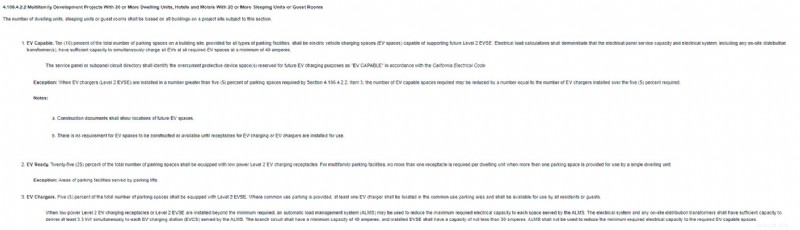 EV Charging Requirements at Large Residential Developments
Altogether, large residential developments will see 40 percent of parking outfitted with some form of EV charging infrastructure. This is a large change from the previous California Building Code, which only required 10 percent for EV Capable.
Furthermore, the code does not simply require chargers at new residential developments, but it is also context-sensitive with the “low power EV charging” requirement–also known as EV Ready. With sites such as apartment complexes, condominiums, and hotels, the vehicle dwell time is usually overnight. Therefore, it is cost-effective to install EV charging infrastructure that is appropriate for those kinds of property types. Low power (20A 208/240V) EV charging is significantly less expensive than typical Level 2 chargers, and extremely less expensive than DC Fast Charging.
Moving forward, EV charging requirements in non-residential developments (Chapter Five of the Green Building Standard) also see a major change from the previous code. For non-residential developments (such as commercial, office, industrial, educational, etc.), the EV charging requirements are linked to the number of parking stalls as shown below.
As you can see, sites with nine or fewer parking spaces will not be required to provide EV Capable or EV chargers. Sites with 10-25 parking spaces will need a handful of EV Capable spaces. Sites with 26 or more parking spaces will need both EV Capable and EV chargers. For large sites with over 200 parking spaces, 20 percent for EV Capable and 25 percent of EV Capable for EV charging.
It is important to note the code also includes a section that permits the installation of a DC Fast Charger to supplement five AC chargers.
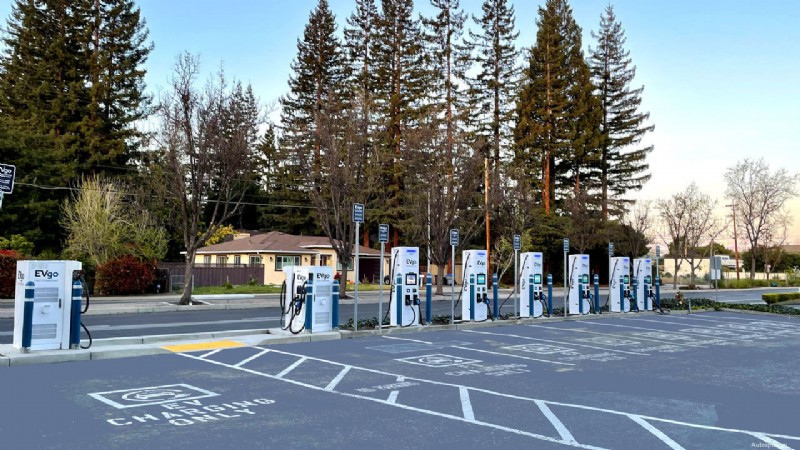 DC Fast Charging | EVgo
Lastly, the code includes a section on future EV infrastructure for medium and heavy-duty EVs at locations such as warehouses, grocery stores, and retail centers.
Exceptions and Additional Notes
In both the residential and non-residential chapters, there are notable exceptions to this new regulation which will be interpreted and enforced by the Authority Having Jurisdiction (AHJ). Not all projects will be required to comply with EV charging regulations.
Another noteworthy mention in the revised code is the inclusion of the Automatic Load Management System (ALMS). In certain circumstances, an ALMS may be used in order to reduce the overall electrical load from the EV chargers. This is a great inclusion in the code as both advocates and opponents to EVs are concerned about the impact of EVs to the grid. With an ALMS, the chargers can communicate with one another and can throttle power output as needed to remain within the constraints of the electrical grid or site power capacity.
Lastly, the new California Building Code acknowledges EV charging spaces as parking spaces when assessing parking calculations for new developments. This is a critical piece of the code as it allows developers to not “lose” any parking to EV charging spaces since they are treated as two separate uses. That being said, when EV chargers are installed, that space is to be used only for the purpose of charging an EV. An internal combustion engine vehicle or even an EV may not park there without charging. Several jurisdictions and property owners are already taking action on this by fining vehicles and/or towing them.
Unchanged EV Charging Sections of the California Building Code
Most notably, accessibility when it comes to EV charging has remained unchanged from previously adopted codes. Projects that are public will continue to be required to provide accessible accommodations, such as larger stalls and access aisles for mobility impaired patrons, appropriate parking and path of travel signage, and path of travel improvements.
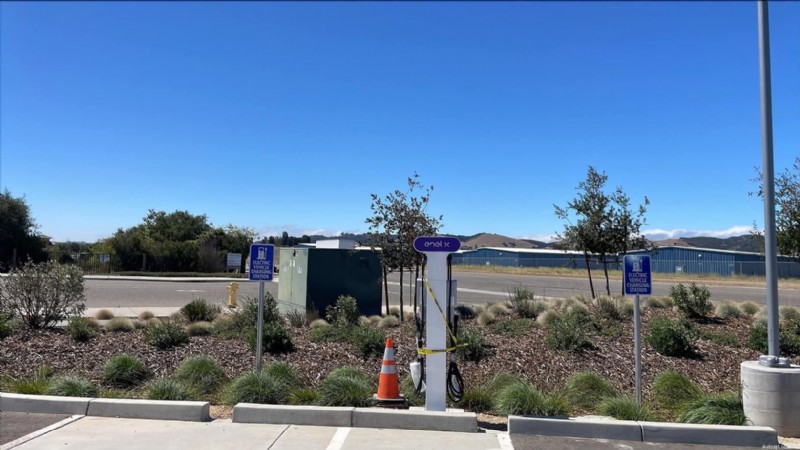 Newly Installed EV Charging at a workplace
Additionally, single-family housing will still only be required to provide EV Capable in the parking area. Homeowners will still have to hire an electrician to make minor modifications to electrical to be able to charge EVs at home.
Overall, EV charging required at new developments is a welcome sign to the progress of EV adoption. As more and more people make the switch to electric, so will the need for more charging infrastructure. By requiring developers to install chargers at new developments, more people can switch to an EV since charging will be more abundant.
Ultimately, the new 2022 California Building Code will pave the way for thousands of new EV chargers over the next decade. Most notably, multi-unit developments (MUDs) such as apartments or condos, get a big boost to EV charging infrastructure as they have typically been left to seldom retrofit projects. With a building code requirement, individuals at new MUDs can rest assured they will have proper charging access with both low power and standard EV charging options.

Hi there! I’m the founder and project manager at Charged Future: the EV charging consultancy. Charged Future helps businesses achieve their EV charging goals. Specifically, I serve as the project manager for your EV charging project, which can save you both time and money! Additionally, I can search and apply to all eligible rebate applications, which can typically cover a large portion of the project cost.
Request a free quote for your EV charging project!
