
Honda is now testing DC fast charging at its European R&D facility in Offenbach, Germany.
Here we have the press release:
“Europe’s most advanced public charging station for plug-in vehicles has been opened by Honda at its R&D facility in Offenbach, Germany. The station uses state-of-the-art 940V technology, enabling up to four vehicles to charge simultaneously with different types of connectors.
The public charging station is powered by renewable energy sources, including via a photovoltaic carport canopy. Its 940V capability can deliver up to a maximum of 150kW of energy across four simultaneous connections.
The charging station will be operated by Honda R&D Europe and is ‘future proofed’ for the next generations of electric vehicle technology. While the station can be used by current models of plug-in cars, vans, bicycles or scooters, its maximum high-voltage capability is designed to cope with the demands of future vehicles that have not yet been conceived.
Honda R&D Europe’s investment in the charging station is part of the ‘Smart Company’ research project within the city of Offenbach, which aims to develop more intelligent and efficient ways of using energy resources. The 940V capability will enable new possibilities for Honda’s internal research into electromobility, in line with its recently-announced ‘Electric Vision’ strategy.
In a later phase of the research project, Honda R&D Europe intends to install a new hydrogen filling station with integrated hydrogen generation at the Offenbach site. Like the 940V plug-in charging station, it can be supplied exclusively with power from renewable energy sources. It will also have intelligent back-to-grid energy storage and transmission capability for the local power networks.
Yasunori Oku, Executive Vice President, Honda R&D Europe (Deutschland) GmbH, said: “We see Europe and especially Germany as one of the most important regions for expansion and progress in electromobility. Honda R&D Europe is intensifying its research efforts at its Offenbach site and is contributing to the rapid expansion of the public charging infrastructure.”
Heike Hollerbach, Director of the Environment, Energy and Climate Protection Bureau for Offenbach, added: “We are pleased with the exemplary commitment by Honda to implement its flagship project here in Offenbach am Main. For us, electromobility is central to all measures for air pollution control, climate protection, parking regulations and municipal planning, and of course also for the city of Offenbach’s climate adaptation.”
The 940V public charging station was officially opened on 29 May 2017, at a ceremony presided over by Bernard Massberg, Head of Mobility for the Hessian Ministry of Economics, Energy, Transport and Regional Development, and the Mayor of Offenbach, Horst Schneider.
This activity forms part of Honda’s commitment to an electric future in Europe, with a specific aim to have electrified powertrains in two thirds of European cars sold by 2025. Development of hybrid, plug-in hybrid, battery electric and fuel cell cars will place Europe at the forefront of Honda’s global electric vehicle strategy.”
What’s most surprising is that Honda isn’t using its latest electric car, the Honda Clarity Electric to do the testing, instead it’s using the good old Honda Fit EV.
Considering the image below, the Honda Fit EV can maintain a 44,1 kW charging rate even at a high SOC (87 %).
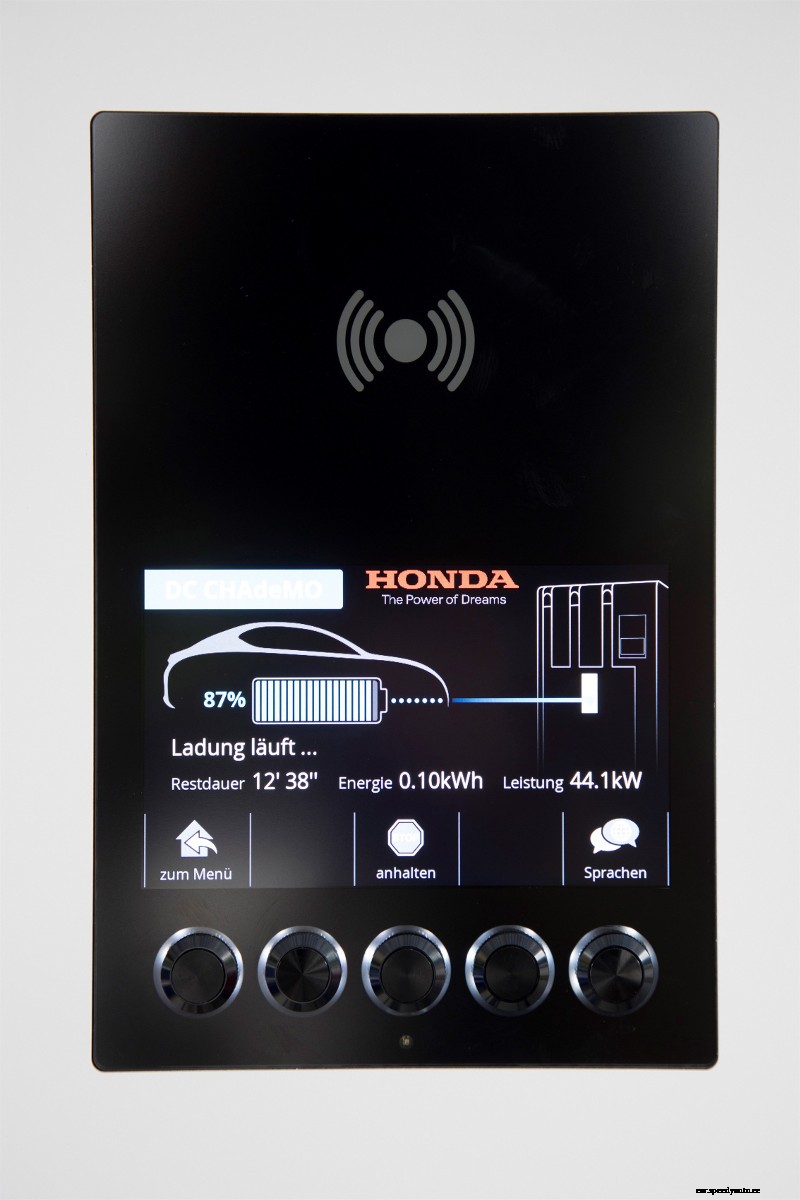
Honda 150 kW fast charger in Europe
The Honda Fit EV was always the car that I though it could go head-to-head with the Nissan Leaf, or even surpass its sales numbers, if Honda had wanted to.
Unfortunately this electric car was never sold, only leased in limited quantities in California, USA and Japan. The Japanese version had DC fast charging capability with a CHAdeMO connector, while the American version didn’t.
However the best part of this electric car was its very resistant battery made with Toshiba SCiB cells.
These battery cells with LTO chemistry can be charged from 0 to 80 % in just 6 minutes!
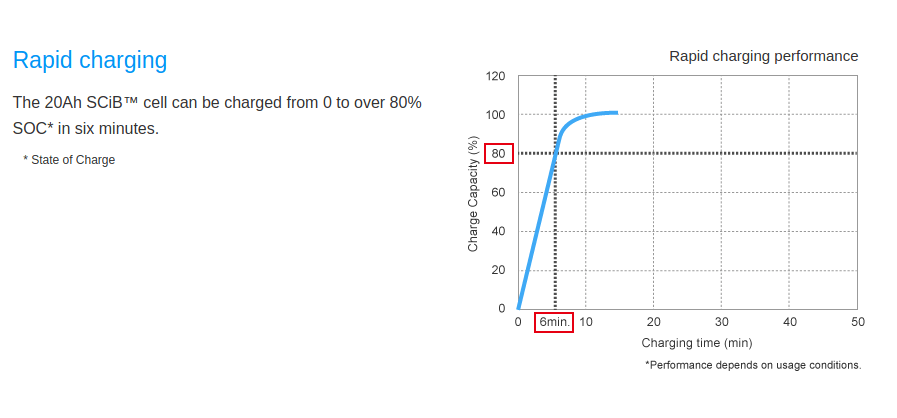
Toshiba SCiB 20 Ah battery cell rapid charging performance
Furthermore, they last forever…
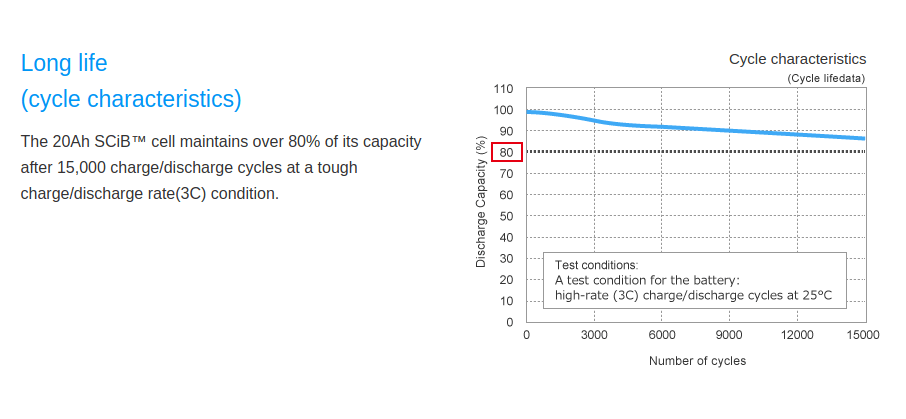
Toshiba SCiB 20 Ah battery cell cycle characteristics
Moving on…
I really hope that the Honda Fit EV being tested in Europe means that Honda is considering to sell it here. It makes much more sense in Europe since its a supermini, while the larger Honda Clarity Electric is more suitable for American tastes.
Honda should at least consider the Fit EV for car sharing or rental companies that would love to have electric cars that run for pennies and last forever…
