
Project COBRA aims to develop cobalt-free batteries for use in electric vehicles and is backed by the European Union. It comes as an European response to China’s dominance in this field.
What is COBRA?
COBRA (CObalt-free Batteries for FutuRe Automotive Applications) is a collaborative research and innovation project on next-generation batteries, co-funded by the European Commission’s Horizon 2020 programme. The project launched in January 2020 and will run until January 2024. COBRA aims to develop a novel Cobalt-free Lithium-ion battery technology that overcomes many of the current shortcomings faced by Electrical Vehicle (EV) batteries via the enhancement of each component in the battery system in a holistic manner. The project will result in a unique battery system that merges several sought after features, including superior energy density, low cost, increased cycles and reduced critical materials. The proposed Li-ion battery technology will be demonstrated at TRL6 (battery pack) and validated on an automotive EV testbed. The involvement of several leading organisations for battery manufacturing ensures easy adaptation to production lines and scale-up to contribute to a higher market adoption while helping to strengthen Europe’s position in the field.
Mission
Vision
Technical goals
Looking at its technical goals, it seems that this project is aiming to develop LNMO battery cells, just like SVOLT.
Now I’m curious to know which cobalt-free battery technology will prevail in the next two years. Will it be LFP, LFMP or LNMO?
Chinese companies are backed by the Chinese government and have vast resources that allow them to bet in all fronts (LFP, LFMP and LNMO). Europeans seem to be aiming for the most promising chemistry (LNMO) to regain lost time and Koreans are waiting on the side lines before committing to a cobalt-free battery technology.
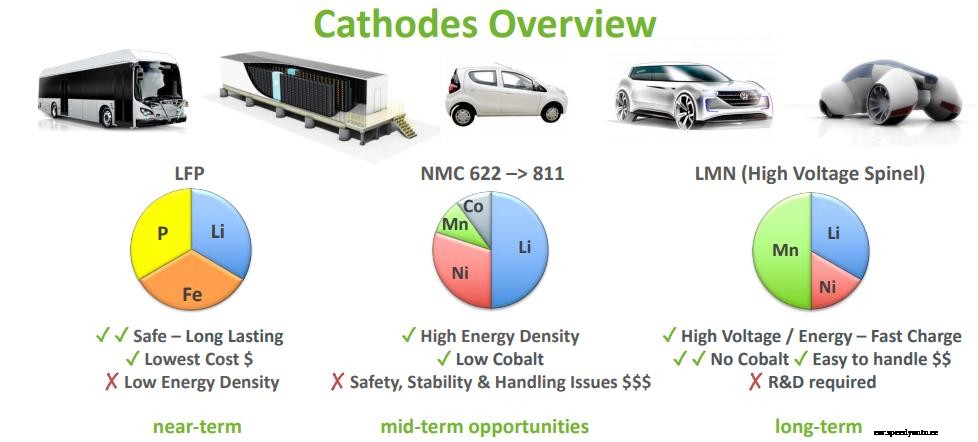
Cathodes overview by Nano One
Cobalt-free batteries allow electric cars to compete with ICE (Internal Combustion Engine) cars on price and availability without the need of subsidies. Without this kind of batteries, the production of electric cars will always remain low and prices high.
Last year, the Toyota Corolla was the best-selling car in the world with over one million units sold (1.236.380). When will we see an electric car reach that level?
