

OnStar is the most popular telematics service available in North America. As of May 2005, it had more than 4 million customers [ref]. But what is a telematics service? How does OnStar know where you are, and how can your car let the OnStar Call Center know that you've been in an accident? In this article, we'll explore the technology behind OnStar, find out how to use it, and learn about some of the controversy associated with it.
ContentsMost people still associate OnStar with emergencies, but today's OnStar offers a host of services, from helping you find a good local restaurant to giving you the latest stock quotes.
OnStar is a telematics service. The word telematics is a combination of telecommunication and informatics: a telematics service is one that provides information to a mobile source, like a cell phone, PDA or car. Today telematics often describes vehicle systems that combine GPS and cellular technologies with onboard electronics. They can include safety, communication, vehicle diagnostic and entertainment features.
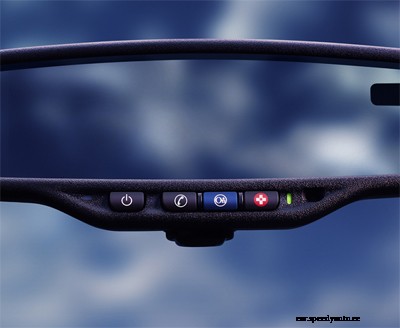
Cars equipped with OnStar have a small panel located in the rearview mirror, the dashboard or an overhead console, depending on the model. The blue OnStar button allows you to contact a live or virtual advisor. The red button with the cross on it is for emergencies, and the phone or "white dot" button allows you to make phone calls just as if you were using a cell phone.
The only way to get OnStar is to buy a car that already has the system installed. The cost of OnStar depends on the make and model of the car. Once you purchase the car, all you have to do is press the blue "OnStar" button on the console to subscribe to one of the service plans. OnStar is available on more than 50 models of GM brands, including Chevrolet, Pontiac, GMC, Buick, Saturn and Hummer as well as other manufacturers such as Audi®, Isuzu® and Volkswagen®. Some models come standard with OnStar, while others include OnStar as part of an add-on "safety" package. GM plans to make OnStar a standard feature on all of its 2007 vehicles.
In February 2006, OnStar announced plans to incorporate a real-time driving navigation system, called Turn by Turn, in select Buick and Cadillac models. An additional 1 million 2007 GM models will include Turn by Turn, and by 2010, it will be a standard service on all cars equipped with OnStar.
Next, we'll learn about the technology behind OnStar.
OnStar's cellular system was analog at first, then progressed to analog/digital-ready. Most OnStar systems are now dual mode, with the capability to use both analog and digital communications systems. By 2008, GM plans to make all-digital cellular systems. Currently there are no plans to make upgrade packages available for older, analog-only models.
OnStar's cellular service is voice-activated and hands-free. The console contains a built-in microphone and uses the car speakers. To make a call, you speak a phone number or a previously stored name associated with a phone number. The console is connected to a Vehicle Comm and Interface Module (VCIM), which uses a cellular antenna on top of the car to transmit signals to OnStar's cellular network. (For more information on cellular technology, see How Cell Phones Work.) OnStar's cellular service has a better range than most cell phones (although you can still lose service in remote areas), with a full three watts instead of a regular cell phone's 0.6 watts. With some OnStar plans, you can also use the cellular service just as you would a regular cell phone plan.
For calls to the advisor, OnStar uses voice recognition software similar to that already used in some hand-held cell phones. However, one of OnStar's unique features is the ability to "surf the Web" using the Virtual Advisor automated system. For this service, OnStar uses text-to-voice technology called VoiceXML. When you ask for information, such as "weather," the software translates your request into XML (Extensible Markup Language) and matches it to settings in your OnStar profile. Then it translates the information into VoiceXML and reads it to you.

The GPS receiver is called OnCore, and it is part of the VCIM (older OnStar-equipped vehicles have separate modules for the cell phone and GPS system). A GPS receiver uses the amount of time that it takes for a radio signal to get from satellites to a specific location to calculate distance. (For more information on GPS, see How GPS Receivers Work). The OnStar Call Center uses four different satellites to pinpoint the car's location when either the driver or the car itself asks to be located.
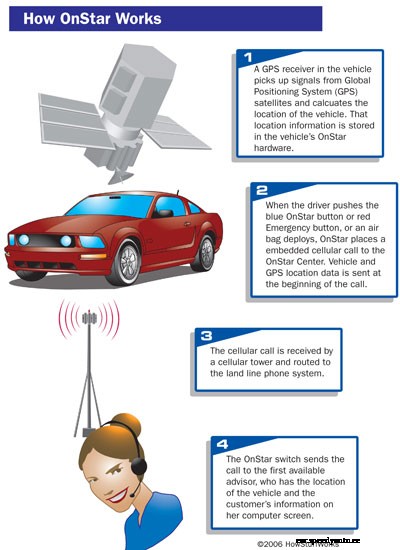
To give a vehicle the ability to call when it is in an accident, OnStar uses an event data recorder (also known as a crash data recorder). GM calls the entire process the Advanced Automatic Crash Notification System (AACN). It's the car's equivalent of an airplane's black box, except that the AACN only starts recording in the event of a crash and only records data.
The AACN system comprises four components: sensors, the Sensing Diagnostic Module (which includes the event data recorder), the VCIM and the cellular antenna. The number and location of sensors vary depending on the specific car, but they all work the same way. When the car is in a crash, sensors transmit information to the Sensing Diagnostic Module (SDM). The SDM also includes an accelerometer, which measures the severity of the crash based on gravitational force. (The range is 1.0 to 2.0 gs, depending on the vehicle.)
The SDM sends this information to the VCIM, which uses the cellular antenna to send a message to the OnStar Call Center. When an advisor receives the call, he uses the GPS to find the vehicle's location and calls the car to check with the driver. Even if there's not a measurable impact, the VCIM also sends a message when the air bag goes off, prompting the advisor to call the car's driver.
Next, we'll learn exactly what kind of services OnStar provides and see how to use them.
In September 2005, OnStar handled, on average:
OnStar has three subscription plans, ranging in cost from around $17 to $70 per month. You can access many of these services by pushing the blue OnStar button on the console and simply stating what you need. Others require you to use a toll-free number to call OnStar.
The Safe and Sound plan includes:
Automatic Notification of Air Bag Deployment - If your air bag is deployed, the advisor attempts to call you. If you do not reply, or if you report an emergency, the advisor will contact an emergency services provider.
Emergency Services - If you press the red button, OnStar immediately locates your car and contacts the closest emergency service provider.
Stolen Vehicle Location Assistance - If your car is stolen, an advisor can use the on-board GPS to track the car.
In July 2005, the Columbian division of GM began offering a similar service, called ChevyStar, with some of its Chevrolet models.
Remote Door Unlock - If you lock your keys in the car, OnStar can send a cellular data signal to the car's computers to unlock them.
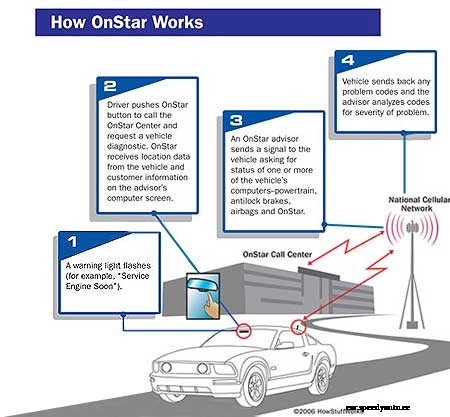
OnStar Vehicle Diagnostics - Because it's hard-wired into the car's electrical system, the Vehicle Comm and Interface Module can also receive information about the status of systems like the engine, air bag and anti-lock brakes. The module checks these systems on a monthly basis, and then automatically sends a message to OnStar. If it's a severe problem, the OnStar advisor will let you know. You also receive an e-mail status report.
Access to Hands-Free Calling - OnStar offers two different cell phone plans. You can purchase blocks of minutes in advance, or you can subscribe to a Verizon Wireless plan. If you already use Verizon as your cell phone service, you can share minutes with the hands-free module and have calls forwarded to it.
Roadside Assistance - OnStar will call a towing company for you, or locate a provider who can bring you gas or change a flat tire.
AccidentAssist - You can call an advisor for help in figuring out the best way to handle an accident. The advisor will provide you with a step-by-step checklist of what to do, and can also call your insurance company for you.
Remote Horn and Lights - If you can't find your car in a parking lot, an advisor can activate your horn and lights.
Virtual Advisor - This service uses voice-activation and text-to-voice technology to provide subscribers with access to information such as:
A user pre-sets his preferences at his OnStar account Web site (such as sports teams to follow or e-mail addresses to check), then presses the "white dot" or "phone" button on his OnStar console to access the Virtual Advisor using voice commands. The weather feature can use the GPS system to get local weather information for the vehicle's specific location. For example, if you want the Virtual Advisor to give you a weather report, you simply say "Get my weather" and the advisor reads the weather report for your area. Virtual Advisor uses pre-paid minutes and may not work with the Verizon plan, depending on the model of your car.
The Directions and Connections plan includes all of the above, plus:
In addition, OnStar recently coordinated with XM Radio to provide bundled services. If your OnStar-equipped car also has a factory-installed XM Radio, an OnStar advisor can assist you with setting up your XM subscription. Both services use the same antenna.
Now, let's look at some of the controversy surrounding OnStar.
The majority of OnStar users are happy with the service, and the many real-life customer stories on OnStar's Web site seem to confirm this. But not all reviews of OnStar are positive. Some users call the service "Big Brother" and say that the service can lead to an invasion of privacy.
In addition to airbag deployment and impact severity, the Vehicle Comm and Interface Module can also record whether you're wearing your seatbelt or how fast you're driving. It keeps data related to events immediately before, during and after a crash for about 45 days. The Call Center retains received information for over a year so that it can maintain quality and follow-up on customer complaints.
OnStar says that it passes this information on to auto manufacturers to improve vehicle safety. However, critics speculate that it could also be used to:
For lots more information on OnStar, telematics and related topics, check out the links on the next page.
Some users dislike that they have to call the OnStar center to use the GPS receiver in their car, so they've found ways to "hack" into the system and obtain GPS data in real-time. One Web site gives step-by-step instructions for doing so. GM does not advocate any tampering with the system. If hacking attempts or modifications render the service inoperable, OnStar is not obligated to repair it.
Although OnStar may be the most popular vehicle telematic service, it's not the only one out there. Other car manufacturers offer similar systems:
Japanese automakers Toyota and Honda licensed OnStar technology in previous years, but both companies dropped it in favor of developing their own systems, called G-book and Internavi, respectively. Nissan also has its own telematics service, called CarWings. All three are only available in Japan.
Related Articles
More Great Links
Sources
