
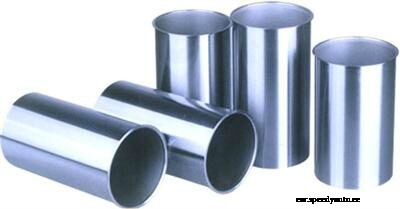
Another advantage of installing a cylinder sleeve in one bad cylinder is, additional cost savings.
Consequently, not having to buy oversize pistons and rings. You may be able to reuse the pistons and only have to replace the rings. So, whatever the reason is, it’s not all bad news. Furthermore, many blocks are just too thin to reliably accommodate over boring without sleeves. When a cylinder sleeve is installed into a cast iron block, the process is fairly simple and effective. Sometimes, cylinder sleeves are also call Liners.
So, as you can see this is a fairly common procedure.
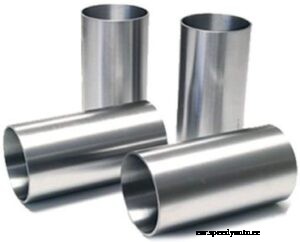
So, not all sleeves are the same. Different materials expand at different rates than others. As a result, affecting the press fit measurement needed. Always ask your sleeve supplier how much press fit, is recommended for their sleeve. Because, sleeve manufacturers, offer a wide range of bore diameters. Ranging from 2” to 8.5” that can range up to 24” in length. Sleeve thicknesses are available from 3/32” and 1/8” for bores up to 5-1/8”. For some special applications, sleeve wall thicknesses of 1/16” and 2mm can be achieved.
Measure the sleeve top-middle-bottom, rotate the sleeve 90 degrees, and measure again top-middle-bottom. Therefore the average measurement is the size of the cylinder sleeve. Use this measurement to calculate interference fit. Some minor sleeve distortion, may have occurred during shipment. The sleeve will conform to shape after it is pressed into the cylinder bore. A little trick to aid in pressing in a sleeve is to refrigerate or freeze the sleeve to shrink it. So, stick the sleeve into the freezer AFTER you measure it.
It is time to determine how much press is needed for the application. Usually .003 for most applications. Please keep in mind that the machinist’s past experiences, should also be considered.
There are numerous factors, that will affect the amount of press required to hold the sleeve in place:
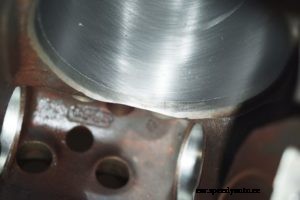
Stop the boring tool 1/8″ to 1/2″ ;(depending on type of block, piston travel, oil ring location, length of crack, etc.); from the bottom of the cylinder; to leave a step (ledge) for the sleeve to sit on. So, the cylinder head, will hold the sleeve from the top. Bore the block to size to accept the sleeve. Next, change the boring machine cutter, to a pointed tool.
In order to square the step/ledge, set the tool about .010″ (per side), less than the block has been bored to. Lightly cut away some of the chamfer; until the cutter reaches the flat, or the top of the step/ledge. This allows the sleeve to sit fully on the step/edge, not partially on the chamfered edges.
The recommended way to install sleeves is to, chill or freeze the sleeves and to preheat the block. Placing the sleeves in a household deep freeze, will typically shrink their outer diameter about .002˝. Packing them with dry ice or spraying them with some liquid nitrogen; will shrink them even more, typically .003˝ or so.
This often allows the sleeves to drop right in with little or no effort. As a result, reducing the risk of damaging or distorting the sleeves. Preheating the block slightly, to about 120 degrees will also open up the bores a bit, making installation easier. If you do need to apply force to push the sleeve into place; don’t beat on it with a hammer ! Use a mandrel to press it in.
Apply a sleeve retainer compound of your choice; (optional if not repairing a cracked block) to the outside diameter of the sleeve.
Important Note: If the engine block was sleeved, because of a crack or leak; pressuring test the block is a must. You will want to make sure, that your repair is not leaking.
Trim the excess sleeve material from the top of the block; (with the bottom flat of the boring tool if there is substantial material). With a long sharp file, remove any sleeve protrusion, that would cause head gasket problems; or deck the block with a mill. If you don’t want to mill the block; you might try stoning the top deck of the block as a finishing touch. I like to use, a hard griddle stone or a soft knife sharpening stone. Finally, chamfer the top inside diameter of the sleeve.
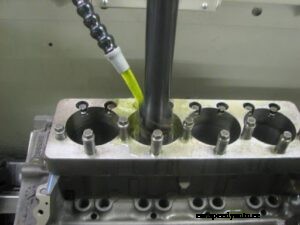
Cylinder sleeves come from the factory semi-finished on the inside. So, you will have to bore and finish hone the sleeve to size. Using torque plates when boring and honing the block; is one way to minimize or correct cylinder bore distortion. In fact, torque plates may be required on many thin wall blocks (sleeved or not); to achieve a really good bore finish that is round and straight.
