
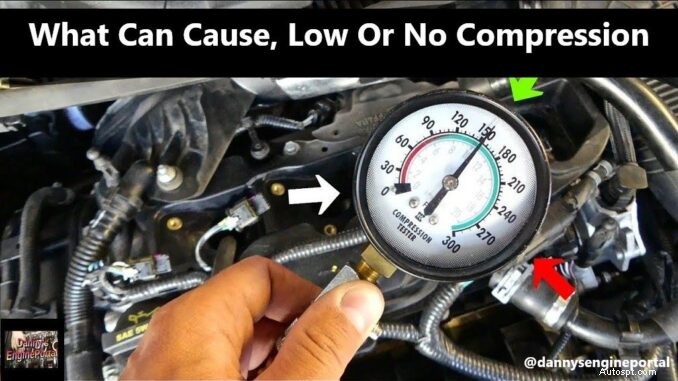
 Engine Compression - What Can Cause, Low Or No Compression
An engine compression test is the most practical way, to learn why you may have, low or no engine compression.
There are some other causes of low engine compression, but these are by far the most common:
You should be aware of these problems, so you can make an informed decision, when investing in repairs. As a rule, most engines should have, 125 to 175 lbs. of cranking engine compression. Also, there should be no more than, 10% difference, between any of the cylinders.
So, to check engine compression manually with a gauge, you have to remove all the spark plugs. The ignition coil, must then be disabled or the high tension lead grounded. Furthermore, if the engine has (DIS) ignition, the ignition coils must be disabled, to prevent them from firing.
Holding open the throttle, is the first step. Then, the engine is cranked for a few seconds, while a compression gauge is held in a spark plug hole. The maximum compression reading is recorded. Finally, the process is repeated, for each of the remaining cylinders.
TIP: If there is low compression, you should follow up with a cylinder leak down test.
This will assist in diagnosing, what is going on inside of the engine.
This test pinpoints, specific leakage. Because, it uses a set of pressure gauges with a regulating device, and can quantify the percentage of leakage.
However, this is a static test that takes more time to perform, compared to a regular compression test.
Most drivers are first alerted there may be a problem, is by seeing engine misfire codes (P0300 – P0312). So, if you see any codes, the first things to check for are fuel and ignition problems. If these do check out ok, the next step is to confirm proper compression.
If readings are very low in one cylinder, it is highly probable that internal engine damage exists:
Consecutive low compression in all cylinders, could mean that the problem of fuel washed cylinders exists. So, this means that the engine has had, too much fuel introduced into it. As a result, all of the oil has been washed off the cylinder walls.
The oil creates a sealing effect, between the piston and ring assemblies, and the cylinder walls of the engine block. This is common with an engine that has, a flooding problem. If the engine seems to run normally, but is weak and puffs smoke, it could have worn piston rings.
In either of these events, squirt a little oil into each cylinder, then repeat the compression test. If the compression dramatically increases, then you have found the problem. If the compression readings do not change, then it would indicate a timing problem.
If a valve seat cracks, it will allow hot gases to leak, burning both the valve seat and the valve. Most cylinders heads are made of aluminum and expand at a different rate, compared to the metal valve seat.
This difference in the expansion rate, can cause the seat to fall out of the head. Once this has occurred, the cylinder will have no compression, as the air escapes into the valve port. Finally, at this point, repair or replacement is your only choice.
A valve spring is responsible for closing the intake and exhaust valves, once the camshaft has opened them. Over time valve springs can become brittle and break.
As a result, letting the valve hang open, which will allow the compression to leak out.
Valve keepers are two half moon pieces of metal, that lock into the valve retainer, holding the valve in place. If these pieces become dislodged, they can fly out of the retainer. Consequently, letting the valve to drop into the cylinder, hitting the piston.
The head of the valve seals against the valve seat. When these valves fail, the head can come apart from the stem. The head of the valve, will drop into the cylinder. This will allow compression to leak from the cylinder, while causing extreme damage to the piston and cylinder head.
So, the piston may fail, due to excessive heat in the combustion chamber. A burned piston will typically have, a melted appearance, or a hole burned completely through the top of the piston. Aluminum can only take so much heat, and when it gets too hot, it melts. The underlying cause, is usually detonation and/or pre-ignition.
Every engine needs a timing belt or chain, to keep the camshaft in correlation with the crankshaft. When these parts fail, the camshaft stops turning, which causes the intake and exhaust valve, not to open and close.
Without the camshaft turning, the engine cannot make compression.
If a camshaft breaks, it will stop the camshaft from turning, much like a broken timing belt or chain.
This usually happens, if there is a blown or weak head gasket. Another possibility, is a broken camshaft in the area that operates valves, for two adjacent cylinders.
And, the engine compression could be too high, in one or more cylinders. This would be an indication of, excessive carbon buildup in the engine.
Thank You!
