
The 2026 Toyota 4Runner has undergone its first redesign in 15 years, moving the needle on a nameplate defined by rugged reliability since 1984. To see if the mid-tier TRD Off-Road Premium (ORP) can hold its own once the pavement turns to dust and rock without the nearly $70,000 price tag of a Trailhunter or TRD Pro, I secured a gas-only tester for the trek to Moab, Utah, during the Easter Jeep Safari.
Kristen Brown
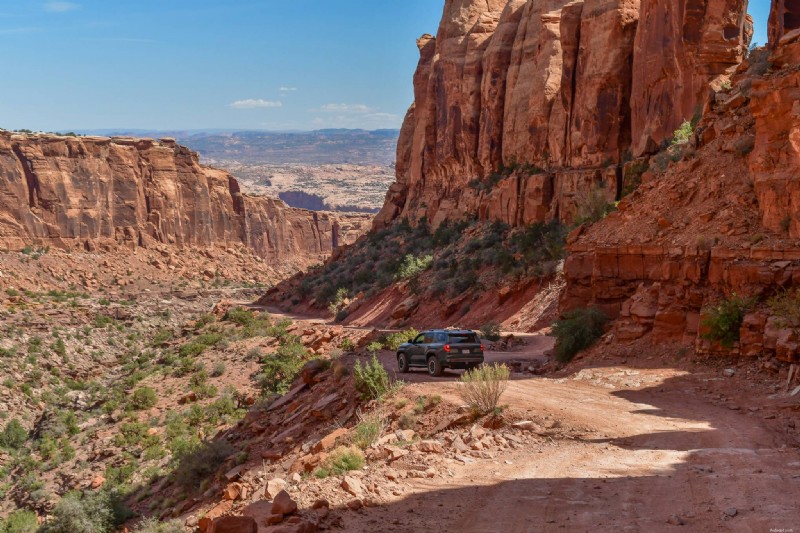
My putting it under a microscope began long before the tires touched red rock. I piloted the 4Runner from the SF Bay Area to Moab—a 15-hour marathon covering over 950 miles of highway and mountain passes through two different states. On that long haul, the new interior upgrades, turbocharger, and effective automatic transmission helped make it a cozy and power-packed roadtripmobile. Once in Utah, I pointed the rig toward the scenic Long Canyon Drive to see how the $58,000 SUV handled the transition from interstate cruiser to off-road contender. I was a bit surprised, in both good and bad ways. Let’s get into it.
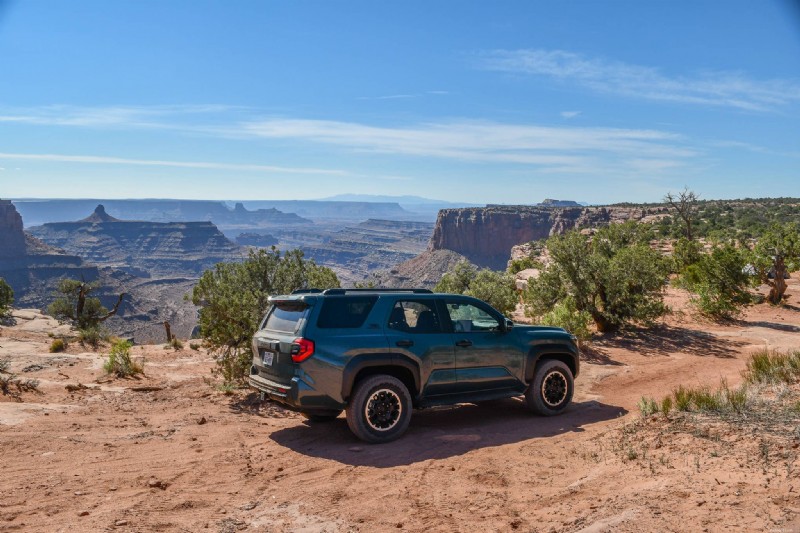
In case you didn’t know, the 4Runner TRD Off-Road Premium is quite a few steps (four) above the base model SR5. And, given the moniker “off-road premium,” it comes with a lot of interior, exterior, software, and hardware updates to drive the off-road focus home. The SR5 starts at $41,870 while the TRD Off-Road Premium starts at $56,070, adding up to a $14,200 price difference. My tester was a tad over $58,000 because of some add-ons, fees, and taxes, so it’s no cheap pony—even though it was the gas-only version, not the more expensive hybrid version of the same trim, which starts at $58,870
Here are the most notable upgrades the 4Runner TRD Off-Road Premium has over the SR5:
Kristen Brown
The TRD Off-Road Premium goes beyond hardware upgrades, too. Baked into it are a few handy off-road software features that the SR5 lacks, like:
The interior saw some upgrades, too, like nicer, leather-trimmed seats, which were a very welcome upgrade on that long drive. And, contrary to popular belief, the Softex upholstery is actually easier to clean when on trails. The SR5 boasts black cloth, which is comfy—but not as trail-friendly (or nice looking).
Are the upgrades worth it? Yes, if you’re planning to take it to more places than the school drop-off and pick-up line or Costco. But you’d have to do it a lot, since it’s a very expensive upgrade.
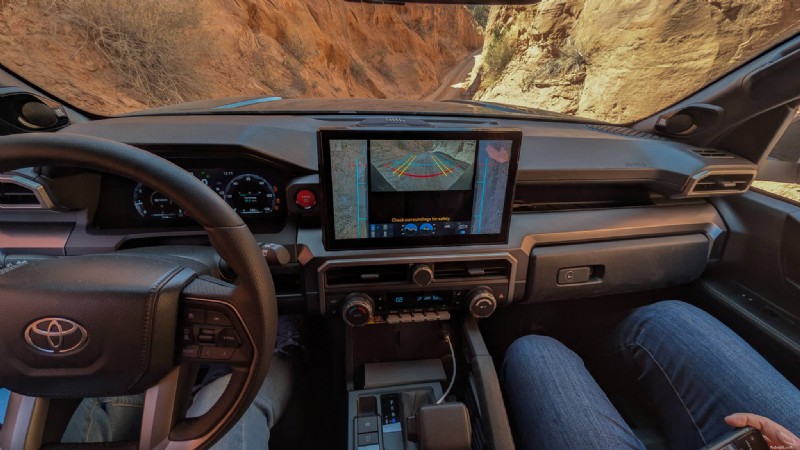
I decided to take the 4Runner on Long Canyon Drive, since it’s not necessarily a difficult trail, but it’s a fun and scenic one. It starts in Canyonlands National Park and spits you out a few miles from downtown Moab. I went in through the National Park’s entrance, so I went down the trail instead of up, and I’m glad I did (mainly because it made for nicer photos). Since it was Easter Jeep Safari, all of the trails were crowded—but Long Canyon Drive didn’t seem too bad. At the beginning of the trail, there were quite a few rocky, washed-out sections, so I put it in 4Lo (which was easy, because shifting is a matter of turning a dial). As I began the steep decline into the canyon, I was very grateful the off-road camera came on automatically, as it was a bit difficult to see over the long, tall hood.
Kristen Brown
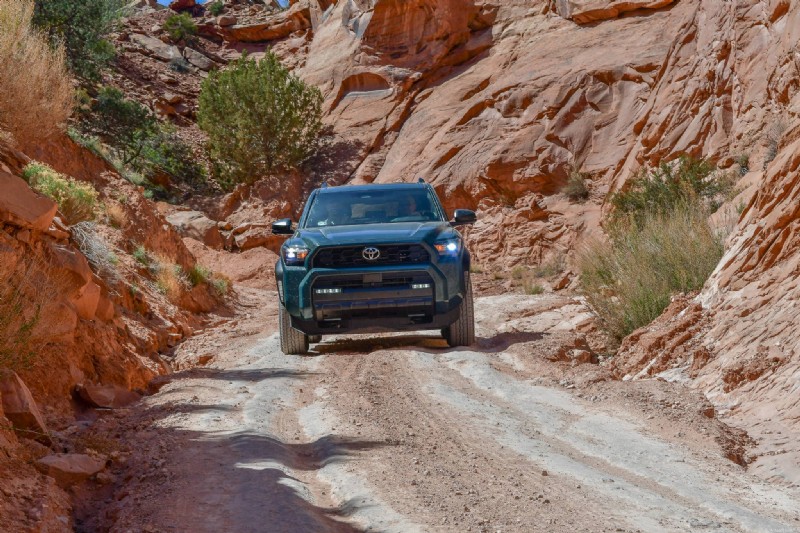
I didn’t need to manipulate the terrain selector at this point because the tires (Falken Wildpeak AT tires) were doing their job perfectly, and keeping it in 4Lo going down the rocky hill kept the speeds low and the RPMs where they should be. I could have used the crawl feature, but I didn’t need to. Now—I took a few pictures near the rock that fell over the trail, and that’s where I encountered my first problem. And, if you’ve driven that trail in Moab, you know that’s not even a quarter mile into the drive. It was the front fairing (for lack of a better term) that was attached to the bumper. It hung very low and took up quite a bit of the 4Runner’s 9.6 inches of ground clearance.
Kristen Brown
It scraped on a lot of obstacles that would otherwise be a snooze fest for the 4Runner TRD Off-Road Premium. Now, if it were my car, I’d have just yanked the thing off, because it looked like it was held on by clips and a few screws. But it wasn’t my car, so my Uncle, who owns an off-road touring business in the region, had to hop out and help spot me to make sure I didn’t cause any damage to it. The TRD Pro or Trailhunter trim doesn’t have this fairing, so for those trims, it would have been a breeze. To have that bit of plastic hold a $58,000 “off-roader” back as much as it did felt like a huge miss. So, if you’re looking at one, removing that chunk of plastic up front should be your very first modification.
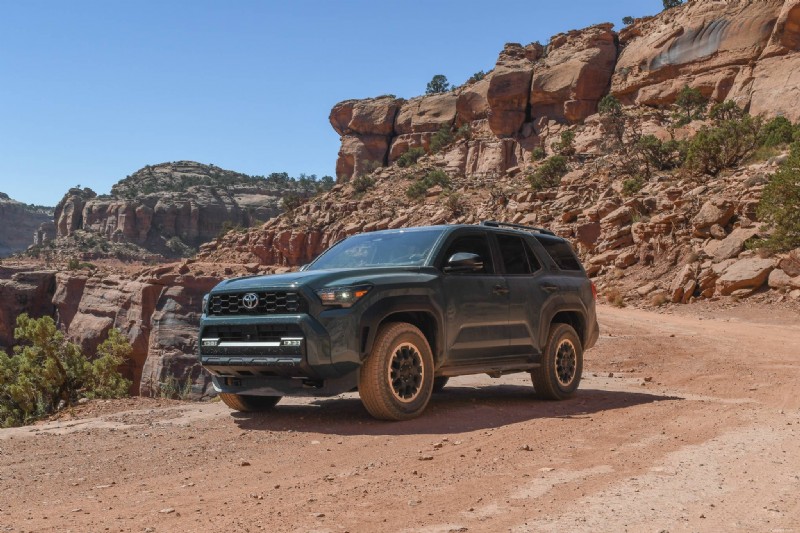
Thanks to the suspension setup from Bilstein and the excellent tires, the ride off-road was buttery smooth, even over boulders and rough patches. No one struggled to hold a conversation, and I didn’t see a single hand on the “oh shit” handles that were on the A and B pillars, or above the windows. The ceiling was a bit low for my 6’1” dad when he sat in the back, so he’d occasionally bump his head when we went over unexpected dips and bumps, but otherwise, everyone else had an amazing time riding in the 4Runner while off-road.
Kristen Brown
Through town, it was just as smooth. Even with all-terrain tires, the interior was surprisingly quiet. You wouldn’t guess it was the same SUV we’d just taken off-road on a rocky, dusty trail. In that way, it had the greatest rock-to-tarmac transition I’ve experienced—and I say that confidently after testing a brand-new Jeep Wrangler Rubicon on Porcupine Rim Trail the day after off-roading the 4Runner. It’s a smooth ride no matter the road surface, and that’s tough to achieve. Well done, Toyota.
I enjoyed every second I spent with the Toyota 4Runner TRD Off-Road Premium, despite the slightly uncomfortable rear seats. I absolutely adored it as a road trip companion. It offers a sophisticated ride that handles daily commuting as well as it does a rocky canyon. It has the potential to be a respectable off-road rig, but I’d highly recommend removing that darn piece of plastic up front to give you more leverage. It’s a great trim if you don’t want to spend $70,000 on the TRD Pro or the Trailhunter otherwise.
Would I take the TRD Off-Road Premium to Moab again to take it off-road? Absolutely. But I’d have a screwdriver handy.

Kristen Brown is an Oregon-based automotive writer and photographer who has been covering the industry since 2018. She specializes in a wide range of topics, including industry news, off-road vehicles, and Subaru culture, with a particular focus on testing new family cars from the practical perspective of a parent. Her writing has been featured in outlets such as U.S. News & World Report, The US Sun, and HotCars, while her photography has been published in Autoweek and Vintage Motorsports.
