
As shorter days draw in, night-time driving becomes more of a necessity, even for those who would usually avoid it. When the sun is starting to set well before 5pm, driving at night is almost unavoidable for the majority of us. With this in mind, it’s important to consider that with less light there are more hazards to consider, and with that, different ways of navigating motoring obstacles.
In this blog, we’ll explore some of the dangers of night-time driving as well as ways to combat this so you can safely navigate the nation’s roads.

Before setting off driving at night, you should consider a multitude of factors that are perhaps less important than during the day. Ensure you are prepared by following these top tops:
Checking your petrol/diesel/electric range: Running out of miles during the day is a pain, but in the dark, it can be an absolute nightmare. Not only are there fewer people around to stop and assist you but it may also be more dangerous to leave your car to find help or fill a fuel can.
Keeping an emergency kit in your boot: You never know when you might get a puncture or other such incident, so be prepared for anything! You could keep an emergency tyre kit in your boot, such as our Tyreweld emergency puncture repair which can temporarily seal a puncture.
Ensuring that your lights all work: During the daytime, there is little need to use your headlights, meaning that you may forget to check that they’re in working order. Before any journey, but especially a night-time journey, you should ensure that all your indicators and headlights are working as they should.
Keeping your windscreen clean: Taking a few extra minutes to make sure the exterior and interior or your windscreens (both back and front) are clean can make all the difference. If the glass is dirty or is full of streaks, it could result in hazardous glare from oncoming cars and headlights.
Checking that your tyre conditions are adequate: Tyre conditions are always an important factor to consider before any journey. However, the dark nights can be more hazardous especially if it’s been raining or the temperatures have dropped. Ensuring your tyres have plenty of grip is essential, as hazards can be less obvious in the dark.
Checking the charge on your car’s battery: During the winter it’s typical to use more electrics with the lights and heating elements, and this can drain power quickly especially with the added cold temperatures. Be sure to check your battery throughout the year, particularly in winter.
Making sure that you are fit to drive: This should go without saying but if you’re tired, sick or inebriated, then you shouldn’t be driving at all, let alone in the dark. With hazards being harder to see, and the darkness contributing more to drowsiness, it is a recipe for disaster.
Driving in the dark can throw up a number of hazards, but by being aware of them you can ensure you feel confident behind the wheel during the darker hours.
As a rule, you should use your headlights for an hour before sunset and an hour after sunrise, although this is dependent on conditions such as cloud cover.
Generally, the controls for your headlights are located to the right of the steering column, but this is different in every car. To make sure you know before setting off, refer to your car’s manual. Our handy visual below can give you an idea of where the different lights on your car are located.
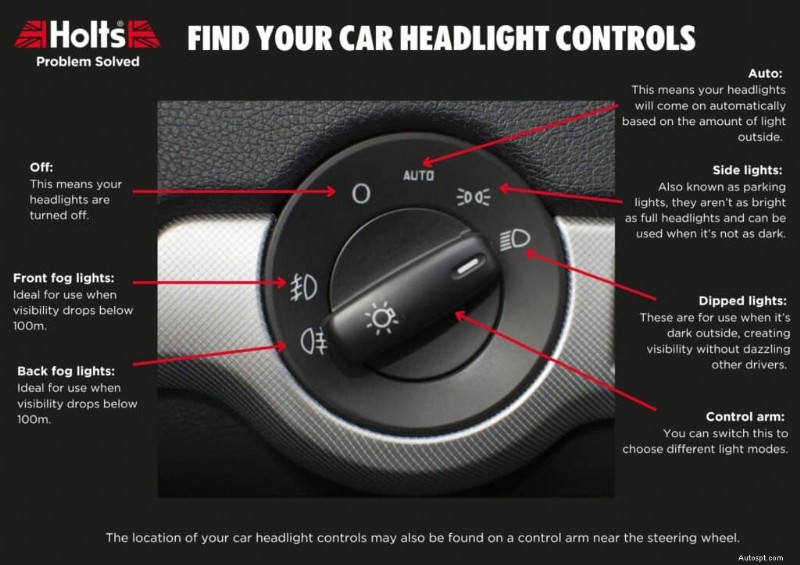
If your car has auto-running lights, it’s still important to check all of your lights are on when necessary. Some auto lights only apply to the headlights and not the rear lights.
Breaking down in the dark can feel a little daunting but if you’re prepared then you’ll know exactly what to do. Here is a step-by-step to help you understand what to do if you break down in the dark:
You can find our comprehensive guide on what to do if you break down here.

The requirements for learners driving at night at exactly the same as driving in the day, you must have insurance that covers the learner driver, as well as have a qualified driver who has been driving for at least three years and is at least 21 years old.
With or without a full driving license in the UK, driving at night for the first time can be daunting so we’d recommend making a couple of trips with an experienced driver before venturing out on your own.
So, there you have it, a complete guide for driving in the dark. Night-time driving is a must-have skill for any driver, novice or expert, with no time like the present to add another “valve to your engine”.
Driving at night requires slightly different considerations for daytime driving but armed with the right knowledge, you can make nocturnal driving as simple as driving in broad daylight. For more help and advice, check out our guides.
