
We’ve all heard claims that state you should let your car idle for longer than 10 or 30 minutes, but these claims were never backed by any scientific proof. Some say it will drain the battery, others warn of insufficient engine lubrication and wear to various parts.
The truth is that a healthy engine can idle indefinitely without any risk of damage. Overheating is the only potential problem, but that can only happen to very old cars or a vehicle with a serious problem in the coolant system.
To explain idling and why it’s important, we need to start with the basics. The engine in your car uses internal combustion to operate. Half of the pistons move down under the influence of combustion, and transfer energy into the crankshaft which raises the other half of the pistons, and generates rotational force. The rotational force is transferred to the transmission, differential, and wheels.
When the engine is idling, the transmission does not receive any of the power, but the engine still has to power the alternator, water pump, cooling fan, and the AC compressor, as well as generate enough power to keep the pistons running.
The idle RPM represents the number of crankshaft revolutions (rotations) per minute and is carefully adjusted to provide enough energy to provide steady engine operation and keep the auxiliary systems running.
It’s well known that AC uses a significant amount of power, which is why the idle RPM will rise by 100-200RPM if the AC is turned on. Most vehicles idle between 600 and 1000 RPM, the exact number depending on fuel type and engine displacement.
Now that we’ve clarified what idling really is, you can see why it has no negative effect on the car. The engine will not stall or jerk, the alternator will keep powering the battery, and should the coolant temperature rise above normal, the radiator fan will engage to compensate for the lack of airflow.
The only real argument to be made against idling is the possibility of insufficient cooling. While it’s true that idling on a scorching hot day can overheat the engine, the likelihood of this happening in modern vehicles is next to zero. In places like Saudi Arabia or The United Emirates, people have no other choice but to idle with the AC on while the outside temperature goes beyond 120 Fahrenheit, and still, their cars have no issues with overheating.
In extremely cold climates of Alaska or Russia, unless you have a heated garage, every liquid in the vehicle will freeze and make restarting it nearly impossible. I’ve heard from several sources that people will just keep their cars running 24/7, and even perform refuels and oil changes while the engine is running! The last one is quite bizarre, but after I’ve learned what technique is used, I can see it happening.
To summarize, idling is not bad for your car, provided it’s a modern vehicle with the transmission disengaged – set to neutral or park. It will consume fuel and wear out the components to the same degree as driving, but other than that, there are no problems with idling.
Unfortunately, an accurate study on fuel consumption on idle has not yet appeared. The best estimate is that the engine uses 0.6 liters (0.15 gallons) of fuel per hour for every liter of engine displacement. I would agree with this assessment as my 2.0L diesel uses a liter of fuel per hour of idle.
The bigger the engine, the more fuel it consumes when idling and it can really make a difference if you’re driving a larger SUV or truck. However, significant savings can only happen if there’s enough time in your commute to effectively shut off the engine.
The answer to this question is not as simple as it seems. You have to look at the problem from a financial, practical, ecological, and mechanical perspective.
First, let’s discuss the financial and practical aspects. If you’re driving a 5-liter V8, it uses 0.75 gallons of fuel during an hour of idling. At the time of writing this article, the price of gas is $3.76 per gallon, which means that by idling for an hour, you’re wasting $2.8 worth of gas.
The easiest way to determine whether shutting off the engine is would be worth it or not is to average out the amount of time you’re idling at red lights or railroad crossings during your daily work commute. If you idle for just 5 minutes in one direction, it will quickly add up to almost 3.5 hours monthly. You could save $10 by just shutting off your vehicle and waiting for the traffic light to change colors.
Practicality concerns the use of AC and how convenient it is to manually stop and start the vehicle every time. It’s not much, but given the level of stress driving can induce, maybe it’s just worth it to burn those few cents of fuel at the traffic light.
From an ecological standpoint, shutting off your engine is objectively better. If you’re concerned about the effect your vehicle has on the environment, not idling is a small step in the right direction.
For the last aspect, I can only offer my opinion based on experience in the industry. I believe that turning the engine off at every stoplight is not good for the battery or the starter. The battery has to supply the starter with a lot of power to crank the engine, and frequent starts and stops can drain it faster than the alternator is capable of recharging it.
The modern start-stop systems come with claims that they do not accelerate wear on engine parts, but car manufacturers have proven time and time again that they’re willing to sacrifice durability and reliability to meet the ever-increasing eco standards.

Idling poses a serious environmental issue on a national and global scale. The U.S. Department of Energy states that the idling of personal cars wastes 3 billion gallons of fuel and produces 30 million tons of CO2 annually. Other research includes heavy-duty vehicles and raises the total estimate to 6 billion gallons.
When we take into consideration the total amount of CO2 emitted by passenger cars – 762.3 million tons in 2019, the 30 million caused by idling seems like a small percentage. However, this is not a good way to look at it, as every little reduction matters, especially when there are 250 million cars on the roads.
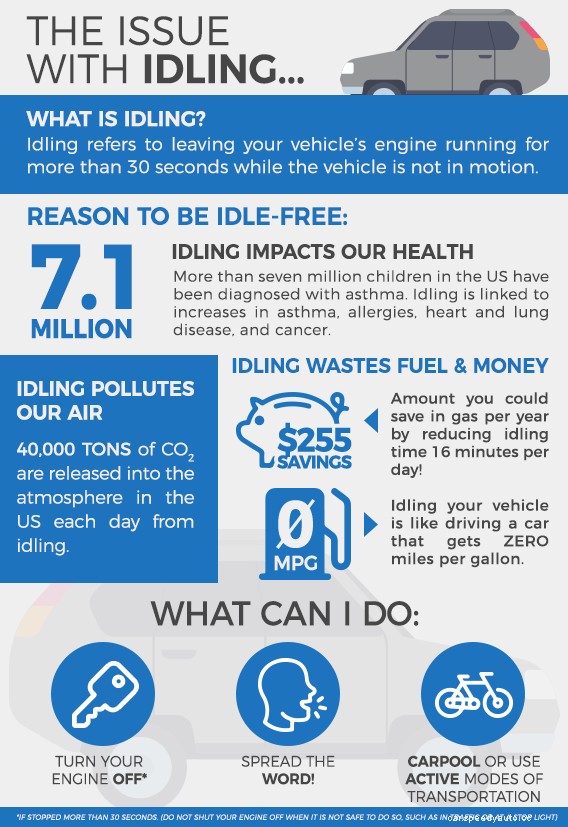
Idling is a natural part of driving, as stop signs, traffic lights, and crosswalks will make you come to a stop and wait for a while. But, there are still ways for you to reduce the CO2 emissions of your vehicle without inconveniencing yourself.
You must know your city well, and how each of the traffic lights operates. If you get caught by a red light just as you’re approaching the intersection, you’ll wait a while until you can move again, making it an excellent opportunity to turn off your engine.
Some traffic lights have a timer for waiting vehicles or for pedestrians. You can utilize them to know how long you’ll have to wait until you can start the engine again.
Toll booths and drive-throughs are other places where it’s easy to reduce idling. Rather than keeping the engine running and trailing the vehicle in front, you can turn off the engine and wait until the column starts moving again. Train tracks and traffic jams, as frustrating as they can be, provide a great opportunity to shut off the engine.
When you’re dropping off your kids at school or waiting for someone to board, shutting off the engine can save a minute or two of idling. We all know that “I’ll only take a minute” is never true and you’ll end up idling for several minutes.
Other than environmental reasons, leaving the car running will not have any negative side effects on the vehicle. The claims that it burns oil and wears out components have no backing. The extent of component wear is comparable to regular driving.
If you have a good reason to keep the engine running and burning fuel, then it’s completely fine to leave the engine running for 2 hours.
You can, but because of the effect carbon monoxide has on the body, you should exercise some caution. Considering that the engine is running for hours when you’re driving, you being in it while it idles doesn’t make a difference.
If it’s not too cold outside, opening a window slightly is a good idea. Otherwise, set the AC to draw in the fresh air instead of recycling cabin air.
The side product of internal combustion engines is carbon monoxide, a poisonous gas that will cause sleepiness and death. You should never sleep in a car if you’re in a garage or enclosed parking lot, or if you’ve noticed a smell of gasoline or exhaust fumes in the cabin.
Modern cars with fuel injectors and electric fans can idle indefinitely without any risk or damage to the vehicle.
Idling with the AC on will only consume slightly more fuel, but it isn’t bad for the vehicle. The engine is more than capable of adjusting to the extra load caused by the power draw of the AC compressor.
Because there’s no airflow cooling the radiator, as long as your car is capable of maintaining the optimal temperature, I would go as far as to say it’s better to let the engine running than shut it off and cold-start it.
Whether you’re in an area that’s very hot or cold, the temperature gauge will tell you all you need to know about idling for extended periods of time. If it’s stuck in the middle, you can idle for as long as there’s fuel in the tank. However, if the gauge moves in either direction, don’t leave your vehicle idling for long.
Here are some other VehicleFreak articles you can check:
6 Reasons Your Car Is Overheating When Idle
Engine Knocking At Idle: Causes and Fixes
How Do I Reset My Idle Air Control (IAC) Valve?
