
Ever thought of driving cross country experiencing the caravan lifestyle. But can’t afford a vehicle to do so. Many believe that you need to spend a fortune to buy a pickup with a decent towing capacity. Have you considered buying a Ford F-150?
This is a great pickup for someone with a tight budget. But what size trailer can an F-150 pull? Let us look at the F-150 and find that out.
The Ford F-150 can pull a travel trailer or camper safely up to 6,000 pounds. Under certain conditions, the F-150 can pull trailers weighing up to 7,000 pounds.
Is the F-150 a good choice for towing a caravan? And if so, what size camper should you aim for?
The F-150 can tow up to 13,200 pounds with the right gears and tow package. However, when it comes to towing a camper, most (but not all) F-150 models can safely tow a camper under 6000 pounds. Depending on several factors, which we’ll see later. Some F-150s can safely tow trailers weighing up to 7,000 pounds.
In theory, the F-150 with Supercrew Cab which is a heavier and longer version, combined with the Trailer Max towing package has a maximum towing capacity of 13,200 lbs.
However, this means towing in an empty truck with no passengers except for the driver or any other equipment.
The Ford F-150 is very good but has limited towing capacity in the real world. If you plan to tow a trailer that weighs more than 6000 pounds] including the load you put on the truck itself, consider a larger truck with a heavier payload.
So what size trailer can the F-150 pull? We already mentioned that the towing capacity depends on many factors. And the size of the trailer that the F-150 can pull will also depend on the factors that determine its towing capacity.
The more powerful the engine is, the higher the towing capacity. A more powerful engine produces more horsepower and, above all, more torque.
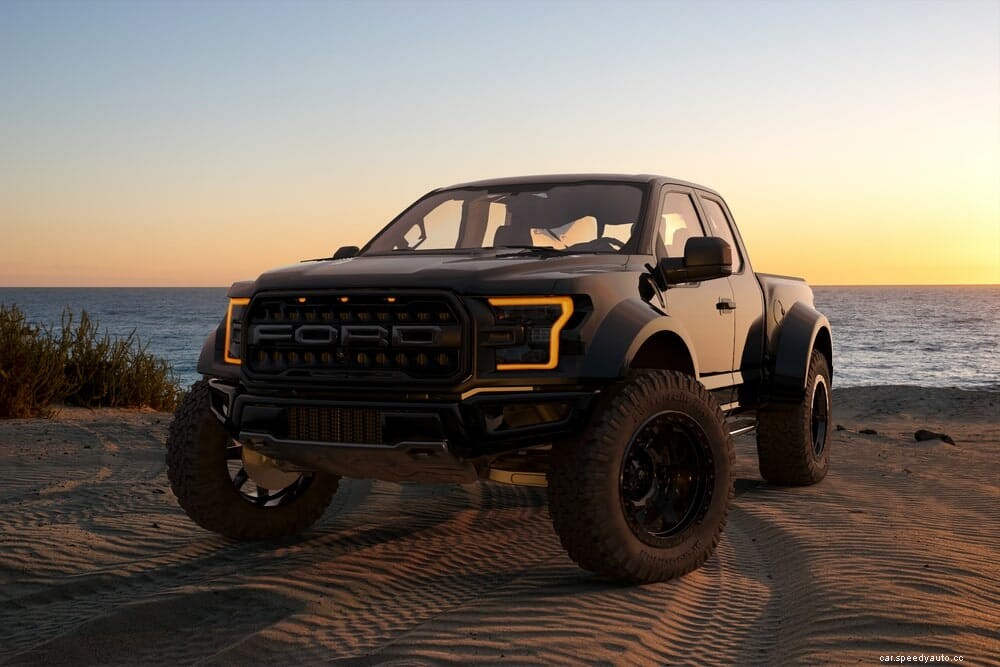
Various engine types and sizes are available for the F-150. The most powerful is the 3.5 liter V6 Ecoboost engine. It’s a powerful gas engine producing 375 hp. More importantly for traction, it can produce 470 lb per ft of torque at 3500 RPMs.
This is an important factor to note. The Ford F-250 which has a 6.2 liter V8 produces less torque than the F-150.
Note that this is the standard engine on the F-150 Platinum and Raptor, but not on other F-150 models. You can even buy an F-150 XL with a 3.5-liter EcoBoost V6 engine, but this is optional on all other models except the Limited or Raptor.
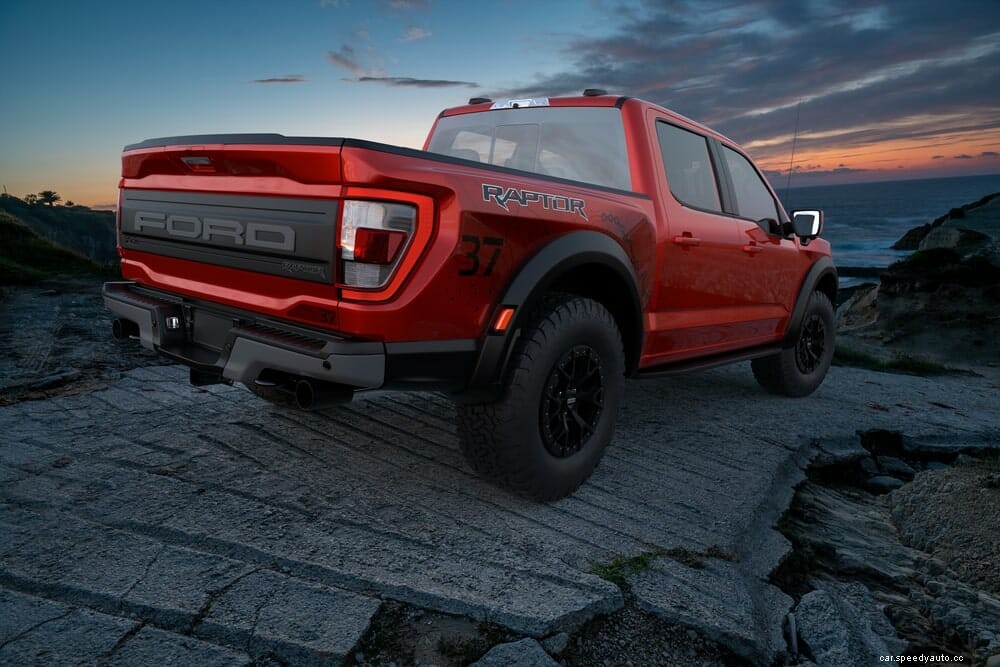
In fact, in the Raptor, you have a high-performance version of this engine for even more torque. The Raptor’s powerful 3.5-liter EcoBoost V6 delivers an impressive 510 pounds per foot of torque. At 3500 RPMs and a total of 450 horsepower. Which is great for its off-road capabilities.
The axle ratio plays an important role in how the vehicle utilizes the torque generated by the engine. Which of course plays a role in the vehicle’s towing capacity.
Torque is basically the force that turns the wheels of your truck and trailer. You feel it best when accelerating after stopping. Once you and your load are up to speed, torque doesn’t really come into play.
The axle ratio determines how often the wheels turn to efficiently use the energy generated by the engine. The slower they turn, the more energy expended on towing vehicles and trailers. When spinning fast, this energy is less productive or efficient.
Axle tramping is a strange type of “wheel hopping” that can occur in rear-wheel drive vehicles. This is caused by a sudden torsional load on the suspension which essentially causes the drive wheels to vibrate violently as they turn and then return.
Even the slightest impact on the axle can have a very negative effect on the travel trailer being towed behind you.
We are talking about very simple Newtonian physics here. If you have connected the towing vehicle and the towing device, the two affect each other. The faster you drive, the stronger the effect.
Cutting through corners or passing through the wind is when you can get into trouble. Since you control the behavior of the tow vehicle, you basically want it to “lead” in terms of physical strength. This means that the drawbar should be as heavy as possible and as long as possible for maximum control.
Imagine a big heavy truck pulling a small, light tractor. It is clear that on a swing, the towing truck carries the greatest load. Therefore the truck remains stable.
On the other hand, imagine a super heavy long trailer being towed by a small light truck. Of course, in this unlikely scenario, a gust of wind or whatever could easily throw off the towing vehicle. And once that happens and the driver loses control, the towing device follows.
This is why manufacturers mention towing limits for their vehicles. Maybe the vehicle has more than enough power to pull a specific load, but it also needs to be backed by size.
For pickup trucks, the truck weight relevant to towing is called GCWR or “Gross Combined Weight Rating”. Basically, it’s the weight your truck can carry as a payload and its own weight. As for the length of the truck, it’s a matter of the type of truck cab plus the length of the bed.
The truck payload is essentially the maximum combined weight of driver, passengers, equipment, and fuel. If you exceed the prescribed load, you have a high risk of complications related to tongue weight.
Payload depends on many factors and varies with the Ford F-150 depending on the equipment and engine. The following are some basic statistics for the 2018 F-150 by equipment.
The Ford F-150 XL 3.3L petrol engine with 4WD and Super Crew cab has a maximum payload of 1680 pounds. The 5-liter, 2-wheel-drive (rear) single-cab V8 petrol engine has a maximum payload of 3270 pounds. From the start, this difference was quite striking, as the 5-liter capacity is almost double that of the main F-150 XL.
Payload is technically related to the weight of the box and suspension. It is also directly related to hitching weight, which is defined as the amount of pressure or weight the hitch exerts on the F-150 or other towing vehicle.
Drawbar pressure is also affected by the total weight of the trailer and how that weight is distributed across the trailer. The greater the total weight and how much rests on the drawbar, the greater the weight of the drawbar.
The weight of the tongue can be a double-edged sword. On the one hand, the increased weight of the tongue makes the whole platform more stable. It also helps avoid mishaps like the dangerous swaying of the trailer while driving on the road.
If the trailer is too light, or a large part of the load is behind it, this can cause the trailer to lose control at high speeds or cause a dangerous collision when driving on uneven surfaces.
On the other hand, too much weight on the drawbar can make towing a trailer difficult. In extreme cases, an overloaded tongue may crack, break, or fail to weld, resulting in a serious driving accident.
To avoid this problem, Ford and its competitors recommend a nose weight of about 10% to 15% of the total trailer weight, including all loaded equipment.
There are some basic calculations you can do with your F-150 each time you tow to make sure you’re within the safe range. Assuming an average payload of around 2000 pounds, you need to account for at least another 1000 pounds for passengers and equipment.
This leaves you with only about 1000 pounds for the weight of your tongue without exceeding the recommended safety limit.
Also known as the GVW, this is a measure that takes into account the total weight of the vehicle. This includes the dry weight of your truck with an empty gas tank and the total weight of the cargo in the box.
When you add that to the trailer weight, it should not exceed your gross vehicle weight rating, which can be found in your owner’s manual.
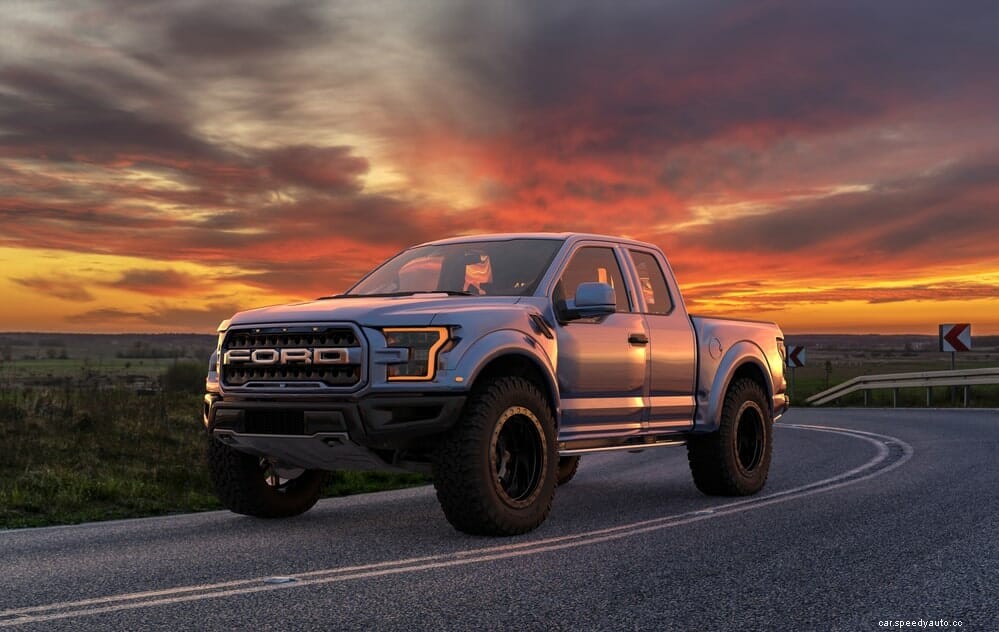
Diesel engines have their own set of pros and cons. If you are wondering what size travel trailer can an F-150 pull, you might also need to look at the capabilities of the F-150 diesel engine. Yes, the Ford F-150 comes with a diesel engine as well.
Technically, Ford is offering the F-150 with a diesel engine. However, they are pretty rare and hard to find. Most of their diesel engines are reserved for the larger vehicles in their lines such as the F250 and F-350 pickups. These weigh three-quarters of a ton and a ton respectively.
Let’s assume, you find a Ford F-150 with a diesel engine. Should you proceed to buy it. Maybe you need to look at the pros and cons of a diesel engine first.
Diesel engines tend to produce more torque and power overall. Diesel fuel is also more energetic than gasoline, which means you get better fuel efficiency. This can be a good thing if you often tow heavy trailers. However, for a truck of this size, the difference in performance and fuel efficiency is negligible.
This is also countered by the fact that diesel engines are usually more expensive than their gasoline counterparts. If you only tow your RV or boat once or twice a month, it’s likely to take a long time to get your investment back in a diesel engine instead of a gasoline one.
Obviously, you know that Ford F-150s come in a four-wheel-drive option. Maybe the diesel motor is not the ideal option if you are asking what size travel trailer can an F-150 pull. But what about the 4WD option.
It really depends on where you live, what your budget is, and where you will be driving and towing. Rear-wheel drive trucks mean that power is always sent to both rear wheels. Many F-150 kits include four-wheel-drive, which increases the price dramatically.
However, it should be noted that a distinction is made between “rear-wheel drive” and “four-wheel drive”.
The four-wheel-drive F-150 typically moves and behaves like its rear-wheel-drive sibling. When road conditions become loose or slippery, you can turn a knob or press a button that activates the front gearbox to send some of the car’s power to the front wheels. It also consumes a bit more fuel.
If you live in a part of the country that doesn’t get snow and ice in winter and you’re just towing your boat or RV on paved roads, a rear-wheel-drive truck can do you a good job. If you live somewhere where you can see ice and snow in winter, or you tow your camper on loose pavement, the extra money you spent on a 4WD truck will pay off in no time.
In some places, the winter condition can get awful and make driving really hard. If you were in this situation, and you were trying to pull a travel trailer, 4WD is going to be necessary.
Most 4WD F-150s have Four highs and Four lows. When you turn on the all-wheel-drive system activates the limited-slip differential or limited-slip differential, and the front wheel hub moves slightly slower than the rear wheel hub.
You shouldn’t go up only four heights unless the conditions are loose or slippery. Riding the four highs in dry conditions when you have proper traction can potentially damage the hub and other components.
Low four-wheel drive is something you rarely use and should only be reserved for those times when you need to get out of a camper or a stuck vehicle.
The new 2022 F-150 is available with several engines—a 290-hp 3.3-liter V-6; a 400-hp 5.0-liter V-8; a 325-hp twin-turbocharged 2.7-liter V-6; a 400-hp twin-turbocharged 3.5-liter V-6; and a 250-hp 3.0-liter diesel V-6. No matter which engine you choose, the F-150 comes paired with a 10-speed automatic.
For the first time, the F-150 is also offered with a hybrid powertrain.
Ford claims that the new 400-hp hybrid powertrain which consists of a 3.5-liter twin-turbo V-6, a 35 kW electric motor, and a 10-speed automatic transmission will offer up to 700 miles of driving range per tank, and can also power an onboard generator for keeping the power flowing at job sites or during power outages.
Buyers will be able to choose between rear- and four-wheel drive with any of the F-150’s available powertrains. A four-wheel-drive Lariat with a hybrid powertrain can reach 60 mph in a brisk 5.4 seconds and it offers agreeable handling.
High-spec models such as the King Ranch come with a variable-assist steering system that sharpens responses at low speeds for a more agile feeling.
The Tremor model promises the most off-road capability. It offers 33-inch all-terrain tires, an upgraded suspension, a locking rear differential, and a four-wheel-drive transfer case borrowed from the mighty F-150 Raptor.
The Tremor can leap to 60 mph in just 5.3 seconds, trailing the more powerful Raptor by just 0.1 seconds.
With all of this in mind, it’s important not to overlook the towing package. It’s basically an upgrade of components that Ford put in trucks to increase towing efficiency. For someone who is asking the question, what size travel trailer can an F-150 pull, this is an important section to think about.
This includes the towing box itself, as well as several elements that increase towing capacity and improve overall handling. There are several variations and additional features you can find from one layer of padding to the next.
This includes things like Class IV towbar. This is available with Ford’s main towbar. This is considered an additional option on the XL and XLT. However, this is standard on the Lariat, King Ranch, Platinum, and Limited Edition models.
It has a towing capacity of up to 6,000 pounds with the 3.3-liter V6 and 2.7-liter EcoBoost engines. The Class IV hitch trailer has a maximum towing capacity of up to 7,000 lbs on the 3.5L EcoBoost and 5.0L V8 engines.
The EPA estimates the 2022 F-150 with the turbocharged 2.7-liter V-6 will earn up to 20 mpg city and 26 highway. The twin-turbo 3.5-liter V-6 is rated up to 18 mpg city and 24 highway. The hybrid version has been estimated as high as 25 mpg city and 26 highway.
Going on 75-mph on a highway route. the Tremor model with the twin-turbo 3.5-liter returns 19 mpg.
Some of the more exotic features of the Ford F-150 Raptor and the other towing packages they offer aren’t exactly “ordinary”.
To put it in a low-end perspective, the F-150 Lariat, with its 3.3-liter Ti-VCT V6 engine, will make around 290 horsepower and 265 foot-pounds of torque.
In this configuration, you’re considering a maximum tow range of around 5,000 pounds, which isn’t enough to tow a large RV. Towing a small to medium-sized camping trailer might be an option.
Now, if you took that same Lariat and outfitted it with a 3.5-liter EcoBoost V6 engine that makes 375 horsepower and 470 feet of torque, with a SuperCrew cab, plus a long bed and an upgraded tow package, you’d be amazed.
Now the maximum tow capacity is close to 10,000 pounds. This way you can pick up a sturdy caravan trailer and maybe even a towing toy.
The National Highway Traffic Safety Administration (NHTSA) provides the following tips for preventing trailers from swaying.
First, when towing, always use the gear recommended by the manufacturer. Second, drive slowly, this reduces the load on towing vehicles and trailers. Third, try to avoid sudden or sharp turns when driving fast.
Fourth, check the tire pressure of towing vehicles and trailers. Under-inflated tires reduce the carrying capacity of both.
The towing capabilities differ drastically between different models of the F-150. The standard truck with the 3.3 liter V6 can tow 5000 pounds. While the 5-liter V8 Supercab can tow close to 10,000 pounds.
When it comes to budget pickups that have a high towing capacity, the F-150 is among them. Other than that, the Toyota Tundra, Nissan Titan, Chevy Astro, and the GMC Safari are among the best.
If you are planning to tow a travel trailer rather than a regular one then this is important.
Pulling the 5th wheel is different from pulling the caravan. With the 5th wheel, you get what is called a trailer hitch. Part of the crane equipment is on the tailgate, making the whole platform very stable. They seem to be one complete unit in terms of weight distribution. This is better for two reasons.
Trucks can carry multiple loads within their loading area as designed. In windy weather, the 5th wheel is very firmly attached to the truck, so it wobbles a lot less.
Because of this, the same truck can tow a fifth wheel which is heavier than a trailer. In the manufacturer’s chart, you can see that pulling the gooseneck (which is another name to indicate the 5th wheel) scores better for pulling maximum weight than simply pulling the trailer.
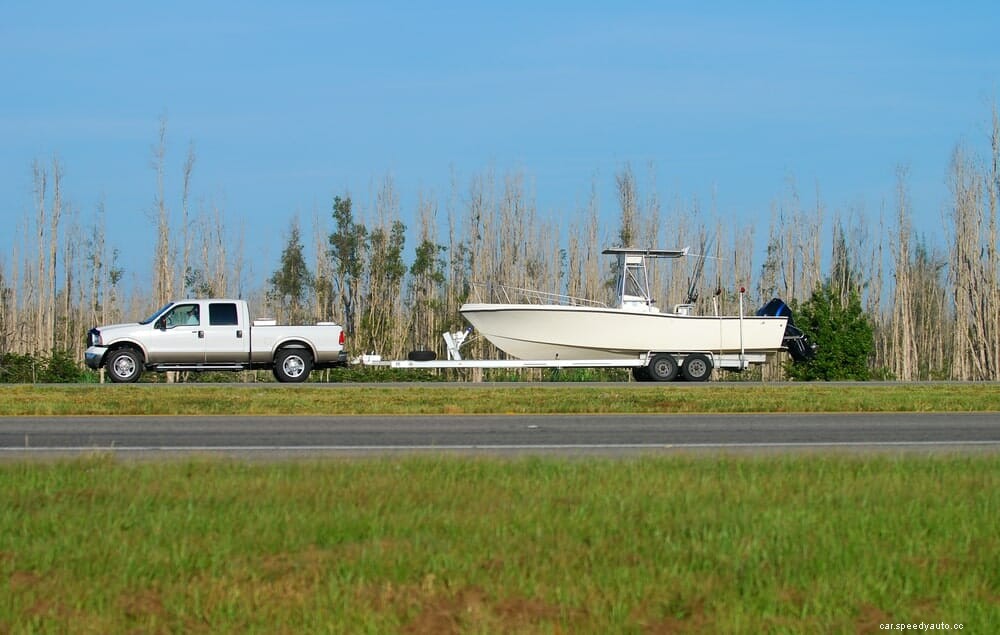
Sometimes you can perfectly pack and distribute the payload on your trailer by tracking tongue weight and towing capacity and still feel the trailer rock. Sometimes it is something you can’t control, like strong winds that are causing the trailer to rock.
When this happens, it can be very worrying. If you notice the trailer rocking during the first few miles of the journey. You should take this as a sign that something is not loaded or that you have inadvertently exceeded the reasonable load capacity or tongue weight.
At times like this, you need to stop and adjust, unpack, or even slowly go home to leave some things that are not important.
If you are driving down the road and the trailer starts to rock, you must remain calm. Sometimes the pressured reaction is to accelerate, which can make the sway worse.
The first thing you should do is slow down by taking your foot off the gas, but don’t stop right away. Hard braking can sometimes exacerbate the swaying of an overweight trailer.
If the swaying is caused by strong winds and the trailer can be controlled within seconds of slowing down, you’re probably fine. If things are going to get out of hand or a storm is making it difficult to keep the trailer straight, then pull over as soon as possible.
It is a well-known fact that towing affects fuel efficiency. When there is more weight to move, that adds more pressure to the engine. But how much more fuel is burnt?
Estimates say every 100 pounds added will decrease the fuel efficiency by 2%
Ultimately, the F-150 is one of the best American trucks to take on the roads. But is it good enough to pull a travel trailer with it?
There are a lot of factors that affect the towing capabilities of the vehicle. The F-150 performs well in each of those categories. It’s a decent truck to pull a light travel trailer.
Here are the stats. The average weight of a travel trailer is 5200 pounds. This is the dry weight. With fuel, gear, and other equipment, you’d be adding 1000 to 1500 more pounds.
So if you were to use the F-150 to tow a travel trailer, you might need to look for a powerful version of it. Remember, the F-150 can pull a maximum of 10,000 pounds. With the right add ons, you should be able to pull a travel trailer using an F-150.
