
As the cost of petrol rises, car manufacturers are taking more and more care in designing their cars to be fuel efficient.
Aerodynamic car features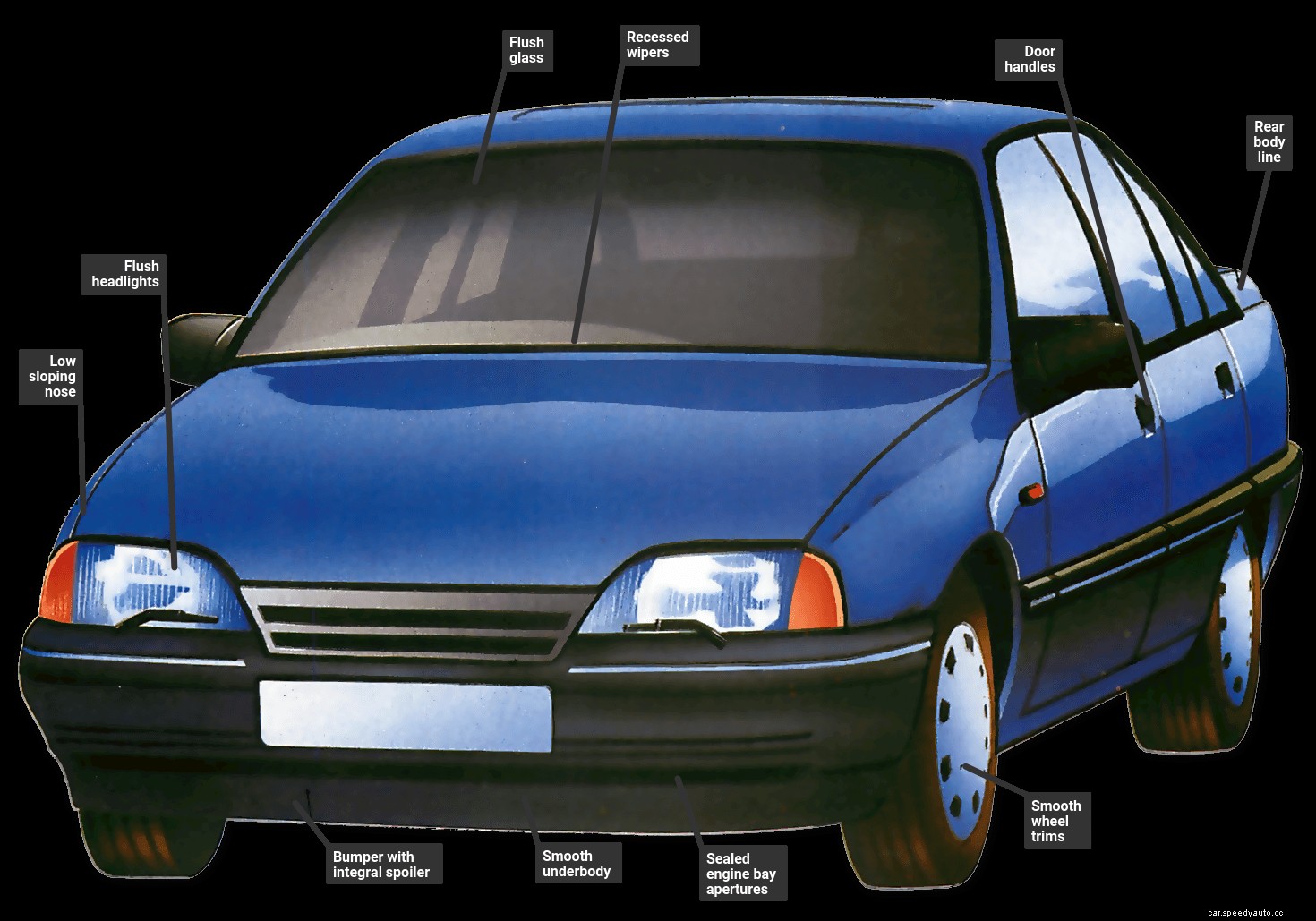
One aspect of car design that plays a part in saving fuel is aerodynamic efficiency - in other words, making sure a car meets as little resistance as possible from the air it travels through. The more aerodynamically efficient it is, the less fuel it will use to travel along at any given speed. The faster the car moves, the more important it is to keep the air resistance - drag - to a minimum.
The aerodynamic efficiency of a car's shape is measured by its co-efficient of drag (generally known as its Cd figure). For example, a flat plate held at right angles to the airflow has a Cd of 1.25, whereas the most efficient production car shapes at the moment have a Cd of about 0.28.
However, this Cd figure cannot be used by itself to calculate a car's aerodynamic drag because it does not take into account the car's frontal area. The frontal area is the car's total cross-section, or the total amount of space it occupies when viewed from the front.
A full-size car and a scale model of the same thing would both have the same Cd figure, but the larger version would need a lot more power to propel it at speed because its frontal area is larger.
For this reason, the important figure is the CdA (coefficient of drag multiplied by frontal area), which gives the total amount of drag acting on the body. Thus, if you are comparing two cars, you must compare the CdA figure rather than the Cd.
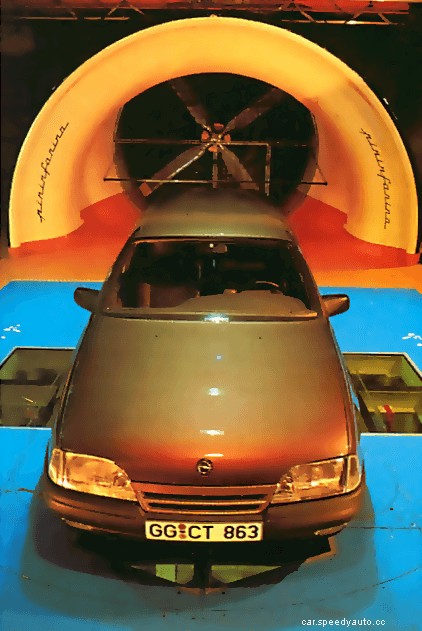
Car manufacturers use wind tunnels to see how prototypes of their cars behave. In a wind tunnel, the car is anchored down and a stream of air is blown past it to simulate the conditions that the car would meet when driven forward.
The car is connected to instruments that record how much down-force or how much lift is being generated at each end of the car. The flow of air past the car is made visible by attaching small tufts of wool to the car's body, or by blowing a stream of smoke past it.
In both cases the path that the wind takes as it flows over the car can be seen by how the wool or smoke behaves. Smoke also shows the behaviour of the air in front of and behind the car. Woollen tufts arrange themselves along the lines of the airflow over the body but cannot show the air behaviour in front of or behind the car.
The model or car in the wind tunnel can be turned round at various angles to the airflow so that the engineers can see how the body shape behaves in side winds.
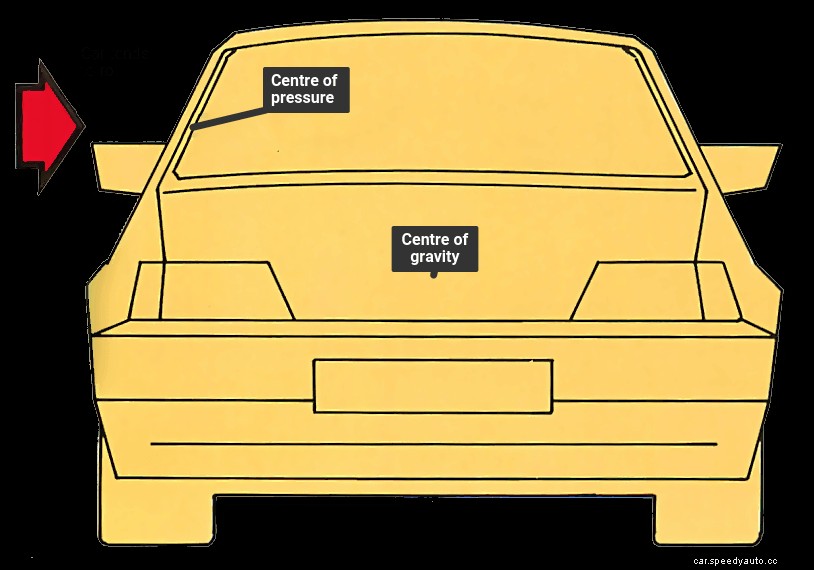 The centre of
pressure
is the effective point on the car's bodyshell
where the wind acts. The relative positions of a car's centre of pressure
and its centre of gravity (the point inside the car through which gravity
effectively acts) are critical in determining the stability of the car.
For example, if the centre of pressure lies well in front of the centre
of gravity, a side wind would tend to deflect the car off course (right). A
car is most stable when the centre of pressure lies slightly in front of
the centre of gravity, as is the case with a front-wheel-drive car in which
most of the weight is towards the front.
The centre of
pressure
is the effective point on the car's bodyshell
where the wind acts. The relative positions of a car's centre of pressure
and its centre of gravity (the point inside the car through which gravity
effectively acts) are critical in determining the stability of the car.
For example, if the centre of pressure lies well in front of the centre
of gravity, a side wind would tend to deflect the car off course (right). A
car is most stable when the centre of pressure lies slightly in front of
the centre of gravity, as is the case with a front-wheel-drive car in which
most of the weight is towards the front.
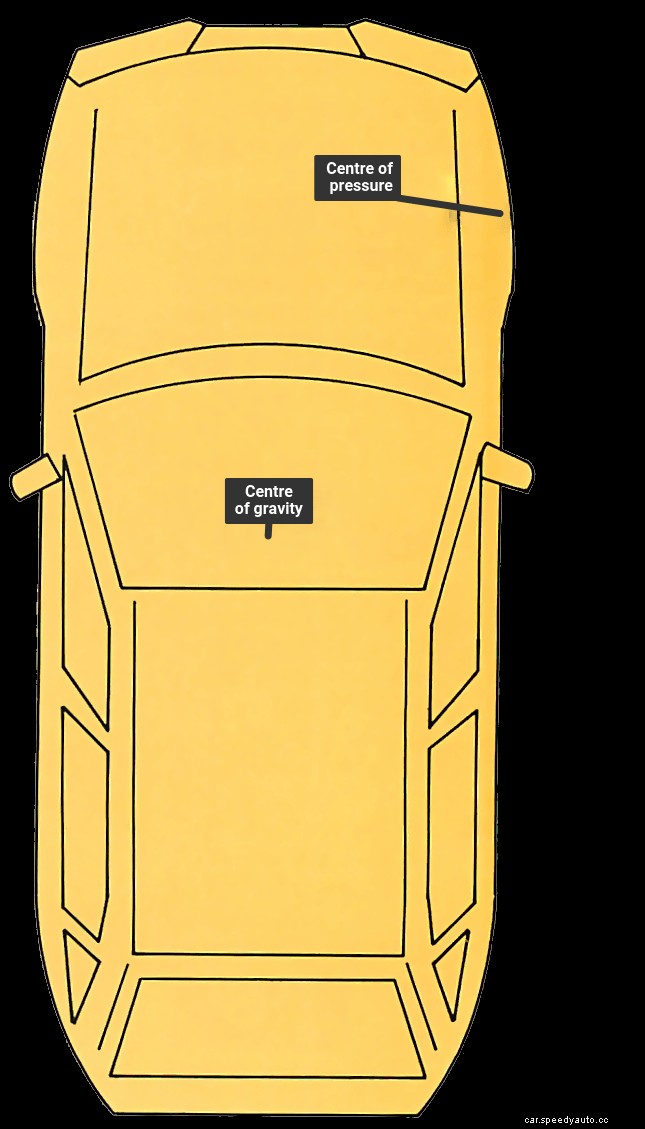 The relative heights of these two factors is also important. If the
centre of pressure and the centre of gravity are both high up on the car,
then a side wind could tend to make the car roll and, in extreme cases,
turn over.
The relative heights of these two factors is also important. If the
centre of pressure and the centre of gravity are both high up on the car,
then a side wind could tend to make the car roll and, in extreme cases,
turn over.
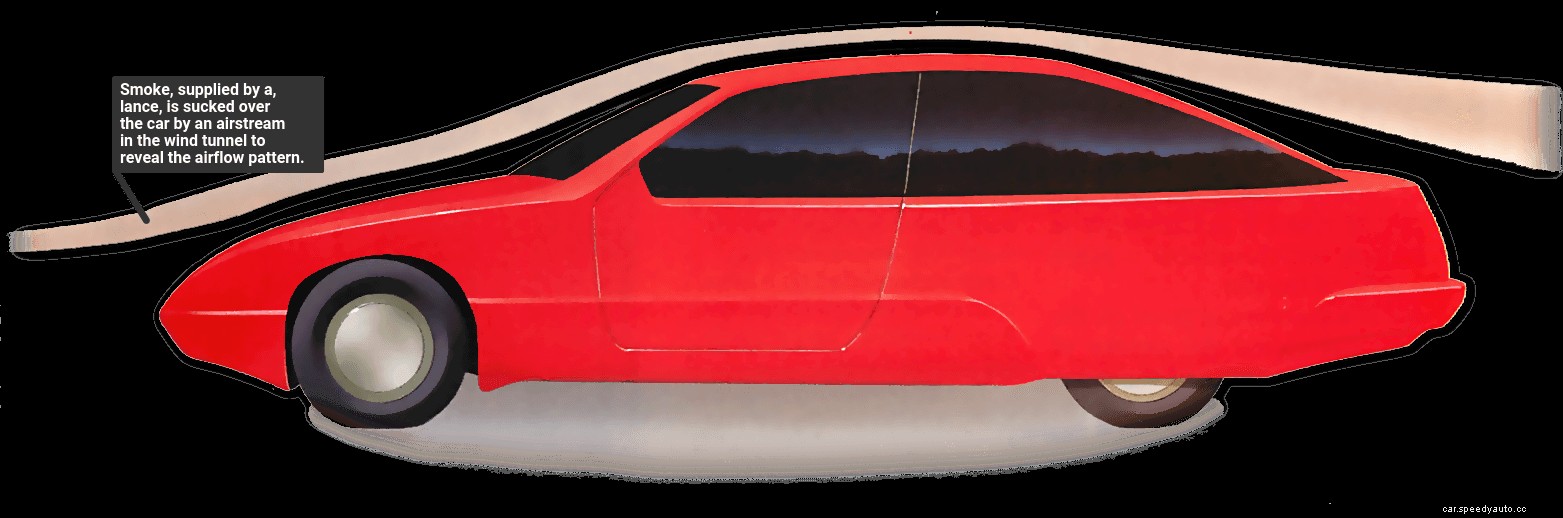
Once the car is set up in the wind tunnel, its drag is measured by the amount of force that the car exerts on its anchored-down wheels as the wind blows past it. As modifications are made, the effects on drag can be measured and recorded.
Usually, the car's designers will have produced a prototype that looks as if it will slip through the air easily, but once items such as air intakes and door handles are added, the efficiency falls.
Some of the features that help to smooth the airflow can be seen on cars such as the Vauxhall Astra. The Astra has a low, smoothly sloping nose to cut through the air, a windscreen that is almost flush with the surrounding bodywork so that the airflow is not disturbed, side windows that are also nearly flush with the bodywork and wheel trims with a minimum of contours. Careful attention to details such as recessing the door handles and streamlining outside mirrors helps to reduce the aerodynamic drag by allowing the air to flow more smoothly and lowering the tendency for eddies to form.
Other techniques used on modern aerodynamic cars include recessing the windscreen wipers under the scuttle panel when not in use, having pop-up headlamps that fit flush to the nose of the car when switched off, and eliminating raised gutters around the edges of the car's roof. By careful attention to detail, the airflow can even be made to keep the rear light lenses clean.
Good airflow means that the car slips through the atmosphere with minimal disturbance while remaining stable. A certain amount of downforce is needed at either end of the body for stability, but any turbulence should ideally happen behind the rear of the car —this also helps to keep it clean.
Wind tunnels use a large motor-driven fan to suck a stream of air past a car to simulate driving through still air at speed. The car sits on pressure-sensitive pads in the middle of the tunnel and a viewing screen in the side of the tunnel allows the engineers to see what is going on.
When a car is being developed for production, some of the aerodynamic purity of the original design is usually lost. Sometimes the changes are made for reasons of cost. For example, fitting a smooth undertray can improve the efficiency of a car's shape, but this panel would cost extra money to produce and could make access to components such as the gearbox more difficult.
On other occasions, practical considerations, such as the need to fit wider tyres , can make the car less aerodynamic than the slim-tyred prototype. If the car is to be mass-produced, its sales may be held back if it includes features that are too unfamiliar.
An example of this is the faired-in k streamlined) front wheels of Ford's concept car, the Probe. The Sierra, which looks very similar to the Probe but without the faired-in front wheels, sold slowly until the public got used to it. If it had faired-in front wheels, sales might have been further held back.
It is relatively easy to design a car that will slip through the air in a straight line when there is no wind blowing, but it is more difficult to ensure that the car will be stable when a wind is blowing on to it from the side, or when it is cornering at high speed, which creates a force on the side of the car.
There is a theoretical point on the side of a car called the centre of pressure which is where the wind pressure effectively acts. By paying attention to the centre of pressure and the balance of forces, engineers can design more stable cars.
For example, if the centre of pressure were well above the centre of gravity of the car, a side wind would make the car roll as well as trying to push it off line. If the centre of pressure is well in front of the car's centre of gravity, a strong and gusty side wind will make the car try to turn round to put the centre of gravity in front.
However, the location of the centre of pressure shifts with changes in the car's speed, and in some cases can even shift so that it is in front of the car itself. The solution is first to ensure that the car's centre of gravity is well forward. This is one of the reasons for the popularity of front-wheel drive layout, which has a forward weight bias.
The centre of pressure also tends to be kept further back if there is a greater area of bodywork towards the rear of the car. Some racing cars of the past had tailfins which improved their stability at speed by increasing the area to the rear. The low, sloping bonnet line which gives good penetration through the air also helps to keep down the side area at the front of the car.
