
You might not realize it, but the transmission line is one of the most important and overlooked part of your car. It serves as the connector between the radiator and the transmission of a vehicle. They are made of composite aluminum or metal and a rubber hose. They are essential in preventing the transmission from overheating, making sure that the hot fluid is directed away from the transmission.
If the transmission line is not working properly or if it is damaged, the performance of your car will be compromised. The most common thing that will happen is the overheating of the transmission.
In the rest of this post, we will tackle how to change transmission lines. It might seem like a difficult task at first, but once you are aware of the specific steps that are involved, you will realize that it is actually easy. You can do it even on your own and there is no more need to pay for the services of a licensed mechanic to do the job.
How to Change Transmission Lines: Do It Like a Pro What You Will Need to Follow this TutorialStep-by-Step Guide on How to Change Transmission Lines1. Raise the Vehicle2. Drain the Transmission Fluid3. Remove the Transmission Cooler Lines4. Drain More Fluid5. Spray Brake Cleaner6. Install the New Transmission Lines7. Replace the Transmission Fluid8. Lower and Start your VehiclePro TipsHow to Spot Problems with Transmission LinesConclusionBefore we proceed with the rest of the discussion, here are the materials that you will need to prepare for changing the transmission line.
This section will provide a quick discussion on the steps that are involved in removing your transmission line and replacing it with a new one. As you will see, it will only require a few minutes of your time and there is no need to exert too much of an effort. For a visual guide on how to do these steps, refer to the video below:
The first thing that you have to do is to raise the vehicle so that you can access what is underneath. If you have a car ramp, this will be a lot easier. Make sure to do this on an even surface and use only high-quality jack stands to be confident that your safety is never compromised. It will also be better to do this in an area that has sufficient lighting.
Now that the vehicle is in a stable position, you have to drain the transmission fluid. Disconnect the clip that holds the transmission line in place. Do not forget to place an oil pan underneath so that it will be able to catch the liquid dripping from the transmission line. Otherwise, you will end up with an annoying mess.
When the oil is finally drained, the next thing that you have to do is to take off the old transmission line. You will need a wrench to do this. Loosen the nut that connects the transmission line. It may be hard to pull the line from where it is linked. With this, wiggle it with more than enough force to make it less tight. Pull and remove.
Now that the transmission line is fully removed, expect that there will still be fluid dripping from its original position. Do not remove the oil pan and wait for a few minutes until there is no more drip.
Before you proceed with the installation of the new transmission lines, do not forget to spray a bit of a brake cleaner on the end where they will be connected. Allow the fluid to drip before you proceed to the next step.
Attach the new transmission line by connecting one end to the radiator and the other end to the transmission. Make sure that you are working on the right side. Use the wrench to tighten the nuts, seeing to it that they are in a secured position. Try pulling the new line to see if it has properly attached to where it should be positioned.
Earlier, we have emptied the transmission fluid. Now that you are done connecting the new lines, you have to fill it with a new transmission fluid. Choose the right fluid based on the type of your vehicle and replace the amount that is recommended by the manufacturer. Otherwise, it won’t do an effective job in cooling the transmission.
At this point, you are almost done. All that you need to do is to lower the vehicle from the stand and start to see if everything is working fine. Inspect for specific problems, especially for leaks. If there is a leak, this means that the transmission lines may not have been properly connected or secured.
In this section, we will also provide you with some tips about transmission lines.
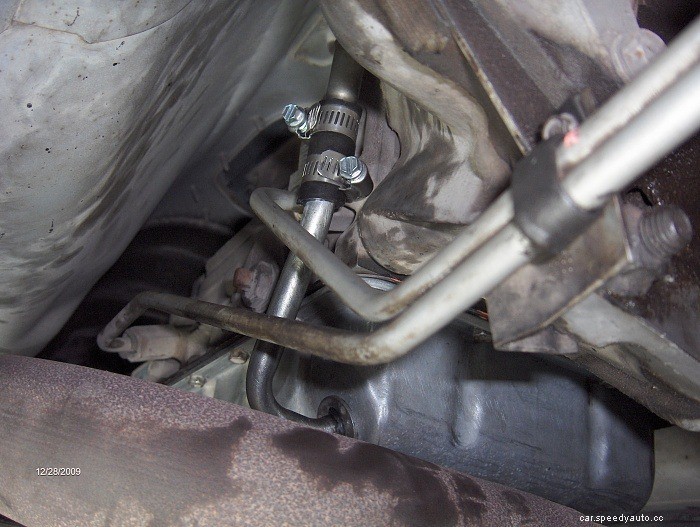
Via: https://www.cherokeeforum.com/f2/how-change-transmission-fluid-filter-196831/
Do you actually need a replacement for the transmission lines? You have to take the time to evaluate its current condition and pay attention to some symptoms, which include the following:
In sum, knowing how to change transmission lines can help you to save a lot of money since you can do the work on your own rather than leaving it in the hands of a mechanic. After all, the materials needed are pretty much basic, so are the steps that are involved. It does not take a lot to do it without the helping hand of the pros.
