
🛠️ About to spend $25–$900 on a scanner? Our $7 Buyer's Shortcut breaks down 18 scanners across 3 budget tiers, names the ones to avoid (FIXD subscription trap, fake bidirectional claims, ELM327 clones), and settles 3 of the biggest head-to-heads. No affiliate fluff. Get the Shortcut ($7) →
Disclosure: Some links in this article are affiliate links. This does not affect our review process or product rankings.
Don't waste money on the wrong tool. See which scanner features you actually need for your specific car.
Two mid-range bidirectional scanners, similar price points, completely different strengths — and picking the wrong one means you’re either paying for features you’ll never use or missing the one you actually need. The VD80BT Lite is VDIAGTOOL’s wireless newcomer with a bigger screen and double the RAM, while the XTOOL D7S is a proven workhorse with more service functions and key programming built in.
The VDIAGTOOL VD80BT Lite vs XTOOL D7S comparison comes down to this: Buy the VD80BT Lite if you want wireless Bluetooth diagnostics, a larger 8-inch display, and 4GB of RAM for smoother operation. Buy the D7S if you need key programming, 36+ service functions, 3 years of free updates, and a proven tool backed by hundreds of owner reviews. For most DIYers and budget-conscious shops, the D7S delivers more capability per dollar.
🕑 Short on Time?
The XTOOL D7S is the better value for most buyers — it has more service functions, includes key programming, offers 3 years of free updates, and costs less. Choose the VD80BT Lite if wireless Bluetooth diagnostics and a bigger screen are your top priorities.
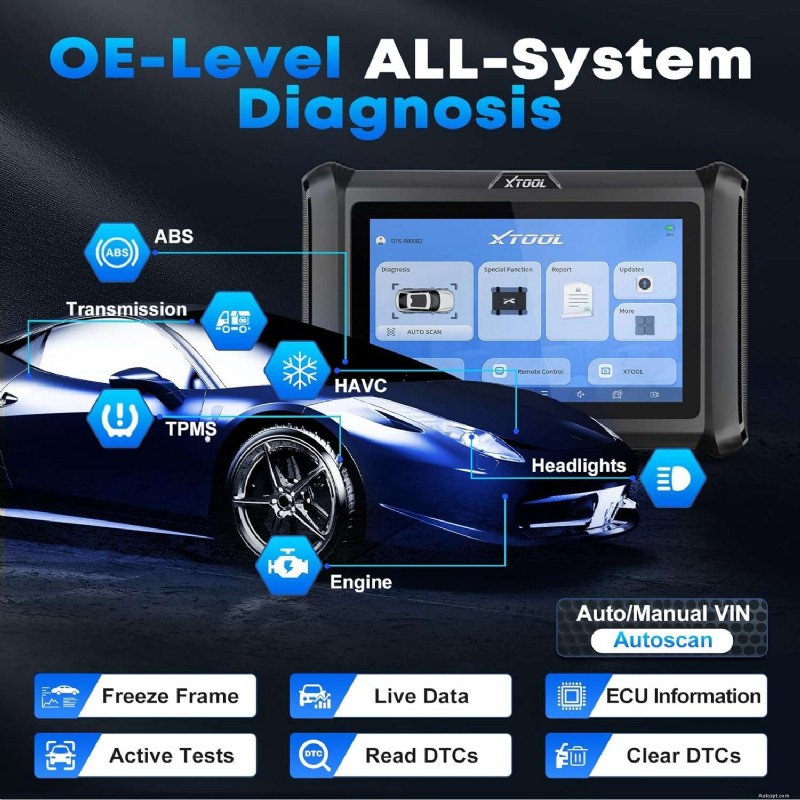
Both scanners offer full-system diagnostics, bidirectional control, ECU coding, CAN FD, DoIP, and FCA AutoAuth. They run Android 10 on the same quad-core 1.5GHz processor with 64GB of storage and a 5000mAh battery. The differences that actually affect your buying decision come down to six areas.
This is the VD80BT Lite’s signature advantage. It connects to the OBD-II port via Bluetooth with a range up to 66 feet (20 meters) and supports dual-band WiFi (2.4GHz + 5GHz). You can walk around the vehicle, check live data from under the hood, or run active tests from the driver’s seat without dragging a cable.
The D7S is wired only — it uses a direct OBD-II cable connection. WiFi is available but only for software updates and online ECU coding, not for vehicle communication. If you’re working in tight spaces, doing road tests, or diagnosing multiple vehicles without constantly plugging and unplugging, the VD80BT Lite’s wireless connection is a genuine workflow improvement.
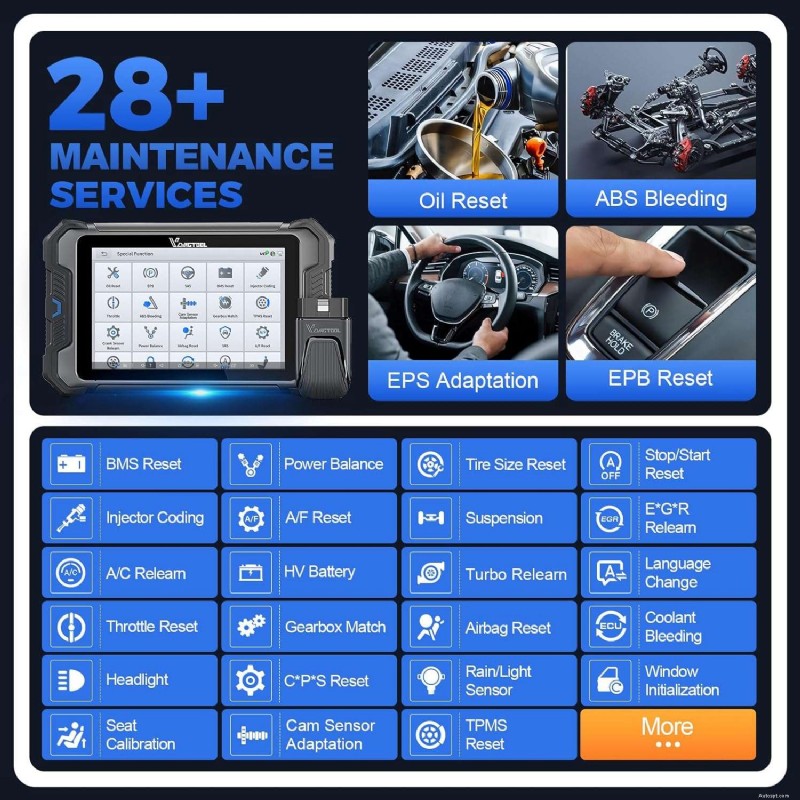
The D7S offers 36+ service/reset functions compared to the VD80BT Lite’s 28+. Both cover the essentials — oil reset, EPB, SAS, TPMS, DPF, BMS, throttle adaptation, injector coding, and ABS bleeding. Where the D7S pulls ahead is with additional functions like suspension calibration, HV battery maintenance, power balance testing, tire size reset, and crankshaft sensor relearn.
If you’re doing routine maintenance resets on a variety of vehicles, those extra functions add up. A shop that handles hybrid vehicles, for example, benefits from the D7S’s HV battery maintenance function — something the VD80BT Lite doesn’t list.
The D7S includes key programming and IMMO functions: read PIN codes, add new keys, generate dealer keys, program all-keys-lost scenarios, and disable lost keys. The VD80BT Lite does not have key programming — that feature is reserved for the full VD80BT model.
This is a significant gap if key work is part of your services. Standalone key programmers cost $200+ on their own, so having it built into the D7S adds real value. If you never touch keys, this won’t matter — but for shops or mobile techs who get key programming requests, the D7S saves you from needing a separate tool.
The VD80BT Lite has an 8-inch 1280×800 display; the D7S has a 7-inch 1024×600 screen. That extra inch and higher resolution make a noticeable difference when viewing wiring diagrams, scrolling through live data PIDs, or reading dense ECU information. The VD80BT Lite also doubles the RAM — 4GB vs. the D7S’s 2GB — which helps with multitasking, faster module scanning, and smoother navigation through menus.
For technicians who spend hours a day staring at the screen, the VD80BT Lite’s larger, sharper display and extra RAM reduce eye strain and wait times. If you mainly use the scanner for quick resets and occasional diagnostics, the D7S’s 7-inch screen is perfectly adequate.
The D7S includes 3 years of free updates; the VD80BT Lite offers 2 years (the Amazon listing mentions 3 years, but VDIAGTOOL’s official comparison page confirms 2 years for the Lite — the 3-year period applies to the full VD80BT). After the free period, annual renewals cost $99/year for the D7S and approximately $144/year for the VD80BT Lite.
Over 5 years, assuming you renew after the free period, the D7S costs ~$198 in updates (2 years × $99) vs. the VD80BT Lite’s ~$432 (3 years × $144). That’s a $234 difference in long-term ownership cost — on top of the VD80BT Lite’s higher purchase price. XTOOL’s established update infrastructure also means faster vehicle coverage additions, since they’ve been pushing OTA updates for years.
XTOOL has been in the diagnostic tool market for over 15 years. The D7S has approximately 500 Amazon reviews with a 4.4/5 rating — real-world feedback from verified buyers you can check before purchasing. The VD80BT Lite is a newer product with significantly fewer owner reviews at this point.
This matters because owner feedback reveals real-world quirks that spec sheets don’t — vehicle-specific compatibility issues, update stability, customer support responsiveness. VDIAGTOOL is building a reputation (their full VD80BT has earned positive coverage from independent reviewers), but the D7S has a larger owner community to draw on for troubleshooting and tips.
Both the VD80BT Lite and D7S offer full-system diagnostics across all available modules (engine, transmission, ABS, SRS, body, chassis, and more). Both support bidirectional/active test control, ECU coding (online and offline), CAN FD for 2020+ GM vehicles, DoIP for newer European models, and FCA AutoAuth for Chrysler/Dodge/Jeep security gateway access. They share the same quad-core 1.5GHz processor, 64GB storage, 5000mAh battery, Android 10 OS, and USB Type-C charging. Both support 80+ vehicle brands and cover all OBD2-compliant vehicles (1996+ US, 2004+ EU).
Prices verified April 2026. Update during article refreshes.
Both scanners support 80+ vehicle brands and all OBD2-compliant vehicles (1996+ for US market, 2004+ for EU). Both provide full-system diagnostics — not just engine codes, but ABS, SRS, transmission, body control, climate, TPMS, and other available modules.
The VD80BT Lite has a notable edge with VAG vehicles (VW, Audi, Skoda, Seat) — VDIAGTOOL includes guided diagnostic functions specifically for the VAG group, walking you through common procedures step by step. Both support FCA AutoAuth for 2018+ Chrysler, Dodge, and Jeep vehicles with security gateway restrictions. Both handle CAN FD (2020+ GM vehicles) and DoIP (newer BMW, Jaguar, Land Rover) without requiring additional adapters.
For ECU coding, the D7S officially confirms support for VW, Audi, and Skoda, with some sources mentioning Mercedes-Benz and Mitsubishi. The VD80BT Lite supports both online and offline ECU coding across a broad range of brands. In practice, ECU coding depth varies by vehicle — check the manufacturer’s compatibility list for your specific make and model before purchasing either tool.
The VD80BT Lite’s 8-inch screen is noticeably larger than the D7S’s 7-inch display, with a higher 1280×800 resolution vs. 1024×600. For reading fault code descriptions, viewing live data graphs, or navigating ECU coding menus, the extra screen real estate and sharper text make a difference during extended diagnostic sessions.
The VD80BT Lite’s 4GB of RAM gives it more headroom than the D7S’s 2GB. Owners of 2GB scanners commonly report occasional lag when switching between modules or loading large vehicle databases. Both include an 8MP rear camera (useful for photographing VINs or documenting issues), a built-in kickstand, and Type-C charging.
The biggest hardware differentiator remains connectivity. The VD80BT Lite’s Bluetooth VCI (vehicle communication interface) lets you move freely around the vehicle while maintaining a diagnostic connection. The D7S keeps you tethered by a cable — functional, but less convenient for underhood work or road testing.
Prices verified April 2026. VD80BT Lite pricing may vary by retailer — check VDIAGTOOL’s official store for current promotions.
VD80BT Lite — Check Price → XTOOL D7S — Check Price →
Specs matter, but what you’re actually doing with the scanner matters more. Here’s how each tool handles common real-world situations:
Diagnosing a no-start with a suspected key issue — D7S wins. It can read the immobilizer PIN, check how many keys are programmed, and add a new key on supported vehicles. The VD80BT Lite can’t touch key programming.
Running active tests during a road test — VD80BT Lite wins. Wireless Bluetooth means the scanner stays on the passenger seat while you drive and monitor live data. With the D7S, the cable limits your positioning.
Routine maintenance resets on diverse vehicles — D7S wins. 36+ functions vs. 28+ means fewer “function not supported” moments, especially for less common resets like suspension calibration or HV battery maintenance.
ECU coding on a VW or Audi — Both capable. The VD80BT Lite has specific VAG guided functions that walk you through common coding tasks. The D7S supports online and offline ECU coding for VAG. Neither is clearly superior here — test with your specific vehicle if possible.
Working on a 2024 Chevy Silverado (CAN FD) — Tie. Both support CAN FD natively with no additional hardware.
Diagnosing a 2023 BMW (DoIP) — Tie. Both support DoIP without extra adapters.
Which One Should You Buy?
Buy the VD80BT Lite if… you prioritize wireless diagnostics for shop or mobile work, want a bigger 8-inch screen with more RAM, prefer a longer warranty (2 years vs. 1), and don’t need key programming. It’s the better pick for techs who value freedom of movement and hardware quality over having the most service functions.
Check VD80BT Lite Price →
Buy the XTOOL D7S if… you want the most features per dollar — 36+ service functions, built-in key programming, 3 years of free updates, and lower renewal costs. It’s the smarter choice for DIYers, budget-conscious shop owners, and anyone who values a proven tool with hundreds of real owner reviews. For most buyers, this is the one to get.
Check XTOOL D7S Price →
The VD80BT Lite comes with a 2-year warranty and VDIAGTOOL advertises a 60-day money-back guarantee with lifetime customer support. The D7S includes a 1-year warranty. XTOOL has regional support centers and a well-established customer service infrastructure built over 15+ years in the market.
For updates, XTOOL’s OTA system is mature — updates are pushed regularly with new vehicle coverage and bug fixes. VDIAGTOOL’s update system is functional but less established. Both require WiFi to download updates.
Yes, both support 80+ brands and all OBD2-compliant vehicles (1996+ US, 2004+ EU). Both include CAN FD for 2020+ GM, DoIP for newer European vehicles, and FCA AutoAuth. The differences are in function depth — the D7S has more service functions and key programming — not in vehicle coverage breadth.
No. Topology mapping is exclusive to the full VD80BT, not the Lite version. Neither the VD80BT Lite nor the D7S offers topology mapping. If you need this feature, look at the full VDIAGTOOL VD80BT or XTOOL’s D8S and above.
The D7S currently has the edge. XTOOL provides 3 years of free updates vs. 2 years for the VD80BT Lite, and renewals cost $99/year vs. approximately $144/year. XTOOL also has a longer track record of consistent, timely updates. VDIAGTOOL is improving but is still building their update infrastructure.
No. Both the VD80BT Lite and D7S are designed for 12V passenger vehicles — cars, SUVs, pickups, and light-duty trucks. Neither supports 24V heavy-duty commercial vehicles. For heavy-duty diagnostics, you’ll need a dedicated HD scanner.
Owner reports and independent reviews indicate the Bluetooth connection is stable within the rated 66-foot (20-meter) range. The dual-band WiFi (2.4GHz + 5GHz) helps avoid interference in busy shop environments. As with any wireless tool, physical obstructions and electromagnetic interference can affect range, but for typical shop or driveway use, owners report consistent connectivity.
No — key programming coverage varies by make, model, and year. The D7S supports common key programming functions (add key, all keys lost, read PIN) on many popular vehicles, but not every vehicle is supported. Check XTOOL’s vehicle compatibility database for your specific car before purchasing specifically for key programming.
🛠️ Before You Spend $25–$900 on a Scanner
No affiliate fluff. No "top 10" lists copied from Amazon. Just the honest breakdown of what to buy — and what to walk past.
28 pages · Technically reviewed by ASE-certified master technicians · Updated March 2026 · 30-day money back
