
The reason why parts in the Japanese domestic market cannot be found very easily is because listings are thin, and on the other hand, the best pieces get sold fast.
This doesn’t necessarily mean that more people are now interested in Japanese cars or the market in general.
Maybe that plays a role too, but the key here is the democratization of sales. If years ago local markets were meant to serve locals, today things have changed, and drivers from around the world can try to catch a fish in the same pond.
With this being said, locals almost always have the advantage. First, they have connections and wider networks. Second, physical distance itself is a crucial factor.
It is always easier to obtain any product when you are close to the source than when you have to order thousands of miles away and wait for days or even weeks for delivery.
But these things are mostly technical arrangements. What we don’t see very obviously is the economic part, as currency swings can shift your real cost even if the yen price looks steady.
Economics are complex to explain, but so are the environmental conditions when weather can decide the speed of the shipment, routes, and so on.
On top of this, the fact that, as mentioned earlier, markets have become global pools means malicious actors try their best to make money.
It means there is also a lot of work to do to ensure the authenticity, product condition, etc. that become part of the purchase.
The good news is that advanced buyers can turn all of this into an edge. With a few technical habits, you can source rare JDM parts with far less guesswork.
A quick “availability snapshot” of how much 1990s Nissan parts inventory is visible inside Japan right now.
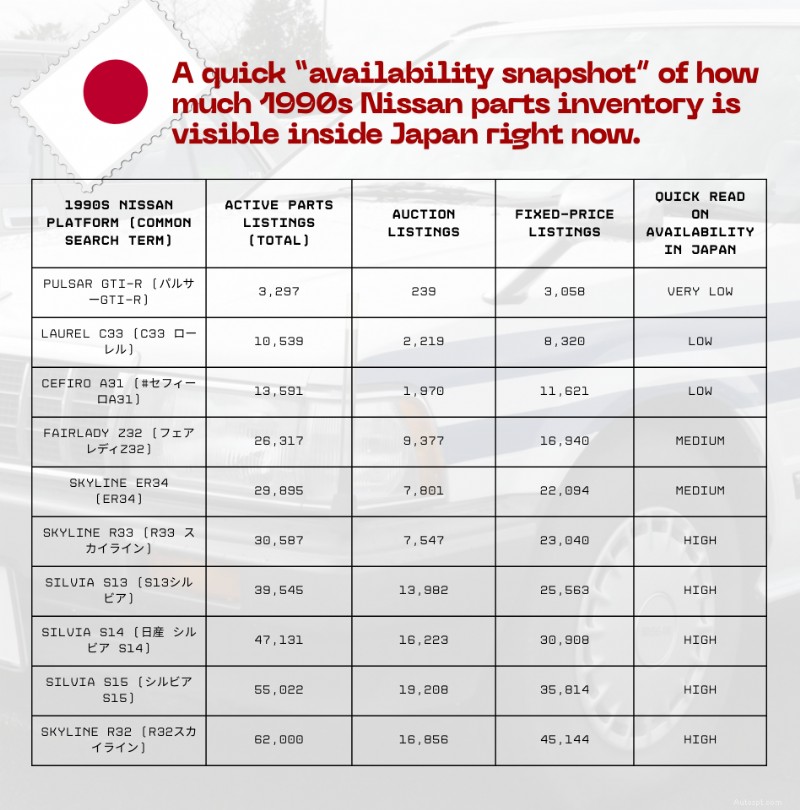
Source note: Counts reflect active listings shown on Yahoo! Auctions Japan search results (Parts category) on December 17, 2025. Results change daily and depend on the exact keyword used.
Many Japanese listings are built for locals first, so accessing some marketplaces can be a tricky mission unless you use a proxy solution.
So, a couple of words about it. Several years ago, people would think the proxy server is a niche tool, designed for specific tasks only, such as doing research, scraping the web, and so on.
This perception (which actually has never been completely true because proxies have always acted as a tool for a wide base of internet users rather than certain professionals) changed a lot as ordinary people got out of their comfort zones and started buying and selling from continent to continent, just sitting in front of their computers.
What happens when a proxy service is switched on is that instead of your device connecting straight to the marketplace, your request goes to the proxy first, and the proxy pulls the page from the internet and sends it back to you.
The key point is that the site sees the proxy’s connection details rather than yours. In practice, that can make it easier to view the same pages and search results that a buyer in Japan would see, which matters when listings are short-lived and site layouts are tuned for local traffic.
When you’re searching for parts online, being consistent is very important. Using the same “location” on the internet each time helps you check if.
It also saves you time. Sometimes a page looks broken in one country but works fine in another.
If you’re comparing many similar parts from different sellers, that wasted time can really add up, especially when you’re checking rare pieces with the right version, color, or production year.
A proxy server helps you see the website the same way every time. That means when you look at the same part again, you’re not getting mixed-up information like different prices, shipping options, or item details just because of your region.
The world market is huge and also messy. The OECD says fake (counterfeit) goods were worth about 467 billion dollars in 2021, up to 2.3% of all global trade. With numbers like that, it makes sense to be more careful when the part is rare or costly.
One easy rule: the rarer the part, the more proof you should ask for. Think of it as “how much paperwork and photos do I have?”.
Start with good photos:
Then check identity details:
If the part is “new old stock” (old but never used), the box and small details often tell the truth faster than the main title of the listing.
You should also ask very specific questions. Instead of “Is it in good condition?”, ask about the one problem that would ruin it for your build, like.
And remember, a serious seller can answer quickly, because they can look at that exact spot.
