
The check engine light is the worst kind of message. It tells you something is wrong without telling you what, and the dealership will happily charge a hundred and fifty bucks to plug in a scanner and read you a five-character code that a forty-dollar tool could have pulled in thirty seconds.
That math is what’s driven the OBD2 scanner market into the state it’s in right now: a strange landscape where you can spend $30 or $3,000 on a tool that, at some basic level, does the same thing.
What separates them is everything else:
We’ve spent the last several weeks comparing manufacturer specs, combing through owner reports on Reddit, r/MechanicAdvice, and the Garage Journal forums, and cross-referencing the bench-test coverage from YouTube channels like ScannerDanner and Pine Hollow Auto Diagnostics.
What follows is our take on who should buy what in 2026, what the jargon actually means, and which tools earn their price tag.
A quick note on methodology: this is a research-based buyer’s guide rather than a hands-on test. We’re working from published specifications, professional reviewer consensus, and verified owner feedback.
We’ll update this guide with long-term testing as we add these tools to our review rotation.
Autel has been the mainstream answer for years, and the MK808Z is the current leader. It’s a seven-inch Android 11 tablet running a Rockchip RK3566 processor with 4GB of RAM and 64GB of storage, which matters because older MK808 variants felt sluggish once you had a few modules deep into a full-system scan. The MK808Z doesn’t.
What you’re really paying for is the combination of full-system diagnostics across more than 80 American, Asian, and European makes plus actual bi-directional control – the ability to command the ECU to fire an ABS motor, cycle a fuel injector, or actuate a window motor without touching the vehicle’s own switches.
Autel advertises 28-plus service functions including EPB retraction, SAS calibration, DPF regen, and injector coding.
We must note, however, that the MK808Z doesn’t include TPMS relearn – if you need that, you want the MK808Z-TS variant instead.
Updates are free for the first year, then roughly $149 per year after that, which pushes the real three-year cost closer to $600 quickly. And while Autel’s coverage on domestics and Asian makes is excellent, enthusiasts working on VAG cars or BMWs often want brand-specific tools alongside it.
The BlueDriver is a Bluetooth dongle about the size of a matchbox that pairs with a free iOS or Android app, and it has held its spot as the single most-recommended consumer OBD2 tool for about a decade running. And the reason is the software, not the hardware.
When BlueDriver reads a trouble code, the app pulls from a database of millions of verified repairs cross-referenced against your exact year, make, model, and engine. A P0300 misfire code on a 2014 Subaru Outback doesn’t just tell you “random misfire detected,” it tells you the three repairs that most commonly cleared that code on that specific combination, ranked by frequency.
No subscription. No upsells to unlock that feature. It’s just included. That’s rather nice to have.
There are limitations, however. The BlueDriver reads and clears codes, streams live data, and generates repair reports, but it cannot run bi-directional tests. Live data refresh on the original Pro hardware runs around four to five seconds per update, which is fine for watching coolant temperature but too slow for diagnosing an intermittent O2 sensor.
The newer Pro Next-Gen ($120) refreshes faster and handles newer protocols better. If you’re just trying to keep your daily driver healthy without dealership trips, either version is more tool than most people will ever need.
The Innova 5610 is the enthusiast pick for buyers who don’t want a tablet. It’s a traditional button-and-screen handheld, which means smaller display, no touchscreen, wired connection. But it pairs that old-school form factor with bi-directional control, lifetime free updates, and something almost nothing else at this price offers: OBD1 support for pre-1996 domestics.
If you own a mix of old and new vehicles… say, a modern daily and a garage-kept ’92 Camaro, the 5610 is close to the only sensible tool.
Its active test coverage is strongest on domestic and Asian makes per owner reports, with European access being its weakness. Innova’s RepairSolutions2 app pairs with it for extra diagnostic guidance, and the lifetime updates are genuinely lifetime, no annual renewal.
The one consistent complaint across owner forums is that Innova’s update servers have been flaky at times, with some users reporting tools that stopped pulling new files after the first couple of years. Worth checking the current state of affairs on the Innova Customer Support subforum before purchasing.
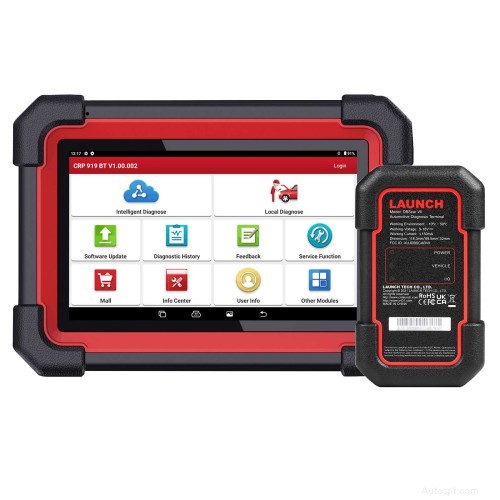
Launch has been making diagnostic tools for more than thirty years, and the X431 database is among the deepest in the business.
The CRP919E BT supports over 150 vehicle brands, more than 100,000 models, full bi-directional control, ECU coding for select makes (including online coding for VAG vehicles), and, importantly for anyone buying a scanner in 2026, native CAN FD and DoIP protocol support.
This matters because new GM vehicles from 2020 onward, along with many Volvos, BMWs, and Stellantis products, have moved to these newer protocols. A scanner without native CAN FD can plug in, establish a connection, and still fail to return usable data.
Many budget tools sidestep this by offering a separate adapter you buy later; the CRP919E has it built in.
Launch includes two years of free updates, which is the most generous policy at this tier. Renewals after that run around $89 per year. The hardware is a seven-inch Android tablet with a 6,100 mAh battery that genuinely lasts through a long shop day, and the DBSCAR VII Bluetooth VCI gives you 30-plus feet of wireless range from the OBD port.
If you work on a wide variety of makes and want ECU coding without stepping up to a $1,000-plus professional tool, this is the one.
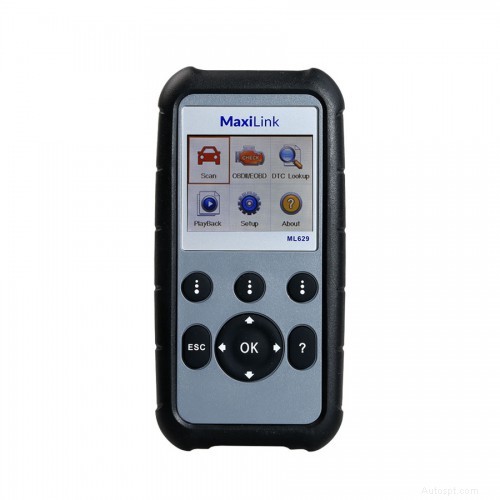
The ML629 is the honest answer to what’s the cheapest tool that does more than read engine codes. It pulls ABS and SRS codes along with transmission and engine data, which puts it ahead of essentially every sub-$100 tool. The interface is dated, the screen is small, the button-based navigation feels like 2010, and it has no bi-directional control, no app, and no fancy features.
None of that matters if your goal is to figure out why the airbag light is on before selling your car, or to read an ABS code that every cheaper tool is ignoring. For buyers who want one step up from a basic code reader without paying three figures, the ML629 is unbeatable value.
Sometimes you just want to read the code and clear it. The NT301 doesn’t pair with anything, doesn’t update over Wi-Fi, doesn’t have an app, and doesn’t pretend to be a diagnostic solution.
It reads generic and manufacturer-specific OBD2 codes, shows live data, runs I/M readiness checks for emissions testing, and does that well enough that it remains one of the highest-rated basic code readers on Amazon year after year.
This is the scanner you buy for a new driver, keep in the glovebox of an older vehicle, or give as a gift to the relative who always asks you about their check engine light.
At this price, it’s a tool you don’t need to protect.
The 3160RS sits one rung below the 5610 in Innova’s handheld lineup, adding RepairSolutions2 guided diagnostics and ABS brake bleed functionality without jumping into full bi-directional territory. For a DIYer who’s doing their own brake jobs and wants to bleed the system without a helper pumping pedals, that ABS feature alone can justify the price.
The guided repair flow walks you through likely causes of each code with parts suggestions and difficulty ratings, which is the kind of hand-holding that makes a new DIYer more confident.
Owners of older Innova tools should bear in mind that Innova has been steadily improving the RepairSolutions app ecosystem and the 3160RS benefits from that more than the older 3100 series ever did.
The Thinkdiag Mini is a small Bluetooth dongle that pairs with the ThinkDiag app on iOS or Android. Under $100, it delivers full-system scans, basic bi-directional control, and ECU coding on select brands.
These are features that typically live in $400-plus standalone tools.
The issue is, and this is a big one… is that many advanced features are gated behind brand-specific software purchases in the app. The hardware is cheap; the full software experience is, therefore, not.
Thinkcar is a subsidiary of Launch, so the underlying diagnostic database is solid. For buyers who are tech-comfortable and willing to navigate the a la carte software model, the Thinkdiag Mini punches far above its price.
For buyers who want everything in one package at one purchase price, the BlueDriver Pro is a cleaner choice.
A few things matter more than the marketing copy suggests.
A scanner that reads codes from every module on your vehicle: engine, ABS, transmission, body, HVAC, is called a full-system scanner. A scanner that can send commands to those modules to activate components is bi-directional. The BlueDriver is full-system but not bi-directional. The Innova 5610 is both. Don’t assume one implies the other.
If you drive anything 2020 or newer from GM, Volvo, BMW, or Stellantis, verify that your scanner supports these protocols natively. Without them, the scanner can establish a connection and still fail to return actual data.
A tool priced at $300 with a $150 annual update fee costs $600 over three years. A tool priced at $400 with lifetime free updates costs $400. Always calculate the three-year total before comparing sticker prices. Autel and Launch generally include one to two years free and then charge annual renewals; Innova and BlueDriver include lifetime updates at no additional cost.
Every OBD2 scanner will read generic codes on any 1996-or-newer vehicle in the US, because federal law mandates it. The manufacturer-specific codes and bi-directional functions – the things that separate a useful scanner from a paperweight on a difficult diagnosis – vary enormously by tool and by brand. European vehicle support is the most common weak spot. If you drive something unusual, check the compatibility database before you buy.
If you just want to read the check engine light and move on, buy the FOXWELL NT301. If you want genuine dealership-level diagnostic capability at home, the Autel MK808Z is the tool most DIYers should buy. If you want smartphone-based diagnostics with the smartest repair guidance on the market, the BlueDriver Pro remains the default, and the reason has nothing to do with hardware. And if you work on a mix of old and new vehicles, the Innova 5610 is the only tool on this list that covers both worlds without compromise.
