
Everybody loves saving money at the pump, especially when geopolitical tensions and inflation are squeezing our wallets. So, when the EPA, under Lee Zeldin, recently announced a nationwide waiver to allow the widespread summer sale of E15 gasoline, it sounded like a massive win for the American driver. Pitched as a way to “fortify the domestic fuel supply” and combat an energy emergency, this move will temporarily flood gas stations with cheaper fuel from May 1 to May 20.
But before you grab that nozzle and start filling up your tank to save 25 cents a gallon, you need to know exactly what you are pumping. E15 isn’t regular gas on discount. Instead, it’s a chemical cocktail that can absolutely destroy older vehicles, classic cars, and the small engines sitting in your garage.
To understand the danger, you have to look at how the fuel is created. The standard gasoline you typically pump into your daily commuter is E10. That means it contains a blend of 90% gasoline and 10% ethanol (distilled corn alcohol).
E15 is essentially the Value Pack of fuel. It bumps that ethanol content up to 15%. Because ethanol is cheaper to produce than pure gasoline, the overall price per gallon drops. You will rarely see a giant sticker warning you about E15, however. Instead, fuel companies market it as Unleaded 88. Because ethanol boasts an incredibly high octane rating of 114, splashing that extra 5% of corn juice into standard 87-octane regular gas bumps the overall rating to 88.
Normally, the federal government bans E15 during the sweltering summer months because ethanol evaporates faster than gasoline, leading to increased smog. But to keep pump prices artificially low during global conflicts, the government is temporarily looking the other way.
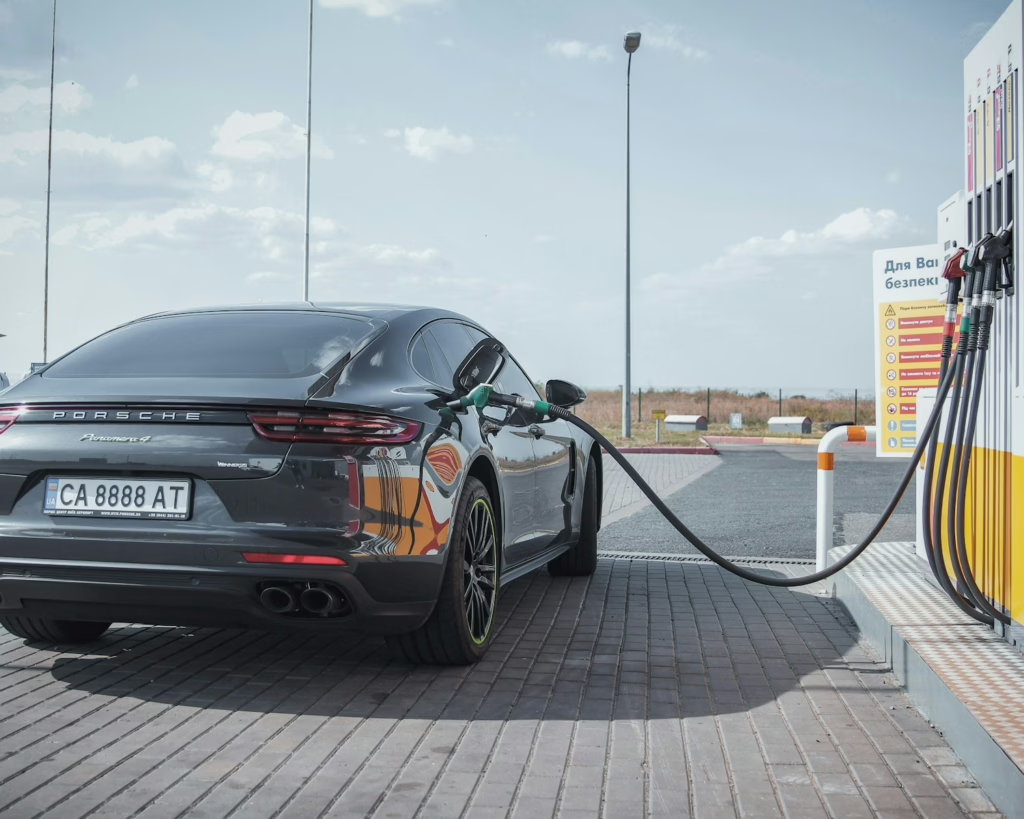
If you drive a modern car built after 2001, you are generally in the clear. The Department of Energy and the EPA have run exhaustive, multi-million-mile tests proving that 21st-century cars have the advanced oxygen sensors and fluoropolymer-lined fuel systems required to handle higher ethanol concentrations.
But if you drive a pre-2001 vehicle, E15 is your worst enemy. Ethanol is a powerful solvent. More importantly, it is highly hygroscopic, meaning it actively sucks moisture right out of the air. When that water-logged fuel sits in an older gas tank, it causes catastrophic phase separation.
In older cars, that high concentration of alcohol will eat straight through standard rubber seals, dissolve plastic fuel lines, and even corrode certain aluminum alloys inside the engine.
The danger doesn’t stop at classic cars. If you are filling up a jerrycan for your weekend chores, pay extremely close attention to which pump you select. Small, carbureted engines absolutely despise E15.
Putting Unleaded 88 into your lawnmower, chainsaw, dirt bike, or outboard boat motor is a recipe for a massive mechanic’s bill. These smaller engines lack the sophisticated computers needed to adjust the air-fuel ratio. Because ethanol burns cooler but leaner than gas, your chainsaw’s engine will run incredibly hot, potentially melting valves or seizing entirely. On top of this, the solvent properties of E15 will quickly disintegrate the delicate rubber diaphragms inside small carburetors.
Even if your car is brand new and perfectly capable of running Unleaded 88, the savings are mostly an illusion.
While ethanol is cheap and abundant, it contains roughly 33% less energy than standard gasoline. According to data from the DOE’s Alternative Fuels Data Center, reducing the energy density of your fuel means your fuel economy is going to take a hit. The EPA estimates most drivers will see a 1.5% to 2% drop in MPG when switching to E15.
In the real world, especially if you are towing a heavy load or doing a lot of stop-and-go city driving, your car’s computer has to dump more fuel into the cylinders to achieve the same amount of work. That theoretical 1.5% drop can easily balloon to 4% in the real world.
