
Drivers are increasingly complaining about the intense LED headlight brightness that comes from newer vehicles.
A recent AAA survey shows that six in 10 drivers think headlight glare poses a problem after dark, and nearly three-quarters of those said it has gotten worse over the past decade. However, the issue is not as clear as it may seem.
The U.S. is taking baby steps toward adopting smart headlight systems that adjust their beams based on what is in their path and look less harsh to oncoming drivers, but they still could be years away from hitting the roads.
“Several factors, including new headlight technologies and taller vehicle design, are contributing to growing driver frustration with headlight glare,” said Mark Schieldrop, senior spokesperson for AAA Northeast.
Among the AAA survey findings, 70% of drivers who wear prescription glasses experienced more glare than those who do not. Women also reported glare more than men. Factors such as driver age and height did not show a significant influence on the likelihood of experiencing issues with headlight glare.
Also, headlights are often misaligned, and drivers don’t realize it.
“Consistently, over a few decades, a lot of cars have poorly misdirected headlights,” said Dr. John Bullough, director of the Light and Health Research Center at the Icahn School of Medicine at Mount Sinai in New York City. “If they are too high, the beam hits (oncoming drivers) in the eyes. If they are too low, drivers can’t see much past their car. Not all states require headlight alignment to be assessed.”
Over the past decade, automakers transitioned to LEDs and high-intensity discharge (HID) headlights from halogen headlights, which produced a soft yellow light that is easier on the eyes. On the plus side, LED bulbs last longer and an LED array has many small bulbs, which can be shifted in different directions to shape the beam. The white light also makes it easier to spot road markings and more closely resembles daylight.
“LEDs put more light on roads where people need it,” said Greg Brannon, director of automotive engineering and industry relations for AAA Inc. “There is no evidence that LED lights are a hazard.”
But there are drawbacks to LEDs. While they are not actually brighter, the bluish-white light they emit it more irritating to the human eye.
“There is a problem,” said Bullough. “There are some issues (with headlights) people are experiencing more than they did 10-to-20 years ago, and they are making more people complain. But the basic regulations for headlights and how they produce light in certain directions have been the same for several decades. Technology has changed.”
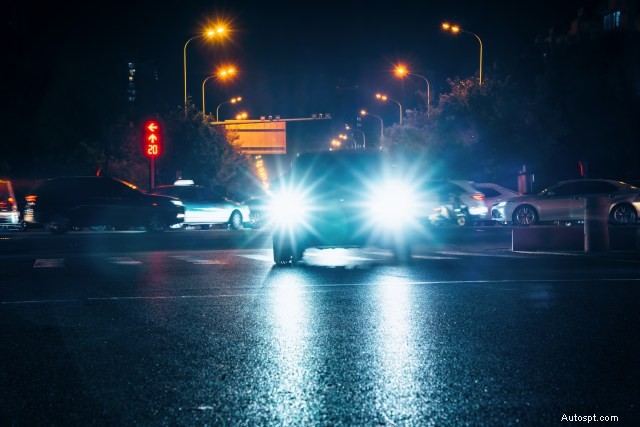
Groups such as the Soft Lights Foundation argue that the use of LED and HID headlights “has become a source of dangerous, blinding glare,” and has an online petition asking Congress and federal agencies to regulate LEDs. Nearly 80,000 people have signed the petition so far.
However, there is a case for making headlights on U.S. cars brighter — but also smarter. The U.S. has a much lower maximum output for high beams than most countries and standards have not changed in decades.
AAA research shows that 64% of American drivers do not extensively use their high beams, often out of concern for other drivers. But driving with low beams all the time can be a safety hazard.
“If you are driving with low beams over 35 mph and encounter something in the road, you can’t stop in time,” according to Bullough.
Changes are coming, although slowly.
“The reality is that vehicle lighting technology has evolved faster than regulations,” said Shieldrop. “And while adaptive driving beam (ADB) headlights — which automatically dim the high-beam when another vehicle approaches — are now permitted in the U.S., they are not yet available in mainstream vehicles.”
Since 2013, Europe and most of the world have been using ADB headlights. Previous AAA research showed that European vehicles equipped with ADB increased roadway lighting by as much as 86% compared to U.S. low-beam headlights.
In 2022, the National Highway Traffic Safety Administration (NHTSA) approved ADB headlighting systems similar to what is used in other countries, but with different criteria for performance, according to Bullough.
The U.S. Department of Transportation drew up glare-proof specifications for ADB headlights, but more testing and information are required. Vehicle manufacturers are waiting for detailed specifications before starting to build and install these systems, to avoid misinterpretations and recalls.
Because these headlights will be brighter, the changes also will require some adjustments by drivers, but the headlights are overdue, said Brannon. “Over time, people will become more accustomed to it,” he said.
AAA recommends taking these easy steps to improve nighttime driving:
This article has been updated and republished from a previous version.
Last updated on March 24, 2026 by AAA Staff

Ellen is a content producer for AAA Northeast, covering automotive, finance, public affairs and electric vehicle news. She is a former newspaper reporter with experience writing for print and online publications about everything from higher education to sustainability. She recently returned to her native Long Island after living in Connecticut for 20-plus years, and has never met a beach she didn’t like.
