
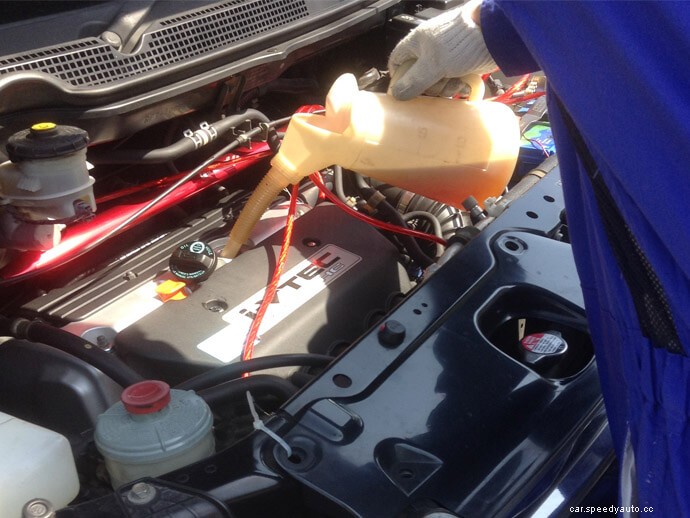
When you say engine oil, there are various kinds of oils that are sold from various oil manufacturers. For beginners, you will most probably having a trouble in choosing one yourself.
So in order to know which oil works best for your car, we will be explaining to you the differences between the varieties of oil that are available, such as viscosities and standards.
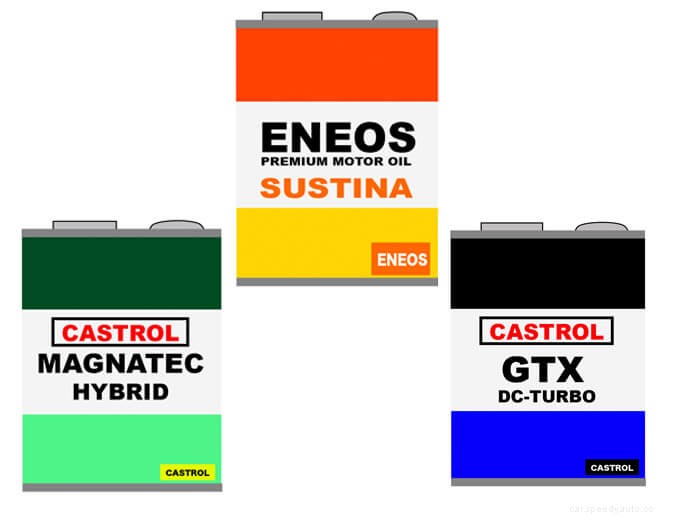
Depending on the combination of the manufacturing methods and standards, there are many types of engine oil that are being sold in the car shop.
Base oil is what we call as the source of engine oil, and there are 3 types of base oil depending on how they were manufactured. After adding some additives to these base oils, they are categorized as engine oil.
However, as it has weak heat resistance and easily oxidized, it deteriorates / degrades rather fast. So, in order to keep your car in good condition, oil replacement needs to be done quite often.
Partial Synthetic Oil
The engine oil is made by mixing mineral oil and chemically synthesized oil, the price is higher since it has better performance than normal mineral oil.
It is recommended for cars which have high loads on its engine such as, cars that drive long distances and high-speed cars.
Chemical Synthetic Oil
This type of engine oil is the best and the most expensive oil of these three types.
It is specially designed and created by removing the impurities of the oil to its minimum amount. Other than the purity, it provides high heat resistance and good performance for the car, and it is hard to deteriorate.
This type of oil is recommended for sports cars and cars with high-performance engine.
Engine oil has standards for its quality and viscosity.
There are various kinds of engines, such as high-performance engines installed in sports cars, and ordinary engines installed in normal cars. So as it is necessary to adjust the engine oil to the engine, engine oil manufacturers made them in a wide variety.
The standards are made to clearly show the performance of these engine oils.
There are two types of engine oil quality standards, ‘API Standard’ and ‘ILSAC Standard’. Later on we will show you the list for each standard, as a guideline, if the car is 10 years or newer and the engine is a normal one, using SJ standard or above would be good enough.
・API Certification
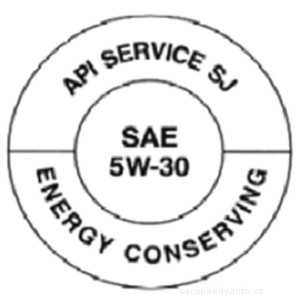
It is commonly known as the donut mark standard set by the American Petroleum Institute. It is divided into grades from SA to SN for gasoline engines, and from CA to CI4 for diesel engines.
・ILSAC Certification
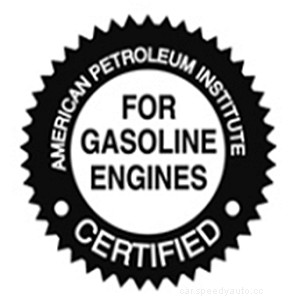
This is a standard that the Japan Automobile Manufacturers Association has decided by grading the oil`s fuel consumption rate when used in cars.
| API Certification | ILSAC Certification | Characteristic/Features |
|---|---|---|
| SA | - | Base oil that does not contain any additives. Engine oil used for low load engines. |
| SB | - | Engine oil mixed with the lowest level of additives. Compared to SA, it has better galling prevention and oxidation stability properties. |
| SC | - | Corresponds to gasoline engines manufactured in year 1964-1967. In addition to SB`s properties, it has deposit prevention property, abrasion prevention property, rust inhibiting property, corrosion prevention properties. |
| SD | - | Corresponds to gasoline engines manufactured in year 1968-1971. It has higher quality and higher performance than SC. |
| SE | - | Corresponds to the gasoline engines manufactured in year 1972-1979. It has higher quality and higher performance than SD. |
| SF | - | Corresponds to gasoline engines manufactured since year 1980. Properties such as prevention of oxidation, high temperature/ low-temperature deposit, rust, and corrosion are enhanced. |
| SG | - | Corresponds to the gasoline engines manufactured since year 1989. The abrasion resistance and oxidation stability of the intake and exhaust valve system are improved from SF. |
| SH | GF-1 | Corresponds to gasoline engines manufactured since year 1993. Sludge prevention property and high-temperature washability are improved than SG. |
| SJ | GF-2 | Corresponds to gasoline engines manufactured since year 1996. It has more evaporability and shear stability than SH. The phosphorus content also decreases. |
| SL | GF-3 | This standard started operation in July 2001. Improvement on fuel-saving performance, reduction of CO2 and purification of exhaust gas than SJ. Standard Environmental plans to reduce the total amount of waste oil and protect the natural environment by improving oil degradation prevention performance. |
| SM | GF-4 | This standard started operation in November 2004. Compared with SL, it has superior level in purification, durability, heat resistance and abrasion resistance. |
| SN | GF-5 | This standard started operation in 2010. Compared to SM, sustainability of fuel saving property and catalyst protection property are strengthened. It is the highest standard available currently. |
| API Standard | Characteristic |
|---|---|
| CA | Corresponds to mild to medium load diesel engine. It has bearing corrosion prevention and high-temperature deposit prevention. It can be used for gasoline engines with light load as long as high-quality gasoline is used. It has no anti-abrasion and deposit property. |
| CB | Corresponds to mild to medium load diesel engine. It has abrasion resistance and deposit prevention while low-quality fuel is used, bearing corrosion prevention property when high sulfur fuel is used, and high-temperature deposit prevention. |
| CC | Corresponds to mild to moderately severe operating condition of subscribed (turbo) diesel engine. It can also be used for high-load driving gasoline engines. High-temperature deposit prevention in turbo diesel engines with low usage load, rust prevention property in gasoline engines, corrosion prevention, and low-temperature deposit prevention. |
| CD | Corresponds to turbo diesel engines that have high loads. It has high abrasion resistance and deposit prevention at high rotation speed operation. It has bearing corrosion prevention and high temperature deposit property for turbo diesel engine even if low quality fuel is used for the car. The standard is abolished at the end of 1995. |
| CE | Corresponds to low-speed, high-load to high-speed, high-load operated turbo diesel engines manufactured since year 1983. Good oil consumption rate, deposit prevention property, sludge dispersion property are improved from CD. The standard is abolished at the end of 1995. |
| CF-4 | It can withstand usage of low sulfur diesel oil (sulfur content less than 0.5%) in the year 1990s and harsh conditions. Higher temperature deposit property and sludge dispersion are improved than CE, thermal stability and oil consumption prevention are also improved. |
| CF | Corresponds to diesel engine that does not require high-speed rotation such as indirect injection type construction machinery and agricultural machinery used in off-road. It was developed as an alternative to CD, and various performances are improved compared with CD. |
| CG-4 | Corresponds to over-load and high-speed diesel engine established from year 1995. Quality is based on CF - 4, it corresponds to light oil with low sulfur content. It also good for the exhaust gas control and it can effectively suppress high-temperature piston deposit, corrosion, bubbles, oxidation and soot deposition. |
| CH-4 | The standard was introduced since December 1998. It corresponds to overloaded and high-speed diesel engine. Improvement on abrasion resistance, viscosity reduction prevention, foaming prevention, and improvement on oil consumption rate. Influence on nonferrous metal for CG - 4 was improved. Like CG - 4, usually it is used for exhaust gas control. |
| CI-4 | It is the newest standard at the moment introduced since September 2002, and the latest environmentally friendly oil. Due to severe heat and oxidation stability requirement, engine tests with increased EGR (exhaust recirculation) and soot were carried out, and also the rubber material that is used for oil seal has been strictly checked as well, making it high-quality oil. Another plus point is that it has longer lifespan than the others. |
Viscosity represents the stickiness of oil.
In the viscosity standard of engine oil, there is a standard called the "SAE standard".
For low fuel consumption engine, choose the ones with low viscosity in order to allow the engine to run without too much resistance.
For high-performance engines, choose the ones with high viscosity as the stickiness won`t fade and also it protects the engine even at high temperature.
For viscosity standard, it was defined by SAE International which is a non-profit technician group in the United States.
In addition to engine oil, standards for steel materials, batteries, headlight, etc. are also specified by them. The standard that determines the viscosity of engine oil is called "SAE viscosity".
We will explain on how to look at the numbers in the table of SAE viscosity classification.
There are single grade and multigrade in engine oil, but now it is mostly multigrade, so we will explain in multigrade.
Usually, we choose the viscosity of around 10W-30. As long as the range of the temperature in the area is not too cold or too hot, it is the most applicable for normal driving environment.
Based on this, let us choose by selecting the right environment temperature and also consider on how your car is being driven.
| Low Temperature Viscosity | 0W | 5W | 10W | 15W | 20W | 25W |
| High Temperature Viscosity | 20 | 30 | 40 | 50 | 60 | - |
For example, it is written as 5W-20 or 10W-30. So in this case, the optimum viscosity will be kept better using 10W-30 even at low and high temperature than 5W-20.
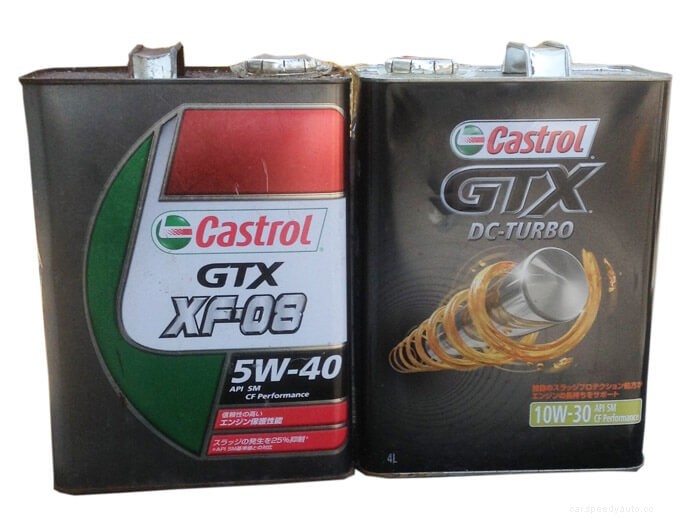
It is important to know the following things before selecting suitable engine oil for your car.
The engine oils used are different depending on whether the engine is naturally aspirated (NA), supercharged (turbo) or diesel.
It is also necessary to choose the viscosity depending on the area temperature in which the car is used.
You also need to consider your driving style of either going high speed or low speed as one of the factors in choosing the engine oil.
So, if your car is a normal car and you ride it normally, you may choose around 10W-30 with a SJ standard or above.
If you cannot decide it yourself, follow the one that is recommended by the car manufacturer. Depending on the car model, there is also the viscosity specification. In that case, let's choose the ones with specified viscosity.
It is a mistake to choose engine oil just because it is expensive oil produced by popular manufacturer.
If it does not fit to your car, it will cause bad side effect, so let's be careful.
Engine oil keeps on degrading and decreasing in amount, and if you keep using the same engine oil, the car’s engine will be in pain. In such a case, it is better to start thinking of ‘Engine Oil Replenishment.
But replenishing the engine serves only as a short escape. Moreover, if the engine oil you use to replenish your engine’s car is different from what it had before, the oil will cause a bad effect to the engine.
So if you do it as a first aid measure, choose the exact same engine oil as before or try different brands with the same standards and viscosity.
Even so, let us remember that the best way to do it is to replace the whole oil and use a brand new one.
By using these tips, as you learn more about engine oil, you will be able to choose the most suitable oil for your car’s engine.
Let us check what kind of engine oil that your car needs.
