
Your car's tires play many valuable roles in the safety and function of your vehicle — from helping you navigate twists, turns, and stops like a pro to carrying the full weight of your car. That's why it's important to pay special attention to these essential components.
Fortunately, maintaining the proper tire pressure on your vehicle is one of the easiest yet most effective ways to care for your car tires. Learn how to check air pressure and inflate your tires with this helpful guide.
Underinflated tires can not only reduce fuel efficiency, but it can also run the risk of getting into an accident, losing proper steering control, damaging various components of your vehicle, and more. If you notice that your tire's air pressure levels have dropped, it's best to prioritize inflating them as soon as possible.
Checking your vehicle's tire pressure is a relatively simple task. You'll want to start by purchasing a tire gauge. These vary in price depending on the type you choose (i.e., digital, basic, etc.) but can usually be found for well under $40. It's also essential to keep a tire gauge on hand, as some gas station air hose gauges are not always accurate. Many modern cars and trucks also display the tire pressure for each tire on the dashboard. Once you have your tire gauge in hand, it's time to determine the proper pressure for your vehicle.
Find the correct inflation level. To do this, you can either look for the recommended pressure on the sticker within your driver's-side door jamb or consult your car owner’s manual. This is the tire pressure specification when the tires are cold, meaning not driven for a few hours.
Remove the valve stem cap from your tire. Some cars and trucks have green valve stem caps with an “N” on them - this means the tire is filled with nitrogen instead of air (air is mostly nitrogen). If your tires have these green valve stem caps, you can find some special stations that dispense nitrogen, but be aware that you can use normal air as well. The inflation pressure specifications are the same regardless if the tire is filled with air versus nitrogen.
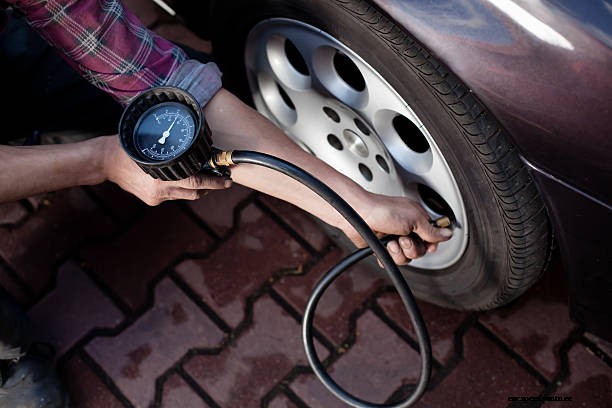
Connect your air pressure gauge to the tire’s valve stem until you receive a reading.
If the pressure level number seems unrealistic, remove the gauge and try again. This time, ensure that the indicator is connected firmly to the valve stem.
It's not always possible to tell if a tire is underinflated by giving it a quick once over. So, check your PSI levels with a gauge each month and after extreme temperature changes. You'll also want to check your pressure levels when your tires have had time to cool down since air expands within your tires while driving.
Filling your tires with air at a gas station is relatively simple. Bring your tire gauge and some spare change since some are coin-operated and are not always accurate in their pressure readings. Try to make this the first stop if you are running errands so that your tires are still relatively cool from sitting for a few hours. Then, follow these steps:
Can't find an air filling station near you or just want some help? Head to your local Firestone Complete Auto Care. We'll give you a free tire inspection and refill your tires free of charge. And if you need new tires, we've got you covered there too!
