
Few things are more satisfying to a gearhead than stomping on the accelerator and being rewarded with a glorious, tire-screaming, smoky burnout. For some, it’s a rite of passage. And in many cases, it’s worth the ticket you’ll get if a cop happens to be within earshot of your vehicular shenanigans! Even if you’re willing to flirt with the law, doing a successful burnout isn’t something that just any person (or any car) can accomplish. In this article, we’ll discuss how to successfully do a burnout in cars with front-wheel, rear wheel, automatic, and manual transmissions. We’ll also discuss some of the common issues associated with burnouts.
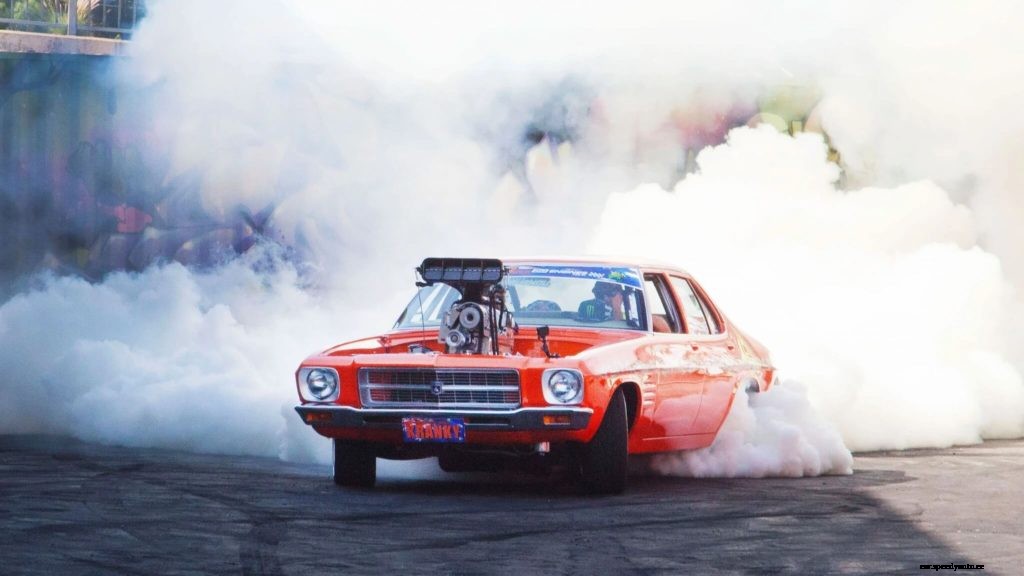
While it might be tempting to simply hop in your car, back out of your driveway, and stand on the accelerator, I urge you to hold off. There are a few things you should do before you try to lay down a crowd-roaring burnout.
First off, you should consider the vehicle you’re driving.
Not all cars are capable of doing burnouts. The cold, hard truth is that if your vehicle doesn’t have enough horsepower, you’re not going to be able to burn the tires. However, even if your car does have a ton of power, there may be some safety features activated that also prevent your car from doing a burnout.
Vehicles with traction control make it nearly impossible to smoke the tires, but we’ll discuss turning TC off in a bit. Some more modern vehicles actually have settings that are specifically designed so you can burn the tires. Models like the Ford Mustang and Dodge Challenger both have “track modes” that make roasting the tires a breeze.
Regardless of how much power and traction control settings your vehicle has, you should inspect your car and tires to make sure everything is in good condition before trying to do a burnout. Blowing a tire or ripping a piece of dangling fender off can cause serious injury to someone who might be standing around when you do a burnout (because let’s face it, someone will probably be recording your shenanigans with their phone).
In addition to specific vehicle settings and limitations, you should make sure that you’re attempting your burnout in a safe location. While you can do it at a busy intersection, it’s not safe and your likelihood of getting caught by the police are much higher. Instead, try to find a deserted patch of country road or an empty parking lot where you aren’t going to disturb anyone.
Not that we’ve laid out the cautionary considerations, here’s how to actually get those tires smoking.
Look, you need to know up front that doing a burnout with a front-wheel drive car is nowhere near as cool as a rear-wheel drive car. Your minivan might be able to do a front wheelie in a cloud of smoke and it still won’t measure up to seeing the rear end of a classic muscle car sliding sideways as chunks of molten rubber fly all over the road.
Most front-wheel drive vehicles just don’t have the power to successfully light up the tires. Even those that do have a lot of horsepower and torque keep it at the top end of the RPM range. In other words, all that power doesn’t kick in until your front-wheel drive car is well on its way down the road. In these cases, standing on your accelerator from a dead stop will result in little more than a loud whine and a short chirp or two from your tires. But with a little cheating, you can smoke those front-wheel drive tires.
Once you’ve found your safe location, start by pouring some water on your front tires. Wet tires are going to spin easier than dry tires. The next step is vital.
Set your emergency brake.
This will lock up your rear tires, which will give your front tires a better chance of spinning. If you have an automatic transmission, all you can really do is stand on your gas pedal and hope for the best. If you have enough horsepower and torque, your front tires should start smoking away.
In case you have a manual transmission, press in on the clutch and raise your RPMs up to around 3,500 or 4,000. Then, let out on the clutch quickly. This is the vital step. Please don’t “dump” the clutch because your engine won’t likely be able to keep up the necessary RPMs after the initial shock, but you can’t “ease” out either like you would during normal operation. You want to do it fast enough that your tires start spinning, but you also want to keep that RPM range high enough that they continue to spin.
You may find that even with the spinning you get a bit of traction, which will result in you dragging your back tires. Hopefully, you’ve produced a big enough smoke show no one will notice.
Now we’re getting to the good stuff. When it comes to burnouts, nothing is as impressive as a rear-wheel drive vehicle with a lot of horsepower. If your vehicle has an automatic transmission, it’s even easier.
To conduct an impressive burnout with an automatic transmission, fire up your engine and set your hand brake. If your vehicle has traction control, you need to turn it off. Traction control is specifically meant to prevent your tires from spinning. If you don’t disable it, doing a burnout will be impossible.
Now, shift your transmission into your lowest gear. Press down on the brake pedal with your left foot and the accelerator with your right foot. When your engine revs to at least 4,000 RPMs, slowly release the brake pedal with your left foot and you should start hearing your tires scream. If you have enough horsepower, you may be able to release the brake pedal entirely. In that case, the only way to stop your burnout is to let off on the gas. If your car doesn’t have enough power to sustain a burnout, you’ll likely need to keep some pressure on the brake pedal to keep it going.
Needless to say, your brakes need to be in good condition to pull off an impressive burnout.
Again, the more power you have, the easier the burnout will be. However, if you need a bit of help getting those tires spinning, you can start out with your rear wheels in some loose gravel or soak them down with some water. Be careful, though—if you’re in gravel you’re going to throw loose rocks all over the place. This could cause injury to any spectators standing by.
Doing a burnout with an automatic transmission is cool, but being able to shred tires at a standstill when you have a manual transmission will take your vehicular prowess to a whole other level. The basic principles of doing a burnout with a stick shift are the same as with an automatic. What makes it more of a challenge is the added complexity of the clutch pedal.
The key to success here is speed.
Start by depressing the clutch pedal with your left foot and keep your right foot on your brake. Turn off your traction control, if equipped. When you’re ready to do the burnout, shift into first gear and apply the gas with your right foot. You need to get the RPMs up, but just how high depends on how much torque and horsepower your vehicle has. Remember, cars with big V8s usually don’t need as many RPMs to get the tires burning as those with smaller engines.
With the engine revving, quickly let out on the clutch with your left foot. This is affectionately known as “dumping the clutch.” Then, immediately move your left foot over to the brake pedal and stand on it. One of two things will have happened at this point. Either your tires will be screaming in a glorious cloud of smoke or you just stopped your car from launching forward and/or stalling because you didn’t have enough RPMs. If it’s the latter, try it again and give the gas some more juice.
However, if you’ve managed to get your tires burning at this point, you’ll simply follow the same steps as with an automatic transmission. Feather the brake pedal with your left foot and the gas with your right to keep the smoke going until you’re ready to move forward, then let off the brake.
Burnouts don’t always go as planned, especially if you’re not that familiar with your vehicle. The worst thing that could happen when trying to do a burnout is that you or someone standing around your vehicle gets hurt. The second worst thing that could happen is that you get a ticket because, again, doing smokey burnouts is illegal.
So, your best bet is to find a deserted stretch of country road before trying a burnout and keep all your pals and their iPhones a good distance away.
You may also find that your burnout isn’t quite as epic as you expected it to be. Remember, if you don’t have the adequate torque or horsepower, you likely won’t produce more than a weak little chirp. And another thing—if you have skinny little “pizza cutter” tires, the smoke show you produce isn’t going to be that impressive either. Wide street tires make the best smoke.
One of the joys of doing an impressive burnout is being able to go back to the scene of the crime after a few days and show your friends those impressive black marks you left on the pavement. You may find that you’ve only laid down one black streak after your burnout. That’s because only one of your tires was spinning while you were doing your burnout.
This unfortunate phenomenon is what’s known as the “one-legged” burnout, also lovingly referred to as the “one-wheel-peal” or “one-tire-fire.” If you want to get more mechanical, you’re only laying down one patch of rubber because your rear axle has an open differential.
What you need is a Limited Slip Differential (aka “Positraction”) so that both rear tires get power. There are several ways to accomplish this. The easiest method is to simply purchase a vehicle that already has a limited slip differential. Most modern muscle cars will have this feature. You can also purchase what’s called in the hot rod circles as a “Detroit Locker.” A Detroit Locker is installed in the rear differential and will lock up both axles so that both tires will spin when power is applied. If you don’t want to spend the money a Detroit Locker, the same effect can be achieved by welding together the spider gears in the rear axle. You’ll get bonus points for doing it like an old-school hot rodder, too.
When you’ve got a limited slip differential (Positrac), you’ll be rewarded with a pair of glorious black marks to commemorate the location of your epic burnout.
Finally, understand that burnouts are hard on your car. Sure, they look awesome, but they also break parts. Those differentials we just mentioned? Yeah, they’ve been known to explode during big burnouts, as have transmissions and even tires. At the very least, you’re going to decimate the tread on your tires, so plan on replacing them often if you become a burnout-addict.
In other words, do burnouts at your own risk!
A big, smokey burnout is a thrilling sight to behold and even more thrilling to perform. But it’s not as simple as hopping in your ride and flooring the gas. It takes some know-how, finesse, and yes, even practice. Hopefully, our guide helps get you started. In closing, we’d just like to stress once more that burnouts can be dangerous, so use some common sense before you try it out for yourself.
