
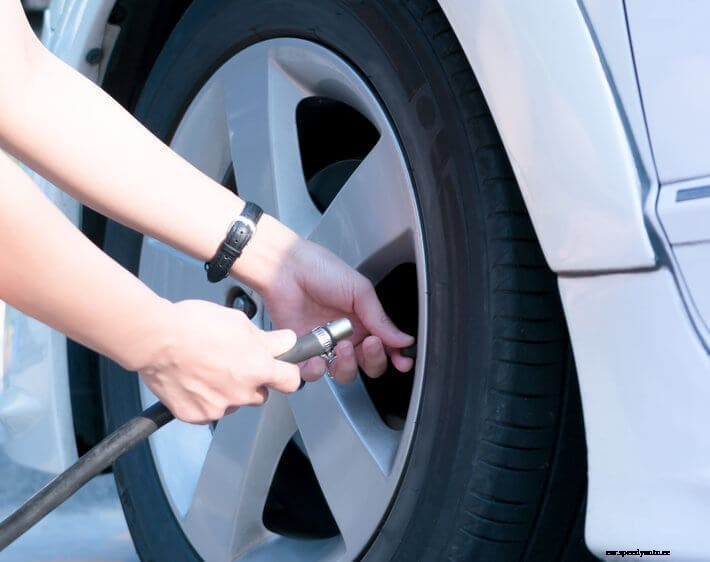
Yes, you typically need to inflate your tires in cold weather. As we'll explain, low temperatures often mean low tire pressure, and low tire pressure could mean dangerous driving conditions.
With the promise of holiday travel up ahead, it’s time to prepare! Firestone Complete Auto Care is here to help you drive safer with a quick lesson on cold weather and tire pressure.
First, a quick science lesson: when the temperature drops, molecules in the air move slower and huddle together. When the temperature increases, molecules move faster and farther away from one another!
You can test this concept for yourself. Just set a basketball outside and wait! The ball will slightly deflate in the cold morning air, then re-inflate in the heat of the afternoon.
When this concept plays out inside your tires, it can affect your tire pressure.
That's because tires lose or gain 1-2 PSI (pounds per square inch) for every 10℉ change in temperature. So theoretically, your tires could lose 4 PSI over the weekend if the temperature drops by 20℉!
While your tire pressure should bounce back after the cold spell passes (assuming it does pass and your tires have no leaks or holes), low tire pressure shouldn't be ignored.
Low tire pressure can lead to:
A small decrease in tire pressure is hard for the naked eye to detect, but it can still have a big impact on your driving. Tires can lose pressure even when temperatures remain constant over the winter. To be safe, we recommend checking tire pressure every other time you visit the pump, and especially when your TPMS light pops on.
Here’s how:
You can find it written in your owner’s manual or on a sticker attached to your door jamb, glove box, or fuel hatch. Recommended tire pressure usually falls between 30-35 PSI for passenger cars. If you’re not sure, try our recommended tire pressure tool.
Measure your tire pressure before driving, not after, for the most accurate reading. This practice is referred to as setting the cold tire pressure. If your recommended tire pressure is 32 PSI, that means 32 PSI before you put rubber to the road and the tires heat up.
Tire pressure gauges can be purchased for a few dollars at most big box retailers. "Pencil" style gauges are cheapest and have a little stick that pops out with the tire pressure reading. Digital tire pressure gauges are a bit more expensive but are extremely easy to use.
This is the little black, blue, green or silver screw-cap on your wheel's valve stem. It should be plainly visible from the outside of your car.
Follow the instructions that come with your tire pressure gauge. If there's a hissing sound when you insert the gauge, it may not be properly seated on the valve stem. Re-adjust the angle of the gauge until the hissing stops. What's your tire pressure? Do your tires need to be inflated?
Repeat the process for each tire and note your tire pressure readings.
There's a good chance you'll need to inflate your tires in winter at least once. If your tire pressure is low, find your nearest air pump. Add air until you reach your recommended tire pressure, or visit your nearest Firestone Complete Auto Care and we'll inflate your tires for you.
If you need help with any of these steps, please don't hesitate to stop by a local Firestone Complete Auto Care. Summer or winter, sunshine or snow—our knowledgeable technicians will check the health of your tires, inflate them to the recommended pressure, and guide you in buying new tires if yours show an alarming degree of wear.
