
The words turbocharger, supercharger, and procharger have often been integrated into today’s vocabulary unconsciously and almost interchangeably. However, few know their origin or what their differences are.
Turbochargers, superchargers, and prochargers are evolutionary devices that have tremendously improved our engines’ power without replacing the engines with more robust and heavy ones.
In this post, you will receive vital information that will help you gain insight into the distinctions between these engineering marvels. In addition, you will learn the genius behind their workings. Hopefully, towards the blog’s end, you will make an informed decision as to which charger suits your needs best.
Table of Contents
Turbochargers, superchargers, and prochargers are devices used to augment the engine’s displacement without actually altering the engine’s size. Therefore, you can squeeze more engine power from a tiny engine than having a larger one.
Turbochargers were initially known as turbosuperchargers when radial aircraft engines used them to restore power lost in high altitudes. At such heights, the air is usually less dense, resulting in severe engine power loss. However, the use of turbochargers can compensate for this loss through a process known as turbo normalizing.
Exceeding the power an engine would typically make at sea level is known as turbocharging, resulting from the exhaust gases driving the turbines in turbochargers.
Similar to turbochargers, superchargers draw more air into the engine through forced induction. However, the engine’s crankshaft through the system of pulleys drives it. Superchargers are of different kinds, although the positive displacement ones are the most common.
Examples of positive displacement superchargers include the root-type and the twin-screw type. The latter is more efficient than the former, although they tend to be noisier. In addition, root-type superchargers are bulkier and may require the car’s hood to be modified to accommodate them. Other types of superchargers include the centrifugal type and electric supercharger.
Conversely to the turbochargers and superchargers, prochargers draw more air into the engine through the centrifugal action of the impeller. As a result, these centrifugal superchargers are more reliable and efficient as they deliver a consistent stream of air across the RPM ranges of your vehicle. They are also lightweight and smaller compared to other superchargers.
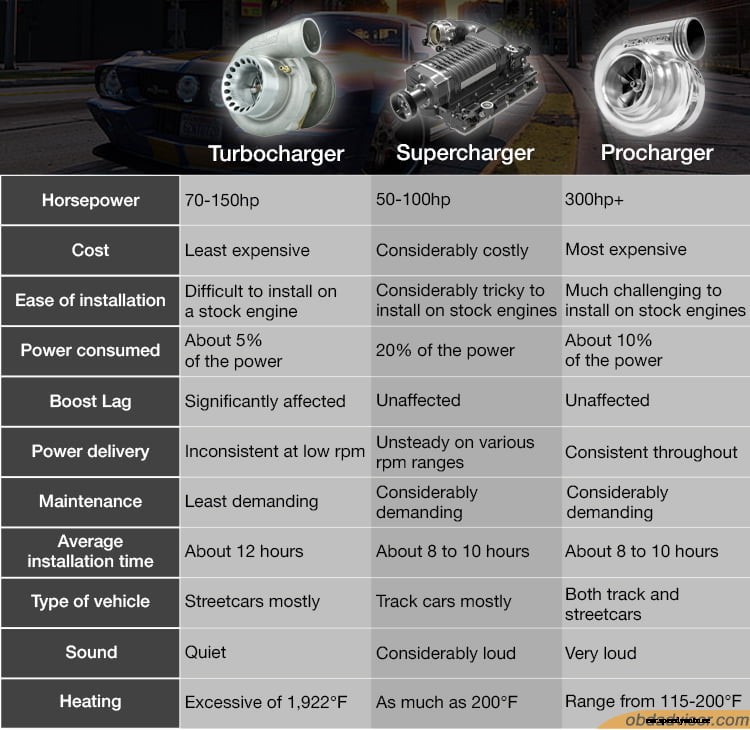
Turbochargers, superchargers, and prochargers make use of intercoolers, which help cool the air, thereby making it denser. Not only do intercoolers help regulate excessive heating of the engine, but they also aid in reducing the excessive engine pressure that’s harmful to your engine. Intercoolers are installed between the engine and these devices.
Turbochargers make use of waste energy from the expanding exhaust gases rushing out through the exhaust manifold. These exhaust gases drive a turbine that rotates a compressor or an impeller, thus creating a negative pressure state. Therefore, more air is drawn into the engine.
Contrarily, superchargers are compressors that are mechanically driven through belts running off crankshafts or electric motors.
A partial vacuum is created during gases’ compression, inducing the forceful drawing of air into the engine. By varying the diameter of the driving pulley, you can control the power superchargers generate. Smaller pulleys rotate faster and create more horsepower when juxtaposed to larger pulleys.
Prochargers make use of an impeller that rotates at high speeds, thus drawing more air into the engine. Similar to superchargers, they are directly driven by the engine through a belt and pulley system.
When the air is drawn, a strong centrifugal force distributes it outwards in a cyclic manner. A diffuser is then used to increase the density and pressure of the air. Consequently, the air is drawn consistently rather than in short bursts.
Prochargers are the most expensive when it comes to enhancing the power produced by your naturally aspirated engine. On average, it costs about $7,000 to purchase a procharger’s tuner kit. It costs an extra $1,000 to $1,500 to have a professional mount it to your engine.
Although prochargers are more expensive, they have better fuel economy than superchargers. Since prochargers are lighter and draw air more effectively, they use up less of the horsepower they generate, thereby burning less fuel.
Superchargers sell for roughly $1,500 to $6,500 for any aftermarket kit. This price is slightly lower than that of prochargers. However, in the long run, they become costlier than the prochargers as they have a poor fuel economy.
Superchargers are also bulkier and may require alteration of the engine’s compartment and the hood. These modifications dig deeper into your pocket.
Turbochargers are the cheapest way to improve your engine performance. On average, it costs about $500 to replace a turbocharger. However, the price may skyrocket to $5,000, especially for high-performance turbo changes.
Often, you may encounter extra costs due to additional piping, especially in naturally aspirated vehicles. Nevertheless, ensure you adhere to your engine’s recommended turbo size to avoid damaging it prematurely or the turbo itself.
To save on maintenance costs, you should only stress your engine to levels it can comfortably manage. Moreover, you can avoid replacing gears and connecting rod bearings too soon by strictly adhering to recommended oil changes.
At sea level, naturally aspirated engines use air at 14.7psi. However, this pressure drops significantly with the rise in altitude. So when a supercharger or a turbocharger increases the engine’s boost by about 7psi, the engine’s cylinders should receive about 50% more air. Theoretically, these engines should generate 50% more power. However, in practice, it’s easier said than done. During compression, the air heats ups and pressure rises.
This condition could result in an engine knock caused by pre-ignition if you don’t take measures to address this situation. By retarding the time needed to burn the fuel completely, you can mitigate this issue. Consequently, precious power is lost, thus reducing the equivalent capacity to 30% or 40% power.
The turbocharger can improve the engine’s power output by 70 to 150 horsepower through the exhaust gases. However, the engine may not reach this capacity due to boost lag, especially at low RPMs.
Superchargers suffer no lag as they are connected directly to the engine. Their instantaneous response is what makes them ideal for drag races. Superchargers deliver about 50 to 100hp increase in engine performance.
50-100hp is slightly lower considering that they make much more, only that some of the power is used to drive them. Superchargers’ drawback in performance is that they don’t deliver consistent power across the RPM ranges.
Typically, prochargers will increase the engine’s power by 45% to 70% of the original capacity, ranging from 300 to 700 horsepower in most average-sized engines. Prochargers also deliver consistent energy throughout the RPM ranges. However, they suffer from belt slips, thereby losing some power after giving upwards of 800RWHP.
Superchargers are primarily fitted in high-performance vehicles. Such cars include the 650-hp Chevrolet Corvette Z05 and the Dodge’s SRT Challenger Hellcat and Demons. Vehicles equipped with superchargers have phenomenal acceleration in the track.
Turbochargers are most preferred in street vehicles, as efficiency is favored over performance. Unfortunately, turbochargers have poor performance when juxtaposed with superchargers and prochargers.
However, they win the day when it comes to purchasing cost, maintenance cost, and fuel economy. In addition, with the advancements in technology, improvements in turbocharging designs have lowered boost lag making it less noticeable to most average drivers.
Prochargers are primarily used in race vehicles. They suffer no turbo lag and deliver more power than the superchargers and turbochargers combined.
When fitted in street vehicles, prochargers are preferred to superchargers. The reason is that they have better fuel economy, and they can be adjusted to legal performance limits. However, superchargers cannot.
Contradictorily, prochargers aren’t recommended to be fitted in street vehicles in noise-strict places, as they’re super loud even while revving at low RPMs.
Garrett GT3782VA 6.0L Turbocharger
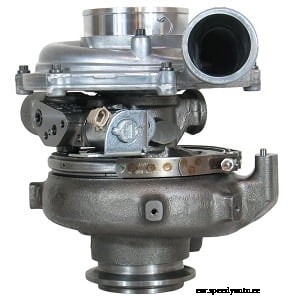
Price range: $789-$809
Check Price at AmazonWhile installing or replacing a turbocharger, it is recommended that you conduct intensive engine diagnosis. It would be best to investigate power loss, noisy operation, alarming oil consumption, and excessive smoke. Then, take the necessary measures to address these issues.
It is advisable to use new air, oil, and fuel filters free from debris and dust during installation. Moreover, fresh new oil which is contamination-free should be used.
Here are the steps to guide you during installation:
Weiand 7740-1 144 Supercharger
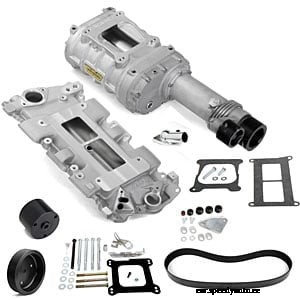
Price range: $2,949-$2,969
Check Price at AmazonWhile installing a supercharger, here are the guidelines to stick to for a smooth process:
It is necessary to tune your vehicle for the effective fuel-air ratio to support the forced induction process. You will also need to adjust your timings as instructed to prevent engine damage.
ProCharger 1DG515 High Output Supercharger
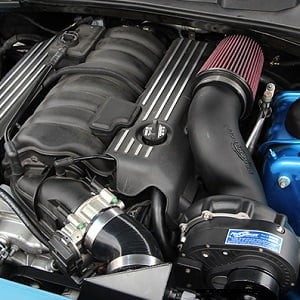
Price range: $6,303-$60
Check Price at AmazonDuring the installation of a procharger’s kit, follow these guidelines for excellent results:
While running on a turbocharger, procharger, or supercharger, regularly service your vehicle, and adhere to the recommended oil height for the longevity of these components. Not only does the oil reduce wear resulting from high friction in their moving parts, but it also cools them.
Turbocharged engines are more reliable and typically don’t need extra servicing when juxtaposed to naturally aspirated ones. Moreover, turbochargers’ parts are cheaper to purchase as compared to prochargers and superchargers.
Approximately, you should change the turbocharger after every 100,000-150,000 miles of travel. Unlike regular engine oil, you should change turbocharger oil every 5,000 miles since they become super hot, resulting in oil burning. Failure to top up the oil leads to conventional bearings falling faster than anticipated.
Prochargers and superchargers require custom pulley and brackets to be added to your car’s engine. These modifications increase the number of components that require servicing. During oil changes, the belt and pulley should be checked for signs of damage to prevent a catastrophic failure.
The good news is while traveling on a faulty belt; the engine will still run. However, your car will have poor fuel economy. On average, you should replace the car’s belt after 50,000 to 70,000 miles of travel. Also, have the belts tightly installed to reduce belt slippage.
Have the supercharger oil checked as often as engine oil changes. Although supercharger’s oil doesn’t collect any combustion byproducts, it can be infested with micro-contaminants.
It is recommended that you change the procharger oil in its head unit after traveling for 6,000 miles. Similarly, it helps to prevent micro-contaminants from infesting the procharger component housing.
Mobil 1 5W-20 Full Synthetic Motor Oil – 160 oz
Price range: $19-$39
Check Price at AmazonRoyal Purple 11748 5W-30 Synthetic Motor Oil – 160 oz
Price range: $39-$59
Check Price at AmazonShell Rotella 5W-40 Full Synthetic Diesel Engine Oil – 128 oz
Price range: $19-$39
Check Price at Amazon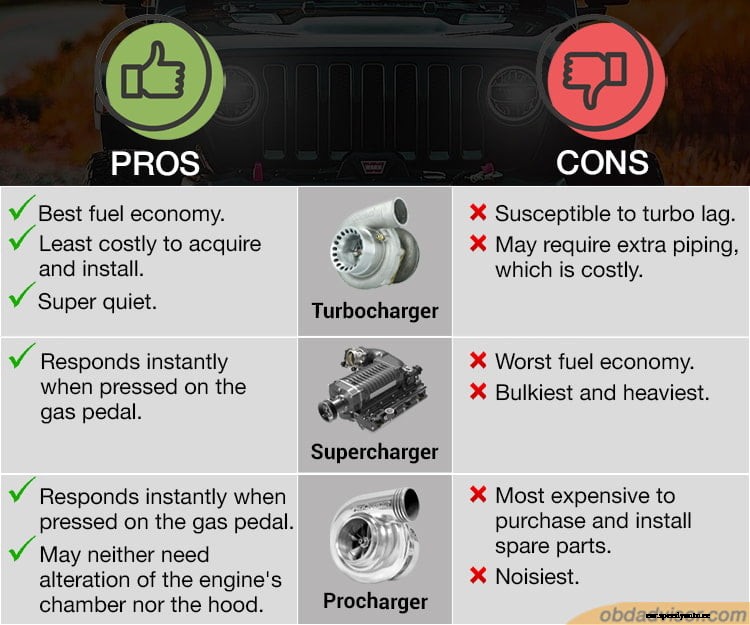
Without a doubt, the turbocharger wins in terms of fuel economy, cost, and ease of maintenance. However, are you willing to put up with the boost lag that inevitably affects these devices?
If you’re more interested in performance, the supercharger will save you the hustle. Although superchargers outperform turbochargers, they have significant drawbacks in fuel economy and rid your engine of some power.
If the cost is not much of a bother, you’d probably settle for a procharger that offers the best of both worlds. It has better fuel economy, is less bulky, and above all, it outperforms the supercharger and the turbocharger combined.
