What transmission do I have? Here’s what nobody told you before
Asking yourself, What are the types of transmission?How to find what transmission I have? or How to determine my transmission code? Check it out NOW!!
Unless you are a mechanic or like to know your vehicle’s ins-and-outs (car, truck, light truck, etc.), there’s a chance that you don’t know what transmission exactly you have in your vehicle. You would be doing yourself a favor to learn a little more about your transmission when you have to get some repair work done, or something just doesn’t seem right with your vehicle. Let’s go overthe main ways to find out what transmission you have.
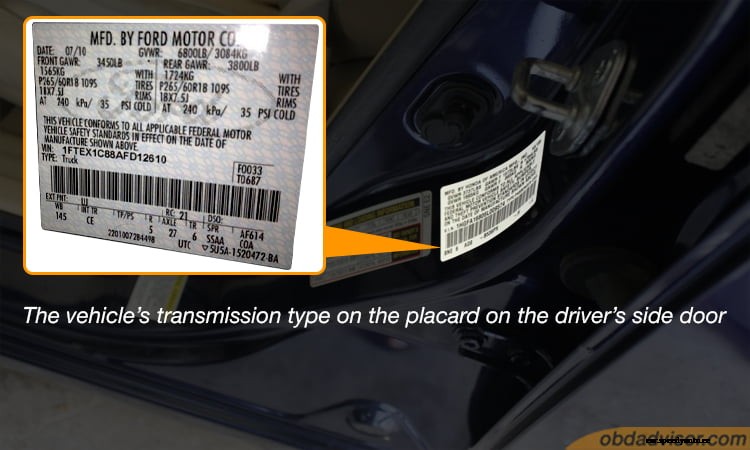
The White card on the driver’s side door is a good place to find your vehicle’s transmission type.
How can I find what transmission I have?
Since more than 200 types of transmissions are made in vehicles today, it can be challenging for the average person to determine their type. Luckily, there are pretty simple ways to help you determine yours.
Even people with experiences choose to use the simplest methods of identifying the transmission. You can essentially find out your transmission type in a matter of minutes. Stop spending more time than necessary. Identify your transmission type with the quick methods below:
Look at the placard on driver’s side door
Look at the placard on the driver’s side door, you can find your vehicle’s transmission type on the white tag just inside the driver’s door.
You can easily find your vehicle’s transmission type on the white tag just inside the driver’s door. This label also has such information as tire sizes and pressures, gross axle weights, and total vehicle weight beside the vehicle’s manufactured date. This comes in handy when trying to determine what year it was classified as. It also has the vehicle identification number, more commonly known as the VIN.
Use the owner’s manual
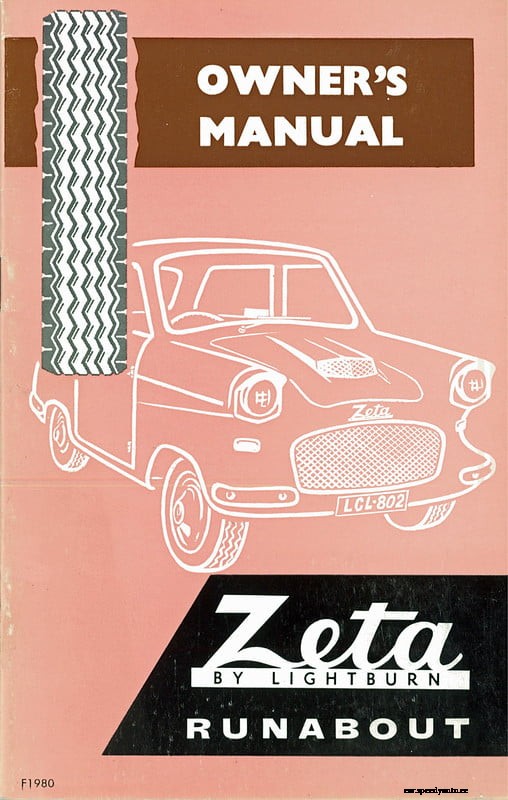
The owner’s manuals contain the vehicle’s transmission and any other information car owners need. Credit: flickr.com
Another place to find your vehicle’s transmission is the oft-overlooked (and usually still in its original wrapper) owner’s manual. You can most often find any other information you need, including the transmissions that came with your vehicle and the fluid each one requires. It will also have the maintenance schedules to see how often you should be changing the fluid and filter (when possible). If you can’t find the owner’s manual in the glove box, you can find them online, either at the manufacturer’s website or from a website that stores them. If you are still having issues locating your transmission model/type and service info, there are a few more ways we can discuss it.
Find under the hood or transmission oil pan
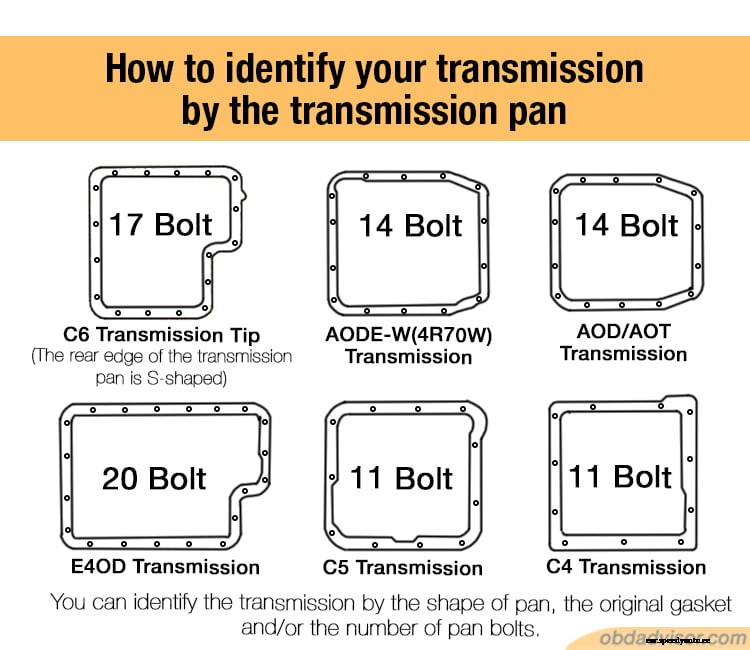
The transmission can be identified by the shape of pan, the original gasket, and/or the number of pan bolts.
Yet another way is to either look under the hood or the oil pan.
Crawl under the vehicle and start looking for part numbers stamped on the transmission or bottom pan’s side. Your local part store or your vehicle’s dealer will be able to cross-reference the numbers to determine the kind of transmission to which the part belongs. Or:
Look under your car hood to see if there’s any tags attached to the radiator cover’s top, the shock towers, and in some cases, the back of the engine compartment, on what is called the bulkhead or firewall. Take a good flashlight, too, because some of the figures may be difficult to read.
Bonus: Tim’s Review of the Best Transmission Code Readers 2021
Decode the VIN number
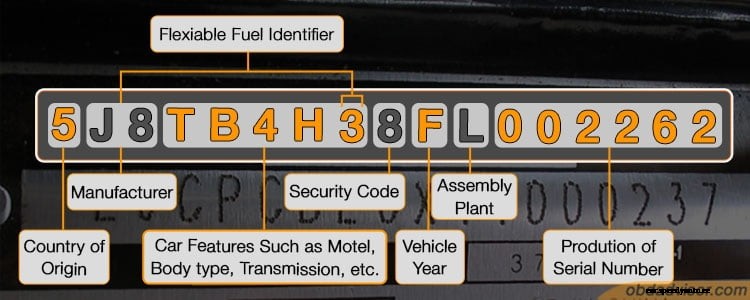
You can find the VIN on either the driver’s side door or the dashboard. It will be on a white sticker with black lettering that also includes other information about your vehicle. It will be a 17-digit code that comprises a combination of letters and numbers. Each of the numbers means something specific to your car.
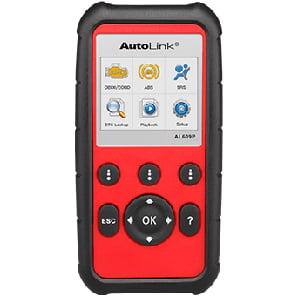
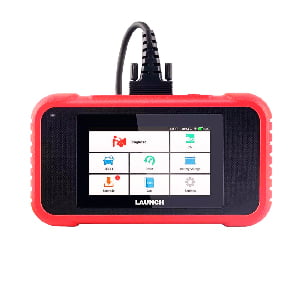
You should use an OBD2 scanner to retrieve the VIN and find all information about your vehicle, including transmission type. If you haven’t got an OBD2 AutoVIN scanner, I recommend you buying one now. Beside VIN decoding, a suitable scan tool lets you perform a number of necessary diagnostic functions on your vehicle.
Autel AL609P AutoVIN Scanner
Rating
★★★★★Check Price at Amazon
Launch CRP129E AutoVIN Scanner
Rating
★★★★★Check Price at AmazonVIN number meaning.
Another way is to find the transmission identification by VIN using VIN decoder like https://vpic.nhtsa.dot.gov/decoder/.
Also, you can take that VIN to an auto dealership or repair shop. They would use their special computer or scan tool to tell you what transmission type you have precisely.
Find your transmission code by vehicle’s model, year, or engine
If you still cannot find your transmission, try it on the ATRA transmission lookup tool. You’ll need to input basic information like the year, make, and model, and the tool will provide you with the transmission code.
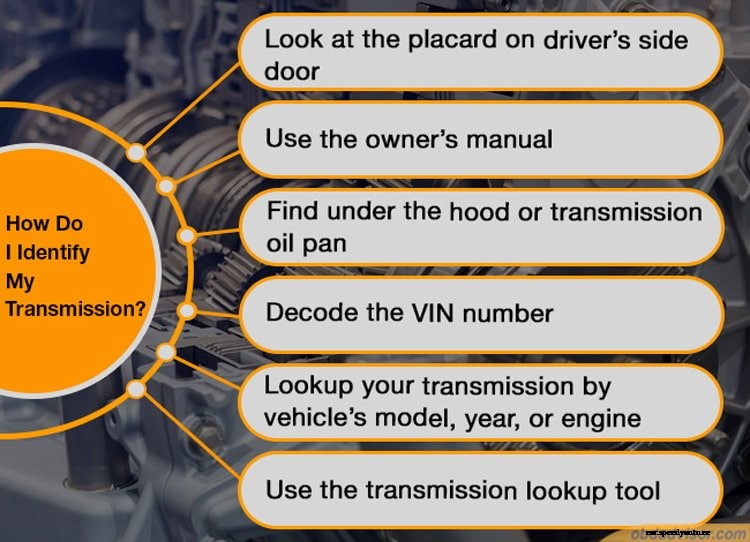
How can I identify what transmission do i have? There are six common ways you can try.
What are the popular transmission types?
Today’s transmissions are varied. In the past, all automatic transmissions had three speeds, meaning that they would start in first gear and shift up into second, then into third or direct drive. In third or Drive, the engine was turning at the same speed as the driveshaft. Those transmissions would not provide the best fuel efficiency, nor would they provide the shift quality we have come to know and expect. Today, 6-speed, 8-speed, even 10-speed automatic transmissions are the norm.
In past years, automatic transmissions were relatively easy to service and required service usually once a year/every other year. The fluids that were used were very simple to keep up with. Dexron for GM and Chrysler, Type F fluids for Fords. Type A fluid was available but typically relegated to tractor use and very early automatic transmissions. But now?
Since the early 1970s, vehicle manufacturers have been looking for a way to increase fuel efficiency. Engines were modified/number of cylinders reduced while removing weight from the vehicles. The “lead sleds” were fast becoming a thing of the past. As this trend continued into the 1980s, the next logical way to reduce fuel consumption was to reduce the amount of power it took to operate all the accessories. This also included the transmissions. If operating pressures were reduced inside the transmission, the engine didn’t have to work as hard to turn the pump inside the transmission. Unfortunately, lower pressures = a higher chance of clutch failures. More changes, along with the advent of computer-controlled engines AND transmissions was the only thing that would work.
In fact, most people think that there are only two types of transmission: manual and automatic. While these are the two main types, there is more to each type than just that distinction.
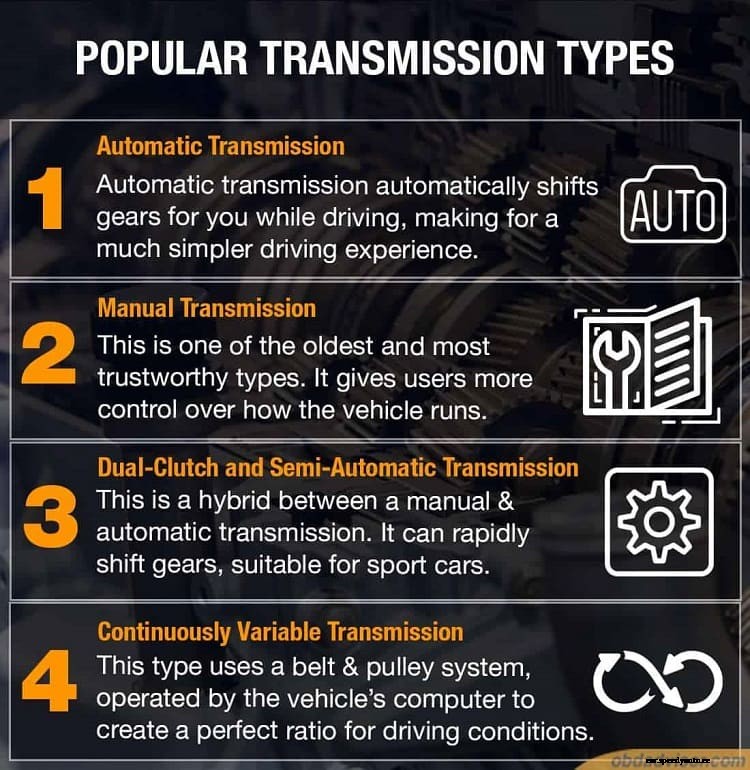
Four most popular types of transmission – check this out to know about your transmission
1. Automatic Transmission
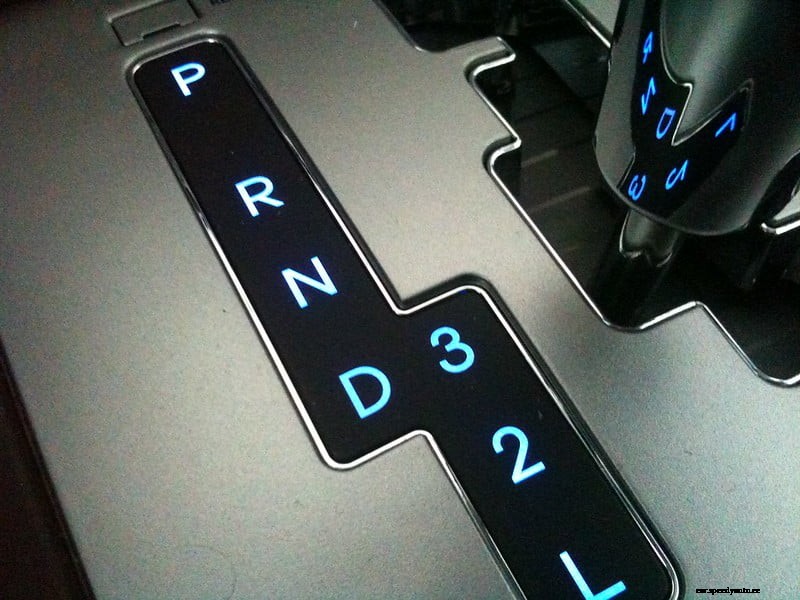
Automatic transmission is the most common type of transmission on the road today. Credit: flickr.com
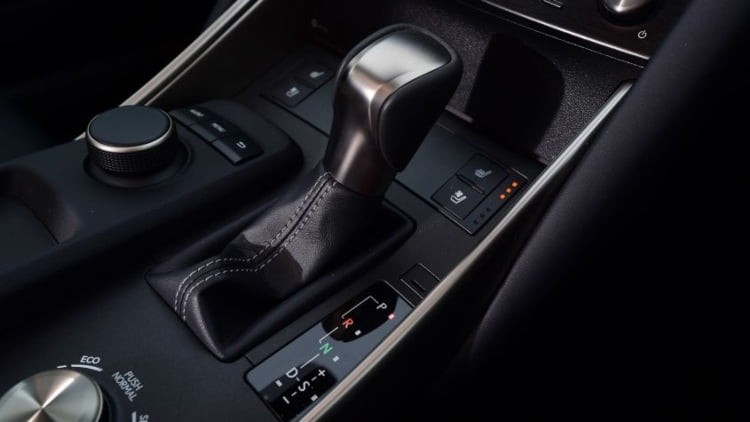
A vehicle with an automatic transmission is one of the most complicated factors in how it actually works. But from a usability standpoint, it is the simplest, so it is the most common type of transmission on the road today.
The learning curve for an automatic transmission is one of the lowest since it’s effortless to learn.
If all you have to do is to press the brake pedal and move your gear shifter into reverse or drive, you have the luxury of an automatic transmission.
It will automatically shift gears for you as you drive, making for a much simpler driving experience.
Of course, there is a mechanical complexity to it behind the scenes. But you don’t have to worry about that unless something goes wrong.
When you open your vehicle’s hood, you may see a code stamped on the transmission or even a tag hanging on it. This will help you identify whether you indeed do have an automatic transmission or not.
The transmission’s pan shape is probably the quickest and easiest way to tell which type it is. Most of the automatic transmissions are either square or shaped oddly.
If you still don’t know whether you have an automatic transmission, you can measure it and find a chart with a quick online search to match the dimensions to yours and identify it.
2. Manual Transmission
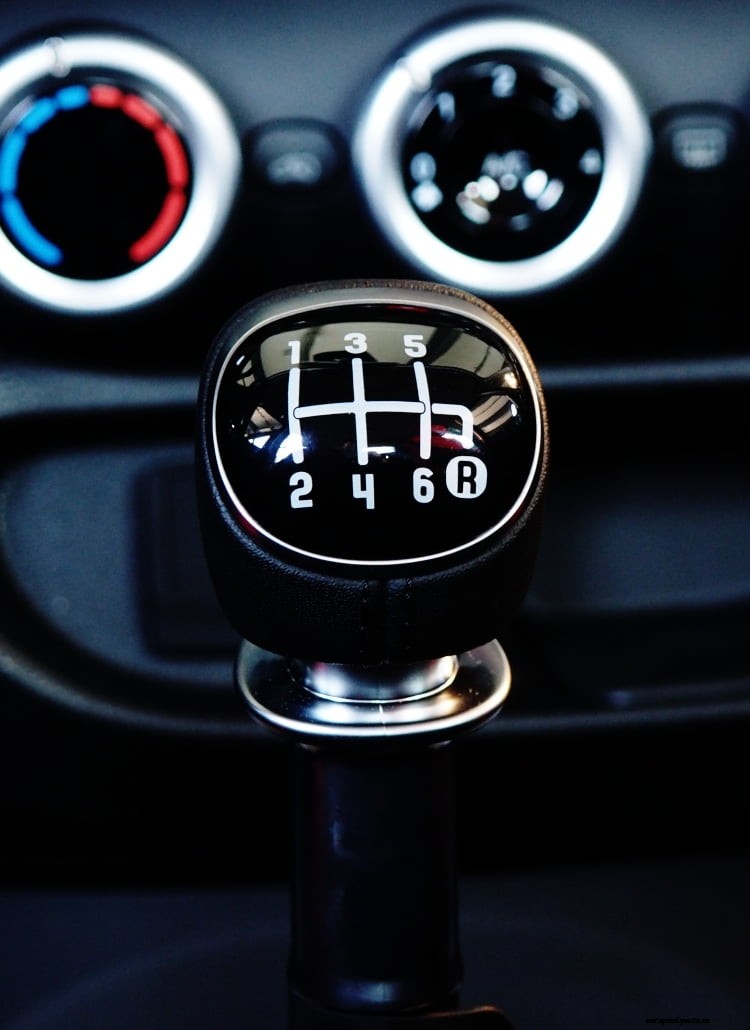
The manual transmission is one of the oldest and most trustworthy types of transmissions that they still make today.
The manual transmission is one of the oldest and most trustworthy types of transmissions that they still make today.
You may have heard it referred to as a standard or a stick shift as well.
As the driver, you have to manually operate the clutch with your foot and shift into different gears accordingly.
The learning curve for a manual transmission vehicle is much greater than the other counterparts. But there are some advantages to having one.
Since the transmission is much less complex, repairs will not be as costly or difficult to fix. Drivers still enjoy a manual transmission because they have more control over how the vehicle runs. Besides, you will generally get better fuel economy than with automatic transmissions.
Identifying manual transmissions can be difficult. The 3-speed, 4-speed, and 5-and-6-speed transmissions all have different characteristics. You can find them in diagrams online if you are unsure about what they look like.
Things to consider when looking at the manual transmission include the position of the selector’s arms and whether the mounting studs protrude from the side case or if the selector’s arms are secured with a bolt.
Knowing this information, combined with a diagram or chart of common characteristics of manual transmissions, you should be able to positively identify the type of manual transmission you have.
3. Dual-Clutch and Semi-Automatic Transmission
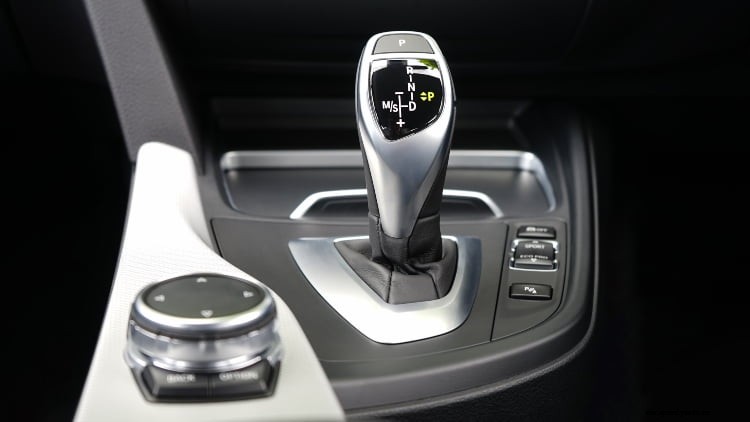
The dual-clutch transmission has separate clutches for even and odd gears.
These types of transmissions aren’t prevalent for a variety of reasons.
It is essentially a hybrid between a manual and automatic transmission. A semi-automatic transmission has a similar design as an automatic transmission, while dual-clutch transmissions have separate clutches for even and odd gears.
This may not seem very easy, but once you get the hang of it, you will see how fast you can shift gears.
Since they can rapidly shift gears, you can find these types of transmissions in sports cars built for speed.
As a result, they are very costly due to the complex nature when it comes to repairs.
4. Continuously Variable Transmission
CVT gives the vehicle a much better fuel economy than any other transmission available.
You won’t notice much of the difference between a continuously variable transmission (CVT) and an automatic transmission from a driving standpoint.
From a mechanical standpoint, the CVT uses a belt and pulley system, operated by the vehicle’s computer, instead of gears to create the perfect ratio for the driving conditions.
This is beneficial because it gives the vehicle a much better fuel economy than any other transmission available.
They won’t break down as much or be as costly as an automatic transmission, but they also aren’t as efficient as a manual transmission.