
There are numerous things that can develop faults in your car. Your battery could die every morning from a parasitic drain, your engine could overheat, or you could wake to meet a flat tire. All of these are a pretty common nuisance we have to deal with, but on the bright side, they are quite easy to fix. There are some components in your vehicle that could fail but do not warrant immediate replacement. A water pump is not one of those.
Unlike the car battery or tire that might go from a good working condition to an unusable state in a couple of hours, the signs of a bad water pump creep up on you slowly until the components fail completely.
The water pump can be compared to the human heart, only that this one is the heart of the cooling system. It is responsible for the constant circulation of coolant throughout the engine. Due to the important duty, the water pump performs in maintaining the temperature of the engine, having a bad water pump comes with consequences including possible engine failure.
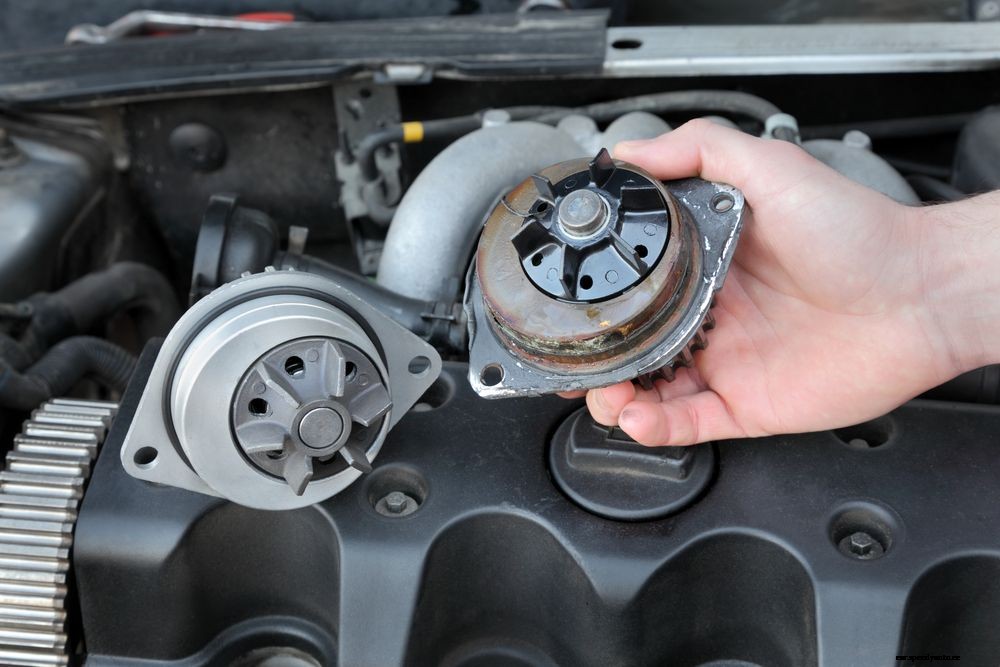
Before we go over the 5 symptoms of a bad water pump, we need to look at what it does and how it works.
The water pump is one of those components that seems like they don’t have much to do, but in reality, this tiny component tucked away from disturbance is what drives coolant from the radiator to the engine and back. This allows the engine to maintain a steady operating temperature even if you’re driving on a hot summer day, or in the winter (though additives may be needed to keep the coolant from freezing when you park).
Almost all car enthusiasts will tell you that the coolant plays a role that is as important as the oil lubricating the engine parts.
This is a testament to just how important a water pump in good working condition is in keeping the car cool:
While the engine oil lubricates the moving parts and reduces the amount of heat generated by friction, the coolant pumped through the engine absorbs the heat produced by the combustion of fuel in the engine and releases it to the environment.
Though the water pumps installed in most modern cars, SUVs, and trucks will last for a very long time, they will still get bad someday. And just like any other mechanical component, they will show a couple of warning signs, which if picked up early, can save you expensive repairs.
It’s not a quick and easy job to replace a bad water pump, but if you have no idea what the symptoms of a bad water pump are, or how to tell when there’s something wrong with the water pump, then you’ve come to the right place.
Here are 5 signs of a bad water pump:
The earliest warning of a failing water pump is a whining noise that starts slowly and gradually increases as the water pump worsens.
This noise is a result of a loose pulley and is hard to miss, even if you’re just revving the car. This happens when the resistance in the water pump is too much for the pulley to overcome, so the pulley starts to slip on the water pump.
As you accelerate the noise will get louder, causing more damage. When you notice this kind of noise, simply stop the car and inspect the pulley for scratch and wear marks.
If you look very closely you might notice what looks like burnt patches on the side of the pulley that’s in contact with the water pump.
It could be that one or more of the bearings located in the water pump has broken out of position and is preventing the unit from rotating properly. If this is the case, then you should avoid stressing your car too much until you are able to get the problem fixed.
Another thing you need to know about this pulley ‘situation’ is that sometimes your water pump might not be the cause of the noise, it could be that the pulley itself is weak and cannot get a firm grip on the water pump head. This is a different issue.
The next problem that could signify that your water pump is faulty is a drop in your coolant level. This is not to be confused with the sort of leak that occurs in the top of the engine, leaking coolant and oil into the combustion chamber and giving off white smoke from the exhaust. No!
When your water pump is faulty, it could be a broken gasket or bearing, you’ll notice fluid on the floor in the front and center part of your vehicle. If you notice any red or green (depending on the type of coolant you have) fluid where your water pump is supposed to be, then you need to get a mechanic to investigate and fix the problem as soon as possible.
Stalling could mean that your vehicle eventually leaks all the coolant in the radiator and the engine starts overheating.
Other than engine oil-related problems, the other thing that might make your engine overheat is a failing water pump.
An engine that is hotter than it should be means that the water pump is not doing its job at full capacity. This is one of the signs of a bad water pump that you need to fix quickly since it can lead to expensive damages to your engine including cracked cylinder heads, burnt pistons, ruined head gaskets, and white exhaust smoke.
It’s very likely that if you do not attend to an overheating engine immediately, the seals and impellers contained within the pump will be destroyed. And, your engine will suffer severely for this if you don’t notice it on time.
Thanks to the internal system monitors that are built into modern cars, you’ll get notified when the engine reaches a certain temperature.
This makes it easy to tell if your overheating engine is the result of a failing water pump or an engine oil problem. If your car doesn’t have this internal system monitoring unit installed, you can tell if the engine is overheating by touching the engine a few minutes after you first start the car – too hot? Then you should get it checked.
One of the visual signs of a bad water pump that you need to be on the lookout for is steams coming from the radiator or engine bay.
This is one serious problem that needs to be addressed as quickly as possible. The water pump works with the help of coolant and water. The primary function of the coolant is to absorb heat from the engine and release the heat when it circulates to the radiator.
If the water pump is broken, you might notice steam around the engine bay either because the coolant circulating the engine block is not enough, or the pump seal is failing and hot fluid is escaping from the bad seal.
If you notice this, stop the car immediately and get a towing company to move the car to the garage because if you keep driving the car, even if it is in the direction of the mechanic, you might cause more damage to the engine.
A slow leak that occurs over a long time will cause different minerals and gunk to collect around the water pump or a gel-like deposit of coolant outside the water pump. There is a possibility of finding a good deal of rust on the pump’s surface, and, if you take a closer look, you might notice pitting (small holes created on metals as a result of corrosion) or cavities on the mounting surface.
Using the wrong type of coolant will also cause the buildup of deposits inside the pump, which can either slow the cooling process or block the coolant path.
While these won’t result in immediate failure, it will affect the amount of coolant flowing through the pump and might ruin the bearing in the pump.
What you should understand about a failing water pump is that these problems rarely appear at the same time – or suddenly without warning. You should include coolant replacement in your routine car maintenance, and ensure to change your coolant a couple of weeks before the date recommended by the manufacturer.
Getting a new coolant and flushing the lines is less of a hassle and far cheaper than getting the radiator, water pump, or engine fixed. If after inspection your mechanic recommends that you get a new water pump, resist the temptation to go with the cheaper option. With a high-quality water pump, you can go about 60,000 miles before a new one is needed.
If the water pump is faulty and so also the serpentine belt, you should replace both so the new water pump is getting enough power and tension to operate at full capacity.
Also ensure that the replacement belt lines up well with the pulley system to reduce the chances of the belt slipping or becoming too tense, because if it does, then it’s likely that sealants, gaskets, bearings, and pump shaft could all be ruined – again.
Get the appropriate coolant for your engine to reduce the chances of deposits collecting on the inside of the water pump.
Replacing water pumps requires certain knowledge about car engines, and this is not a simple DIY for common drivers. If you have the professional skills, tools, and machines, then you could do it in your garage. If this is not you, then you better take your vehicle to the mechanic’s place.
Depending on the make, model, and labor cost, replacing a bad water pump might cost between $300 to $750. The actual price range of a water pump is between $50 to $100, but labor cost can go as high as $200-450.
If you notice any of the signs of a bad water pump listed above, call a professional to check the issue as quickly as possible. Though these symptoms do not appear instantly or without warning, over time they can cause serious damages to the engine if they are ignored or not handled with care.
