
This piece will delve deeper into all Tesla Models and the drivetrains they use.
A Tesla all-wheel-drive car has one motor over the front axle and another over the rear axle. A Tesla rear-wheel drive has one motor over the rear axle. The all-wheel-drive Tesla delivers power to all wheels while the rear-wheel-drive Tesla delivers power to the rear wheels.
I will provide a pros and cons analysis of each system per Model. This information should help you pick the right Tesla for your situation.
Tesla uses an adaptive system when choosing how to distribute power. For instance, when accelerating hard, the onboard computer sends most power to the rear motor to launch the vehicle forward. The car’s still an all-wheel-drive car, but in some ways, it acts like a rear-wheel vehicle.
The AWD system in a Tesla typically delivers power to all wheels. The RWD system sends power to the rear wheels.
The power delivered to each wheel in an AWD Tesla might not be equal, but all times each wheel shares a portion of the power. Similarly, the power sent to each rear wheel in an RWD Tesla might not be equal, but each rear wheel always gets some power.
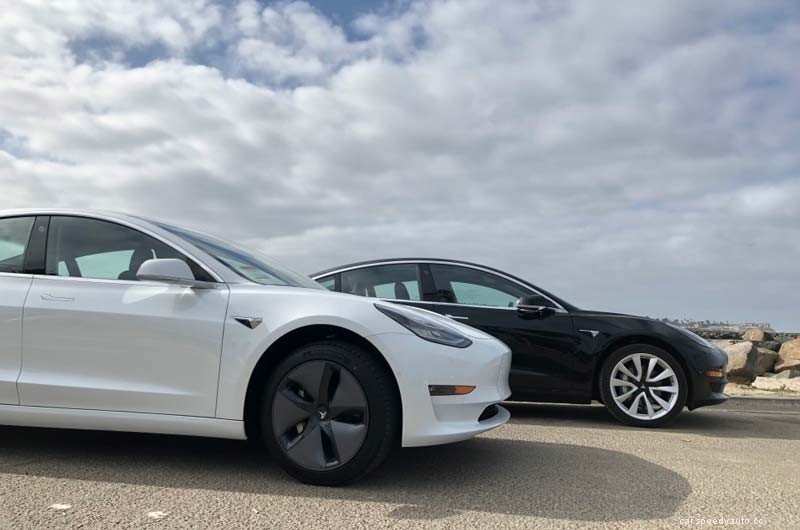
To better understand how each system works on Tesla, we’ll look at each Model and the system it uses.
At the moment, only the Model 3 rear-wheel drive and Model Y rear-wheel-drive standard range offer rear-wheel action. All other Model 3’s and Model Y’s, the Model X, and Model S use all-wheel drive.
You can have a Tesla Model Y with all-wheel drive or with rear-wheel drive.
However, the Model Y rear-wheel-drive standard range is only available in China. Tesla launched the standard range in China in late August 2021.
Tesla has teased a Long Range Rear-Wheel Drive version of the Model Y, but it is yet to arrive.
The Model Y fills the void between the Model 3 and Model X. It has a bigger interior, seven seats, and more space to carry your cargo.
The Model Y versions available all around the world are the Long Range and The Performance option. The Performance option is about $10K pricier than the Long Range.
In return for the extra dollars, you get better acceleration and top speed. Unless you need the Tesla for track days, the Performance option doesn’t seem worth it.
The Performance option also has about 20 miles (32.2 km) of range less than the Long Range. Its extra focus on acceleration uses more power, eating up the miles.
The all-wheel-drive option in these options certainly helps in off-road terrain. With power going to all wheels and Tesla’s intelligent power distribution system, you won’t get stuck at all.
All-wheel drive coupled with a higher ground clearance makes the Model Y the go-to option for off-road performance.
Pros
Cons
Thanks to Elon Musk, we never quite knew whether the Model Y Standard Range RWD would arrive.
Musk stated that Tesla wouldn’t produce the Model Y Standard Range vehicle because he didn’t like its under 250-mile (402.3 km) range. Contrary to Musk’s assertion, Tesla introduced the car in January 2021.
After a few weeks, Tesla abandoned the vehicle as it disappeared from the website. However, Musk stated that the car’s still available on special order.
Tesla usually withdraws such versions after a while, but the company doesn’t appear to want to let go of the Model Y Standard Range RWD. Musk now opines that the Model Y Standard Range meets Tesla’s “standard of excellence.”
In early August 2021, Tesla launched deliveries of the Model Y Standard Range RWD in China.
Pros
Cons
Tesla initially named Model 3’s rear-wheel-drive version the Standard Range Plus. In early 2021, it changed the name to Model 3 Rear Wheel drive.
The name change comes with several improvements, which we will discuss below.
The other model 3’s — Long Range and Performance — use all-wheel-drive systems.
The Model 3 is the cheapest Tesla Model available, but its low price doesn’t make it any less exciting.
As the name suggests, the Long Range offers the longest range at around 350 miles (563.3 km). The Performance version offers about 20 miles (32.2 km) less of range at full charge.
The Performance version claws back some pride with its acceleration figures. It is more than a second faster to 60 mph (96.6 kph) than the Long Range.
That extra grunt of the line consumes more power, reducing range.
The Model 3 is a four-door sedan, so you don’t get as much space as you would in a Model Y. However, the absence of an engine means there’s plenty of room to store your luggage.
The cars’ all-drive system works wonders in snowy or off-road conditions.
Pros
Cons
Tesla’s US website currently features the Model 3 Rear-Wheel Drive. It replaces the Standard Range Plus.
It has received ten miles more of range, which now stands at 267 miles (429.7 km). The acceleration time has increased from 5.3 seconds to 5.8 seconds.
Other than the name and a couple of stats, nothing more has changed. Its base price is slightly below $39,000, and it has a top speed of 140 mph (225.3 kph).
Pros
Cons
All Model S vehicles manufactured since 2017 come with an all-wheel-drive system.
The Model S comes in two versions, Long Range and Plaid.
The Long Range offers more miles of range but is slower than the Plaid to 60 mph (96.6 kph).
The Model S is Tesla’s equivalent of a luxury sedan. It is fast, spacious, and features a sleek exterior.
The Model S Plaid comes with Tesla’s Tri-Motor system. The Long Range uses a Dual-Motor System.
You’ll need to fork out an extra $35K to buy the Plaid. Granted, that’s a lot of money; but, depending on what you are looking for, the Plaid might be worth it.
The Plaid has a 200 mph (321.9 kph) top speed compared to the Long Range’s measly 155 mph (249.4 kph). The Long Range gets to 60 mph (96.6 kph) at an impressive 3.1 seconds, but it doesn’t compare to the Plaid’s 1.99 seconds.
The Tri Motor’s purpose is to increase Tesla’s power. Judging by the stats, Tesla has hit its goal.
Pros
Cons
Like the Model S, all Tesla models available for manufacture use all-wheel-drive systems. Tesla had planned to sell rear-wheel-drive models, but it didn’t.
The Model X features the iconic double-hinged falcon doors.
The standard Model X is just over $1,000 shy of $100K. It maxes out at 155 mph (249.4 kph) and will get to 60 mph (96.6 kph) in 3.8 seconds.
Its Plaid version utilizes a Tri-Motor and is around $15K more expensive than the standard dual-motor Model X. It will get to 60 mph (96.6 kph) in 2.5 seconds and max out at 163mph (262.3 kph).
The Model X is a heavy vehicle, and even with a Tri-Motor system, it can’t go as fast as the Model S.
It is, nevertheless, exhilarating to drive, as you can see by the following YouTube video:
