
Tesla mobile connectors – also known as UMC or Universal Mobile Connectors – are a kind of backup cable that every Tesla owner should have. Since 2018, Tesla has introduced the generation 2 connectors for its vehicles, but do you know how it’s different from the Gen 1 and which one is better?
Gen 2 is better than Gen 1 because it comes with more adaptors, doesn’t overheat, has a plastic handle and sealed control button, creates a more solid connection to the adaptors, and is safer. Besides, Gen 2 is compatible with more models, and unlike Gen 1, it’s readily available to purchase online.
If you’re wondering about the difference between Gen 1 and Gen 2 Tesla mobile connectors, keep reading this article. We’ll look at each one independently then compare both to see which one is a better choice.
As the name suggests, Gen 1 was the first generation of Tesla mobile connectors introduced for all Tesla models produced between 2012 and 2017, including Model S and Model X. It allowed the Tesla owners to connect their cars to various outlets, including domestic sockets or campsite power outlets.
However, it’s not prevalent anymore, and with the launch of Gen 2 and even Gen 3 of Tesla mobile connectors, it’s been almost phased out. It’s only used for pre-2018 Model S and Model X Teslas. Let’s take a look at its specifications.
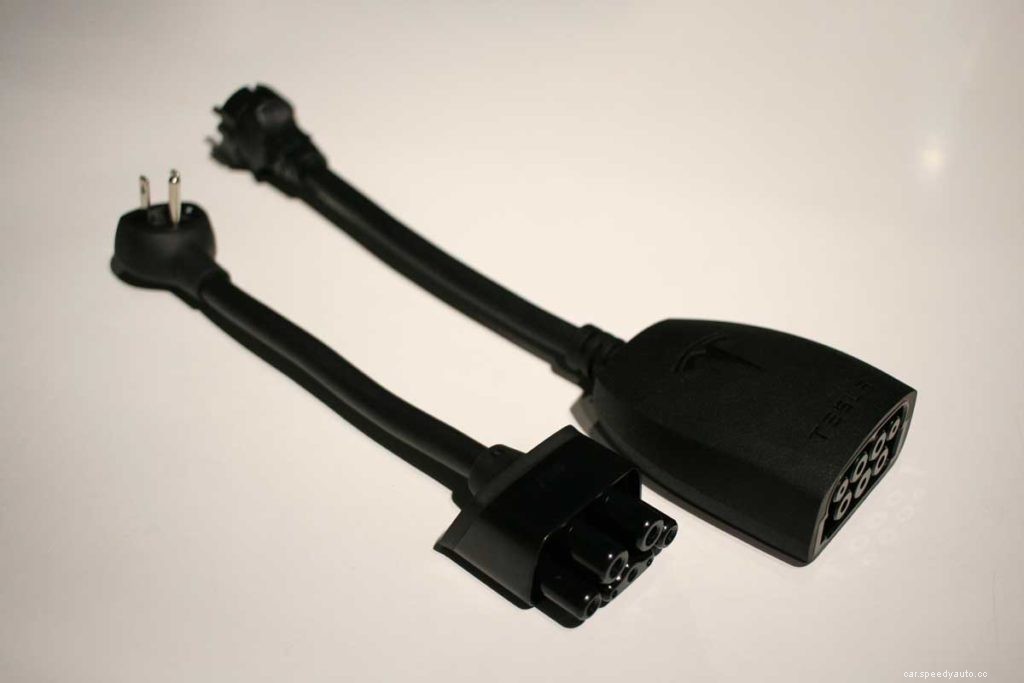
Gen 1 Tesla connector allows 2.3kW-3.7kW of power, but you can increase it up to 11kW with the optional extra 16A 11kW Red commando adaptor p/n 1024110-02-A or 1024110-00-D. Gen 1 mobile connector comes with a round bag for storage. It also contains a 13A 3-pin plug plus a 32A Blue Commando Socket.
The Gen 1 Tesla mobile connector is rated as IP44, which shows it’s splash-proof. So, it’s safe if you leave it outside unprotected in the rain or if it’s not elevated.
We wrote a detailed article about Tesla being able to charge in the rain or not. Check out a few helpful hacks!
Its user manual includes common faults, safety precautions, how to reset, comprehensive fault codes, among others. On the back of the Gen 1 mobile connector’s main brick, there’s also a reset button that you can use if it fails. It can be single or three-phased, and its cable is 6 meters or 20 feet in length.
The generation 2 Tesla mobile connector comes with all Model 3 Teslas and every Model S and X produced from 2018 onwards. It’s somehow an upgrade of the Gen 1 connector; that’s why they’re very much alike. However, they have their differences. Let’s see what its characteristics are.
The Gen 2 Tesla mobile connector allows 2.3kW-3.7kW of power as its standard output, but you can increase it up to 7kW with the optional extra 32A 7kW Blue commando adaptor p/n 1104948-00-B. Its storage bag isn’t circular anymore and is square.
It also contains a 13A 3-pin plug – previously, it contained a 16A Blue Commando socket, but as of 2021, it’s not included anymore. Gen 2 connector is rated as IP44, indicating it’s splash-proof and can be left unprotected outside.
There’s also a complete list of fault codes in its user manual, containing common faults, and other safety considerations. Gen 2 doesn’t have a reset button on the backside of its main brick because it simply doesn’t need it.
The Gen 2 mobile connector is single-phase and offers automatic phase inversion. The cable is 20 feet (6 m) in length.
We’ve covered the basics on How Many Amps Are Needed To Charge an Electric Car. Check out this informative article!
Now that we know the specifications of each connector, let’s compare them and see in what ways they’re similar or different.
Both have the same standard Tesla connector to plug into the charging outlets to offer more convenience. They also look very similar. The only difference is that the Gen 1 looks a bit curvier, while the Gen 2 has a sleeker design – it’s a newer generation, after all!
Both connectors have a 20-feet (6 m) cable that seems to be enough for most situations. But if you find it short and can’t extend it, rethinking how you park your car may be helpful.
They also come with a J1772 connector – or some say, adaptor – which allows you to use all universal chargers and recharge your vehicle safely.
The first noteworthy difference between the two is their packaging. While Gen 1 comes in a round bag, the Gen 2 packaging is square. It’s only a matter of a better design class.
In Gen 1, the handle features a metal stainless steel replaced with a hard but nice-to-touch kind of plastic in Gen 2. The reason is that some overheating issues were reported in metal handles.
They’re also different regarding the adaptors. While both connectors come with the NEMA 5-15 and NEMA 14-50 adaptors – as of 2019, there’s no NEMA 14-50 included with Gen 2 – their appearance is very different in the two generations.
Gen 1 comes with a power outlet of 40 amps which allows the Tesla S and X owners to have an onboard charging of 40 or 80 amps with a single or a twin charger option. So, it maximizes the onboard charging rate and can give you a 29 mph (47 kph) range for Model S and around 25 mph (40 kph) for Model X.
But Gen 2 has a power outlet of only 32 amps to the car because Tesla has decided to lower the average to eliminate the overheating issue. However, it perfectly matches the Tesla Model 3 onboard charging rate.
The cladding on the Gen 1 connector’s cable is thicker than Gen 2, but both are the same length. Despite its relative thinness – which is due to lower amps and weight – Tesla promises it’ll work for at least 6 years.
In Gen 1, the distance between the transformer and the adaptor is about 11 inches (28 cm), while in Gen 2, this distance is only around 7 inches (18 cm) which allows you to see the status indicator on its backside.
Gen 1 has a NEMA 4x rating, but Gen 2 has a NEMA 3r Rating, which isn’t a big difference. NEMA is a standard rating system defined by The National Electrical Manufacturer Association (NEMA), which shows how an electrical enclosure can withstand different environmental conditions.
Another important difference between the two generations is that Gen 1 comes with limited adaptors, and it has a regular transistor which doesn’t protect it from overheating. But Gen 2 offers more controllability with the circuit board chip inside the adaptor, which has a temperature sensor and a memory chip.
Here’s a helpful video on Gen 1 and Gen 2 differences:
