
Every internal combustion engine car built since 1975 likely has a catalytic converter. The catalytic converter uses heat to convert exhaust gas from the engine into less harmful pollutants.
Electric cars do not have catalytic converters. They do not produce harmful pollutants, hence do not need catalytic converters. EVs don’t even have exhaust systems to attach catalytic converters to.
Read on to understand why electric vehicles lack catalytic converters, a vehicle component that has existed in cars for decades. I will also tell you about electric vehicles’ contribution to air pollution and compare it to a combustion engine.
The exhaust gas from ICE (internal combustion engine) vehicles is highly toxic, containing nitrous oxide, carbon monoxide, and hydrocarbons. The catalytic converter converts these toxins to less-harmful carbon dioxide, nitrogen, oxygen, and water.
Electric cars don’t have catalytic converters because they rely on electricity for power, which doesn’t require combustion. The motors on electric vehicles produce no emission, hence no need for a catalytic converter.
EVs use electric charge stored in battery packs to power motion. Therefore, the process doesn’t produce harmful gases and is friendly to the environment.
The lack of petroleum products in an electric vehicle negates the need for a catalytic convertor. That’s because catalytic converters are only necessary for vehicles that burn fuel to keep the engine going.
Catalytic converters minimize the harmful gases released by ICE vehicles, but harmful toxins still escape into the atmosphere.
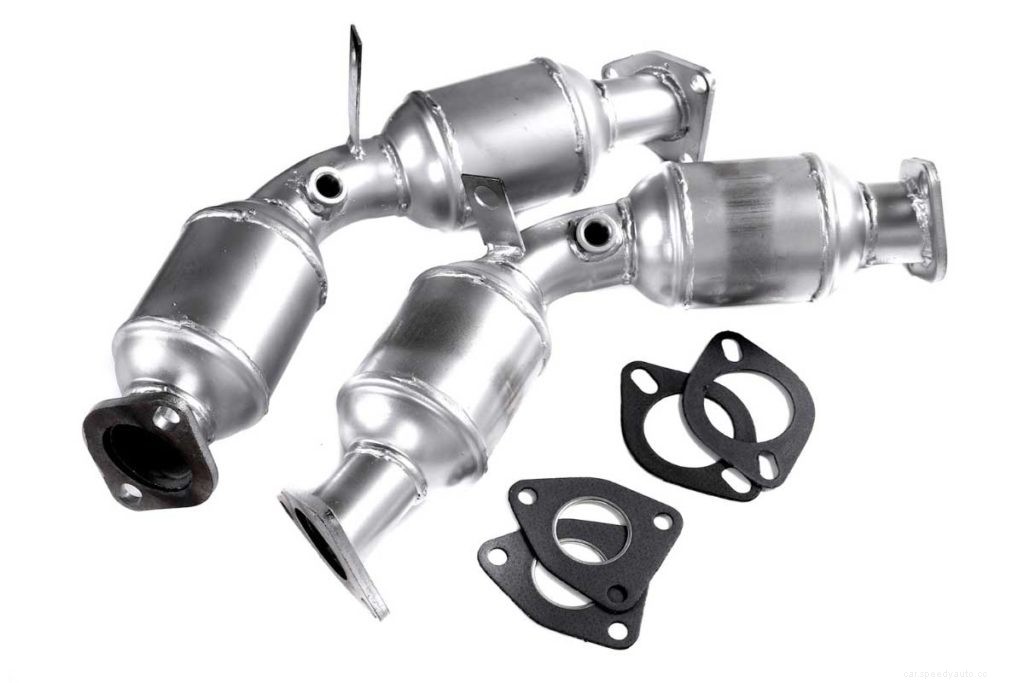
Governments worldwide made catalytic converters mandatory in response to the growing outcry about air pollution. The converters ensured that the cars met the emission standards of the day.
Since then, authorities have taken more steps to reduce emissions, including the ban of the use of leaded gasoline cars. The catalytic converter remains common in most ICE cars manufactured today despite these steps.
Electric vehicles solve the pollution problem created by internal combustion vehicles.
Still, many people are yet to embrace the idea of having an exhaust-free EV. Excuses such as anxiety still plague the adoption of electric cars.
Some detractors also mention that manufacturing electric vehicles creates a large carbon footprint.
We wrote a similar article titled “Do Electric Cars Have a Clutch?” We gave some additional statistics and more. Have a look!
Furthermore, skeptics remind everyone that electric vehicles use electricity from non-renewable sources, so EVs still rely on gas and oil for power at the end of the day.
However, electric cars pollute way less than ICE cars in the long run. The push for renewable sources of electricity also makes EVs the best solution to pollution from motor vehicles.
Catalytic converters help reduce pollution, but we should strive for a world without catalytic converters – a world in which an overwhelming population percentage uses electric cars. It will preserve the environment and save you the cost of replacing the converter when yours gets stolen.
This video by Donut Media explains how a catalytic converter works.
Hybrid cars use electric power and ICE power to move the vehicle. Hybrid vehicles can use engine power or electric power independently or combine both to boost performance.
Hybrid cars have catalytic converters as some of their power comes from internal combustion engines. When using ICE power, the machine releases harmful exhaust gases, which require conversion into less-toxic gases by the catalytic converter.
Hybrid electric vehicles charge the battery pack through regenerative braking – the system captures energy usually lost during braking to charge the batteries. Plug-in hybrid cars charge the battery through a wall charger, the ICE, or regenerative braking.
When running on electric power alone, hybrid cars produce zero emissions. Therefore, the catalytic converter has no use when the car uses electric energy.
The vehicle automatically switches to ICE power when the battery power depletes. When it changes to ICE power, the catalytic power resumes normal function.
| Car Type | Catalytic converter |
| Electric car | No catalytic converter |
| ICE vehicle | Has a catalytic converter |
| Hybrid car | Has a catalytic converter |
| Plug-in hybrid car. | Has a catalytic converter |
Electric vehicles produce close to zero emissions. EV batteries that aren’t fully charged produce negligible amounts of carbon monoxide and nitrogen oxide.
Some publications claim that EV braking emits harmful emissions. Nevertheless, EVs create far fewer emissions than ICE cars do.
The main criticism of electric vehicles is that they use electricity from power plants that use fossil fuels, indirectly making the cars consumers of that fuel. However, the long-term benefits of EVs outweigh this criticism.
A car can function without a catalytic converter, but I wouldn’t advise you to take the catalytic converter out of an ICE. The vehicle will probably produce a check engine light once you remove the converter.
It will then indicate that something is wrong with the system. Furthermore, it might be illegal in your jurisdiction to take out the converter. You’ll also damage the environment more by driving an ICE car without a catalytic converter.
