
If there is one question that is uppermost in the minds of potential buyers of electric vehicles (EVs), it is, EV charging time. Individuals migrating to zero-tailpipe emission electric driving or plug-in hybrid electric vehicles (PHEVs), have only experienced re-fuelling at a petrol station, which takes only a few minutes. EV charging is certainly a very different experience!
Of course do keep in mind that charging a pure electric car (also known as a battery-electric vehicle/BEV) is slightly different than charging a plug-in hybrid electric vehicle (PHEV). With a PHEV, one still needs to visit a petrol station to refuel, while with a pure electric car, one never has to visit a petrol station!
Electric vehicle (EV) charging times vary significantly, from under 30 minutes for DC charging to several hours for AC charging. A number of factors influence EV charging times (see table below). For those new to electric car charging, the charging speed is denoted in KW (kilowatt). In general, the higher the kW, the faster a car will be charged.
In general, an EV can be charged via an external AC or DC dedicated charging station. The EV charging station used at home overnight is an AC charging station, and the fast increasing public charging station infrastructure in the UK is primarily DC charging. The new crop of most, if not all, pure electric cars, are capable of AC and DC charging, while not all PHEVs are capable of DC charging. In any case, a PHEV battery is usually 15 kWh, so a DC charger is really not required. For those keen to gain a better understanding of EV charging costs, simply follow this link!
| Factors Affecting EV Charging Time | |
|---|---|
| Type of EV | A battery-electric vehicle (BEV) takes longer to charge than a plug-in hybrid electric vehicle (PHEV). In general, BEVs have an EV battery size between 30 kWh to 100 kWh, while PHEVs had a battery size lower than 20 kWh. |
| Size of EV battery | The larger the size of the EV battery, the longer it will take to charge (just like an ICE fuel tank. The larger the tank, the longer the time to fill with petrol or diesel). |
| On-board charger | EV charging time is dependent on the on-board charger (OBC) in an EV. The on-board charger converts AC (alternating current) into DC (direct current) via the battery management system (BMS) for storage in an EV battery (an on-board charger is only used for AC charging. For DC charging the on-board charger is not used). |
| Type of charging | In general, DC charging is faster than AC charging, in part due to its ability to circumvent the need for converting from AC to DC. |
| Type of EV charger | A dedicated EV charger is faster than a 3-PIN plug. Moreover, a three-phase EV charger (22 kW) will charge the electric car faster than a single-phase EV charger (7 KW). The performance of the EV charger will also be determined by the limitations of the EV on-board charger and the power supply (single-phase Vs three-phase). |
| Type of EV cable | EV cables come in various types, to include single -phase EV cables and three-phase EV cables. A single-phase (7 kW) charges an EV slower than a 3-phase (up to 22 kW) EV charging cables. The type of EV cable used will depend on the specific EV model and the EV charging station. |
| Power supply to the building | Buildings in the UK are supplied by either single-phase or three-phase. As a general rule, most homes in the UK receive single-phase supply, while most commercial buildings receive three-phase power supply. |
| EV Charging | EV Charging |
|---|---|
| Cheap to charge. An EV can be fully charged between £5 to £10. Significantly cheaper than refuelling a petrol or diesel car, which can cost up to £120 for a full tank. | Takes times to charge, depending on the size of EV the battery. In general, larger the EV battery, longer the time to charge. Filling a tank of fuel takes only a few minutes. |
| Convenience: an EV can be charged at the convenience of your own home or office (no need to visit a petrol station!). | Charging times also dependent on the type of charger used. In general AC charging is slower than DC charging. Fuelling stations do not have this limitation. |
| Lower price volatility and lower risk of price inflation compared to petrol prices (petrol prices continue to negatively impact household finances as fuel prices increase). | Charging speed dependent on the power supply to a building (single-phase/ three-phase). Most homes in the UK are limited to a single-phase power supply, limiting the EV charging to 7 kW.Fuelling stations do not have this limitation. |
| Residential solar can be used to lower cost of charging. Using residential PV solar, the cost of generating and consuming electricity is nominal. Both residential solar and commercial solar installations are ways to hedge against energy price inflation. | Charging speed also dependent on the on-board charger (OBC) in the EV. A 3.7 kW OBC will be significantly slower compared to a 22 kW OBC. ICE cars do not have this limitation. |
| Using solar or green energy is better for the environment and results in zero-tailpipe emission. | It is easier to find a fuelling station than an EV charging station. EV public charging infrastructure, though developing rapidly, is yet not as widespread. |
For those of you new to zero-emission electric driving, we recommend a read of the following articles:
Using a domestic 3-pin plug to charge an electric vehicle (EV) is not only the slowest option, but the least recommended route to charging an electric car. The key reasons for not recommending using a 3-pin domestic plug for charging are:
Over the past three years, we have witnessed a significant increase in the availability of home EV charging stations, to include, improved technical performance and lower costs. Home EV chargers can be single-phase or three-phase, but in general most homes in the UK will using a single phase EV charge point (up to 7 kW).
Charging at home with a dedicated EV charging station like myenergi zappi significantly reduces charging times. As an example, a 60 kWh EV battery charging at 7 kW can be fully charged in just under 8 hours. Most EV owners charge their EV overnight, given the convenience and the lower cost of charging during the night. Yes, you can start every morning with a freshly brewed cup of coffee and a fully charged EV at home!
In general EV owners, do not need to fully charge the EV battery every night. In most cases, the EV is ‘topped up’ overnight. The average distance travelled on a journey in the UK is a mere 12 miles. The latest pure electric cars have a WLTP range between 100 miles to 300 miles on a fully charged EV battery, so enough to last for a few days for the average family. We recommend EV owners to top-up on a regular basis, as this reduces the overall time for charging and also avoids the risk of an empty EV battery!
Those home owners fortunate enough to have a three-phase power supply (11 kW/22 kW), can fully charge a 60 kWh EV battery in 3 hours. Of course, this is dependent on a number of factors to include the capability of the on-board charger of the EV. Not all EVs have an on-board charger capable of charging at 22 kW AC!
We at e-zoomed strongly recommend buying high quality EV chargers. Follow this link to learn more about our top picks for electric car home chargers.
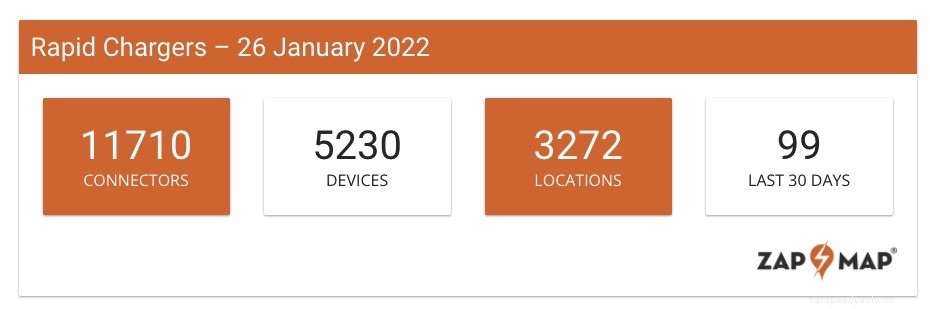
Public charging in the UK is fast developing, with a number of operators increasing the availability of public charging points across the UK. DC charging, in particular, is gaining ground, as companies like Osprey rollout DC charging infrastructure. Osprey is not the only company keen on building an ever increasing network of DC charging station. Others include: Gridserve Electric Highway, InstaVolt, Ionity and many more! According to Zap-Map, there are currently 5,230 rapid charging devices across 3,272 locations in the UK.
As mentioned earlier, the reason that DC charging is significantly faster is because it circumvents the need to convert AC to DC via the EV onboard charger i.e. it supplies the EV battery directly with DC power to be stored in the EV battery. Public DC chargers are becoming faster, with the likes of the Tesla Supercharger network offering up to 250 kW DC charging capability. Charging up to 80% in less than 35 minutes is now quite common. The last 20% (i.e. 80% to 100%), always takes longer as a result of the way EV batteries are manufactured and protected.
| Charging Time (Overview) | |
|---|---|
| Slow charging AC (3 kW – 3.6 kW): | 6 – 12 hours (dependent on size of EV battery & SOC) |
| Fast charging AC (7 kW – 22 kW): | 3 – 8 hours (dependent on size of EV battery & SoC) |
| Rapid charging AC (43 kW): | 0-80%: 20 mins to 60 mins (dependent on size of EV battery & SoC) |
| Rapid charging DC (50 kW+): | 0-80%: 20 mins to 60 mins (dependent on size of EV battery & SoC) |
| Ultra rapid charging DC (150 kW+): | 0-80% : 20 mins to 40 mins (dependent on size of EV battery & SoC) |
| Tesla Supercharger (120 kW – 250 kW): | 0-80%: up to 25 mins (dependent on size of EV battery & SoC) |
