
In what was inevitable, California makes plans to become the first state in the nation to require EV charging stations at new developments.
the Division State Architect (DSA), a government body that oversees the California Building Code, has just published a memo of recommended amendments to the current building code. As stated, the amendment would require one EV charging station at new nonresidential developments where future EV spaces are required.
Here is the proposed amendment that will require EV charging stations at new developments:
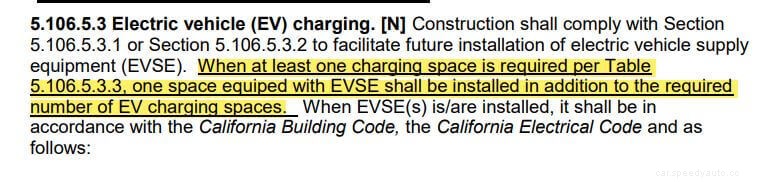
The proposed amendment can be viewed and downloaded here.
If adopted into code, this would set California as the first state in the nation to require a charging station.
To be clear, there are several different types of EV spaces in the building code. As recently detailed in a previous article, there are three different stalls: EV Capable, EV Ready, and EV Installed.
In brief, EV Capable spaces require just the infrastructure for a future installation. EV Ready requires everything but the actual charging station. Lastly, EV Installed requires the whole deal to charge an electric vehicle (EV). This proposed amendment to the California Building Code would require one EV Installed spaces at certain new developments.
Requiring new developments to install EV charging stations is nothing new, however. Some cities, such as the City of Palo Alto and the City of San Luis Obispo, already have these rules in their respective zoning ordinances.
In fact, the City of San Luis Obispo’s EV charging station requirement was adopted in 2019. In just one year, the ordinance has led to nearly 300 charging stations as part of the development within the city. This type of forward thinking has led the city to earn the 2020 Gold Level Beacon Spotlight Awards for Sustainability Best Practices and Community Greenhouse Gas Reductions.
The California Building Code proceeds through a tri-annual renewal with small amendments along the way. The current code cycle, 2019, increased the number of parking stalls to be readied with future EV charging (EV Capable) from the 2016 code. For example, for multifamily residential developments, the building code increased the number of EV Capable stalls from 2% to 10%.
It is safe to say that the upcoming code cycle refresh in 2022 will bring even greater EV charging requirements. In fact, developers and builders should prepare to incorporate multiple EV charging stations at projects approved in 2022 and beyond.
