
Sweden has created its fair share of global brands, but none with a reputation as good as Volvo Cars, when it comes to passenger safety. Volvo cars is an automotive manufacturer based in Gothenburg, Sweden. The Volvo Group has a long history of success and was established in 1927. Since then the company has had multiple owners, to include the US based, Ford Motor Company. Its current owner is a Chinese automotive behemoth, Geely Automobile, which acquired Volvo Cars in 2010. Geely also owns the automotive brands Lotus Cars and Polestar.
Volvo Cars was one of the first mainstream OEM’s to commit to a push towards zero-tailpipe emission road transportation. In 2017, the company announced its intention to ‘electrify every car in our range’. Volvo is not new to ‘electric propulsion’ and had already deployed a test fleet of battery-electric vehicles (BEVs) in 2010 and had launched the first plug-in hybrid diesel car in 2012. In March 2021, the company announced its ambition to be a fully electric brand by 2030. The company is also committed to becoming ‘climate neutral’ across the value chain by 2040. The name Volvo is derived from Latin. It means “I roll’. The logo is an ancient chemistry sign for iron, signifying Volvo’s commitment to using high quality iron.
The company currently has the following battery-electric vehicles (BEVs) and plug-in hybrid electric vehicles (PHEVs):
For those of you new to zero-emission electric driving, we recommend a read of the following articles:
Volvo continues to push ahead with its vision to become a truly electrified automotive manufacturer with the launch of its third pure electric SUV. For those new to electric driving, pure electric cars are also referred to as battery-electric vehicles (BEVs). BEVs are zero-tailpipe emission electric vehicles (EVs), powered by electric propulsion.
SUVs in general have been gaining popularity over the past few years, as both, families and businesses take advantage of the practicality and style, these body types can offer. However, with the introduction of electric SUVs, the popularity has increased further, due to the improved environmental credentials of electric driving.
Though the recent 48 months has witnessed an increased availability of pure and plug-in hybrid electric SUVs, seven-seater pure electric SUVs are still limited. Therefore, the Volvo EX90 7-seater electric SUV is well positioned for success, given the enviable reputation of Volvo Cars, in relation to safety and reliability.
The all-electric EX90 EV has much to offer those keen to migrate to electric driving. Firstly, the e-SUV offers a practical and useful pure electric range. Volvo claims a range up to 363 miles (WLTP) on a full charge, which is quite similar to the range of the all-electric Mercedes EQS SUV (365 miles). Even adjusting for real-world driving conditions, the EX90 should be able to deliver over 300 miles on a full charge.
The Volvo EX90 has a 111 kWh onboard EV battery (107 kWh Usable), and is available in only one EV battery size. Like most electric vehicles, the EV battery is placed below the floor, to lower the centre of gravity and to increase the interior cabin space. The EV is capable up to 250 kW DC ultra-rapid charging and can achieve 10% to 80% charge in 30 minutes.
Put another way, the EV can add 111 miles of electric range in 10 minutes. Of course, the key is to find an ultra-rapid public charging station en route. For the more widespread 50 kW DC rapid chargers, the EV can be charged up to 80% in 97 minutes.
The EV does incorporate a three-phase 11 kW AC onboard charger as standard (0%-100%: 11 hours). Given that most homes in the UK are powered by single-phase power supply, most of us will not be able to take advantage of the three-phase onboard charger. Single-phase EV charging (7.4 kW) will take longer!
The Volvo EX90 also offers Bi-directional charging and vehicle-to-grid (V2G). We can expect Bi-directional charging to become more commonplace, as EVs develop to the next generation. Bidirectional charging allows the electric vehicle to be used to power the home (vehicle-to-home: V2H) or even to sell energy to the grid. It can also be used to power other devices (vehicle-to-load: V2L) or even charge another electric car (vehicle-to-vehicle: V2V).
The all-electric Volvo SUV is perfect for families already familiar with the advantages of owning and driving a Volvo car i.e. a fantastic reputation for safety and quality. However, the manufacturer has further enhanced its reputation for safety in the EX90.
The EV has fitted on its roof one of the most advanced sensor sets, a cutting-edge roof-mounted LiDAR sensor, which comprises: five radars, eight cameras, two interior cameras and 16 ultrasonic sensors. This is part of the company’s vision of Zero Collision in new Volvo Cars. The LiDAR system maps out via in-house developed software a highly accurate image of the EVs surrounding environment, therefore, enhancing the vehicle safety.
The Volvo EX90 is available in two powertrain variants. The all-wheel drive Twin Motor and the all-wheel drive Twin Motor Performance. The Twin Motor can achieve 0-62 mph in 5.7 seconds (maximum power: 408 HP/ torque: 770 Nm). The higher performance variant, the Twin Motor Performance, can achieve 0-62 mph in 4.7 seconds (maximum power: 517 HP/ torque: 910 Nm).
The top speed for the EV is 112 mph. Of course, the electric car also benefits from instant torque and also offers one-pedal driving. The EV has a towing capacity up to 2,200 kg.
Volvo has kept the exterior styling close to its core ‘minimalism’ design philosophy. According to the manufacturer, the EX90 exterior design improves the aerodynamic efficiency of the vehicle. The EV has a 0.29 Cd Drag coefficient.
The seven-seater e-SUV is practical. The rear seats (including the third row) are comfortable for adults, with ample legroom and headroom. The EV offers a 365 L boot space behind the third row and up to 655 L behind the second row. The EV also offers a frunk (front storage compartment).
Volvo has incorporated a 14.5 inch centre infotainment screen, with Google built in. Google apps and services like, Google Assistant, Google Maps etc, are included. The EX90 is also compatible with wireless Apple CarPlay. Phone key technology is also standard, with your smartphone being enabled to function as a ‘car key’. The company has been keen to further enhance its approach to sustainable materials for production of the EV. This includes 15% recycled steel, 25% recycled aluminium, 48 kilograms of recycled plastics and more!
Company-car drivers can take advantage of the lower Benefit-in-Kind (BiK-2%) tax charge for pure electric cars. Bottom-line, electric driving is good for the environment and the wallet. You can lease electric vehicles (EVs) via e-zoomed at very competitive prices!
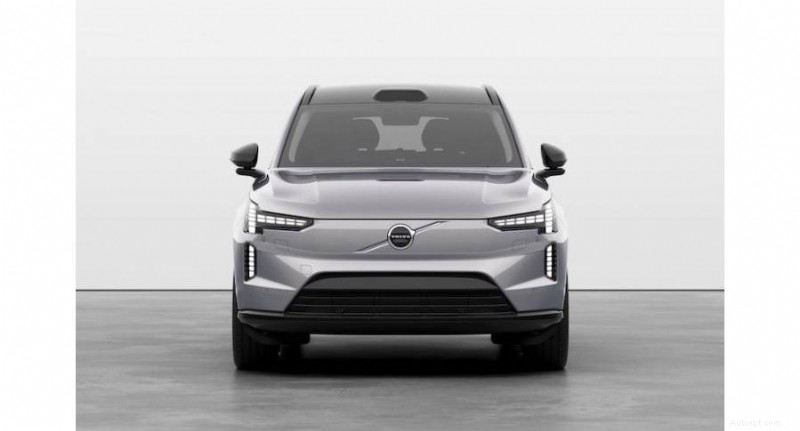
The All-Electric Volvo EX90 SUV (credit: Volvo)
While e-zoomed uses reasonable efforts to provide accurate and up-to-date information, some of the information provided is gathered from third parties and has not been independently verified by e-zoomed. While the information from the third party sources is believed to be reliable, no warranty, express or implied, is made by e-zoomed regarding the accuracy, adequacy, completeness, legality, reliability or usefulness of any information. This disclaimer applies to both isolated and aggregate uses of this information.
